Question
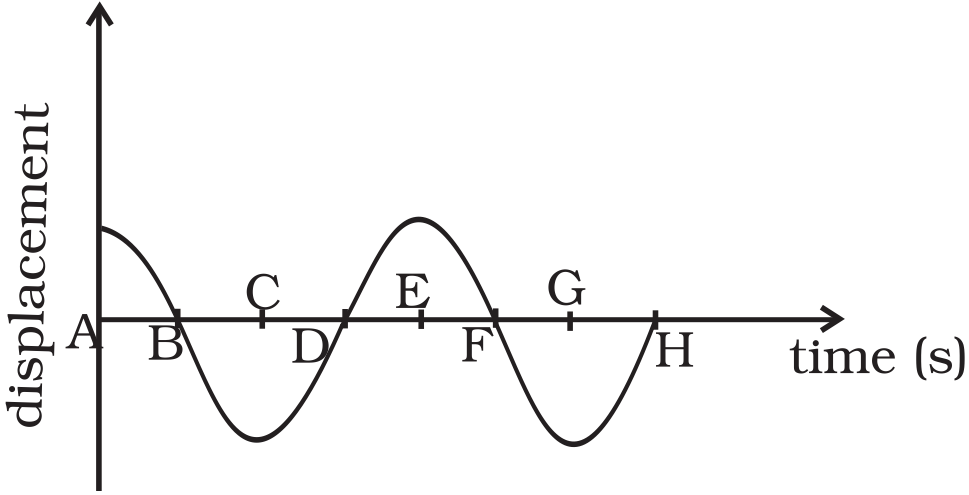
Displacement versus time curve for a particle executing $\text{S.H.M}$. is shown in Fig. Identify the points marked at which,
  1. Velocity of the oscillator is zero,
  2. Speed of the oscillator is maximum.

Answer


Key concept: In displacement$-$time graph of $\text{SHM}$, zero displacement values correspond to mean position; where velocity of the oscillator is maximum. Whereas the crest and troughs represent amplitude positions, where displacement is maximum and velocity of the oscillator is zero.
  1. The points $\text{A, C, E, G}$ lie at extreme positions $($maximum displacement, $y = A).$ Hence the velocity of the oscillator is zero.
  2. The points $\text{B, D, F, H}$ lie at mean position $($zero displacement, $y = 0)$. We know the speed is maximum at mean position.

Need a full question paper?

Generate a complete, print-ready paper with questions like this in minutes — across 16+ boards, with answer keys.

Start Generating Free

Similar questions

A human body excretes (removes by waste discharge, sweating, etc.) certain materials by a law similar to radioactivity. If technetium is injected in some form in a human body, the body excretes half the amount in 24 hours. A patient is given an injection containing $^{99}Tc$. This isotope is radioactive with a half-life of 6 hours. The activity from the body just after the injection is $6\mu\text{Ci}.$ How much time will elapse before the activity falls to $3\mu\text{Ci}?$
A soap bubble of radius 4 cm and surface tension 30 dyne $cm ^{-1}$ is blown at the end of a tube of length 10 cm and internal radius 0.20 cm . If the viscosity of air is $1.89 \times 10^{-4}$ poise, find the time taken by the bubble to be reduced to a radius of 2 cm .
The intensity of sound in a normal conversation at home is about $3 \times 10^{-6} Wm ^{-2}$ and the frequency of normal human voice is about $1000 Hz$ . Find the amplitude of waves, assuming that the air is at standard conditions.
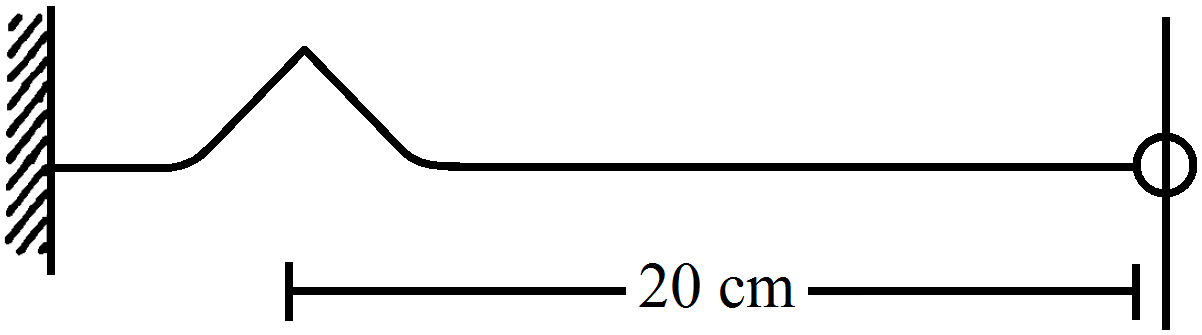
A string of linear mass density $0.5g/cm$ and a total length $30\ cm$ is tied to a fixed wall at one end and to a frictionless ring at the other end figure, The ring can move on a vertical rod. A wave pulse is produced on the string which moves towards the ring at a speed of $20\ cm/s.$ The pulse is symmetric about its maximum which is located at a distance of $20\ cm$ from the end joined to the ring.
  1. Assuming that the wave is reflected from the ends without loss of energy, find the time taken by the string to regain its shape.
  2. The shape of the string changes periodically with time. Find this time period.
  3. What is the tension in the string?
A body of mass 2kg is at rest at a height of 10m above the ground. Calculate its potential energy and kinetic energy after it has fallen through half the height. Also find the velocity at this instant.
An experiment measured quantities a, b, c and then x is calculated by using the relation $\text{x}=\frac{\text{ab}^2}{\text{c}^3}$ If the percentage errors in measurements of a, b and care $\pm1\%, \pm2\% \text{ and } \pm 1.5\%$ respectively, then calculate the maximum percentage error in value of x obtained.
Shows that the projection angle $\theta_0$ for a projectile launched from the origin is given by, $\theta_0=\tan^{-1}\Big(\frac{4\text{h}_\text{m}}{\text{R}}\Big)$ where the symbols have their usual meaning.
Prove that for an adiabatic process $\text{PV}^\gamma=\text{constant},$ where the symbols have their usual meanings.
A light ray falling at an angle of 45° with the surface of a clean slab of ice of thickness 1m is refracted into it at an angle of 30°. Calculate the time taken by the light rays, to cross the slab. Speed of light in vacuum = $3 \times 10^8m/s$
From the top of a building 19.6m high, a ball is projected horizontally. After how long does it strike the ground? If the line joining the point of projection to the point where it hits the ground makes an angle of 45° with the horizontal, what is the initial velocity of the ball?