Question
Distinguish between a convex and a concave mirror.

Answer

 
BASIS FOR COMPARISON
CONVEX MIRROR
CONCAVE MIRROR1.
1.
Meaning
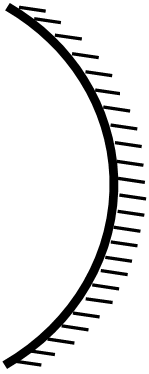
Convex mirror implies the mirror whose reflecting surface is away from the center of curvature.
Concave mirror refers to the mirror whose reflecting surface is towards the center of curvature.
2.
Shape
3.
Center of curvature
Lies behind the mirror.
Lies in front of the mirror.
4.
Type
Diverging mirror.
Converging mirror.
5.
Image
Virtual image is formed.
Real or virtual image is formed.
6.
Used as
Rear view mirrors in cars and bikes.
Reflectors in projectors, searchlights etc.

Need a full question paper?

Generate a complete, print-ready paper with questions like this in minutes — across 16+ boards, with answer keys.

Start Generating Free

Similar questions

A person suffering from the eye-defect myopia (short-sightedness) can see clearly only up to a distance of 2 metres. What is the nature and power of lens required to rectify this defect?
If a potential difference of 10V causes a current of 2A to flow for 1 minute, how much energy is transferred?
A wire is 1.0m long, 0.2mm in diameter and has a resistance of $10Ω.$ Calculate the resistivity of its material?
Make two diagrams to explain refraction and dispersion.
A person needs a lens of power -4.5D for correction of her vision.
  1. What kind of defect in vision is she suffering from?
  2. What is the focal length of the corrective lens?
  3. What is the nature of the corrective lens?
Two resistances when connected in parallel give resultant value of 2 ohm; when connected in series the value becomes 9 ohm. Calculate the value of each resistance.
A convex lens produces an inverted image magnified three times of an object placed at a distance of 15cm from it. Calculate focal length of the lens.
A combination of lenses for a camera contains two converging lenses of focal lengths 20cm and 40cm and a diverging lens of focal length 50cm. Find the power and focal length of the combination.
Draw a simple diagram of the human eye and label clearly the cornea, iris, pupil, ciliar muscles, eye-lens, retina, optic nerve and blind spot.
Do you know that the corneal-impairment can be cured by replacing the defective cornea with the cornea of the donated eye? How and why should we organize groups to motivate the community members to donate their eyes after death?