Questions · Page 1 of 5

Answer the questions.[Phy-3M]

🎯

Test yourself on this topic

50 questions · timed · auto-graded

Question 13 Marks
Name the type of mirror used in the following situations.

  1. Headlights of a car.
  2. Side/rear-view mirror of a vehicle.
  3. Solar furnace.

Support your answer with reason.

Answer
  1. Concave mirror, to get powerful and parallel beams of light.
  2. Convex mirror because it always gives an erect image and enables the driver to view much larger area.
  3. Concave or parabolic mirror because it can concentrate sunlight at the focus to produce heat in the solar furnace.
View full question & answer
Question 23 Marks
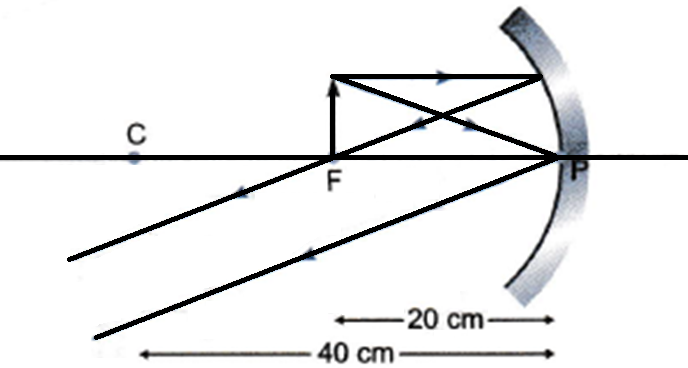
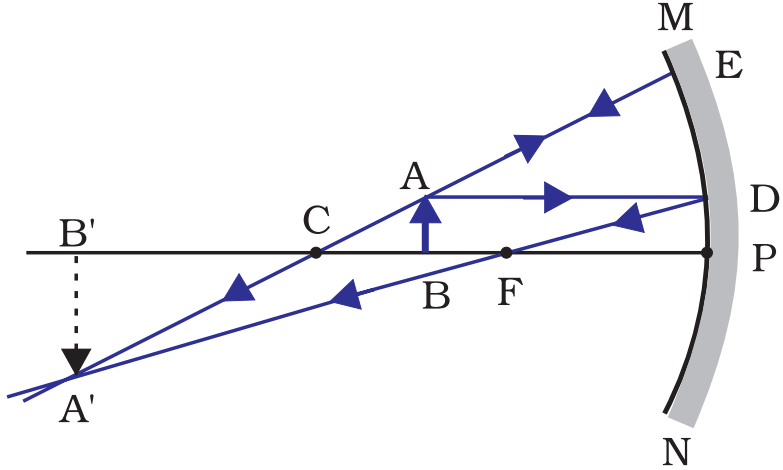
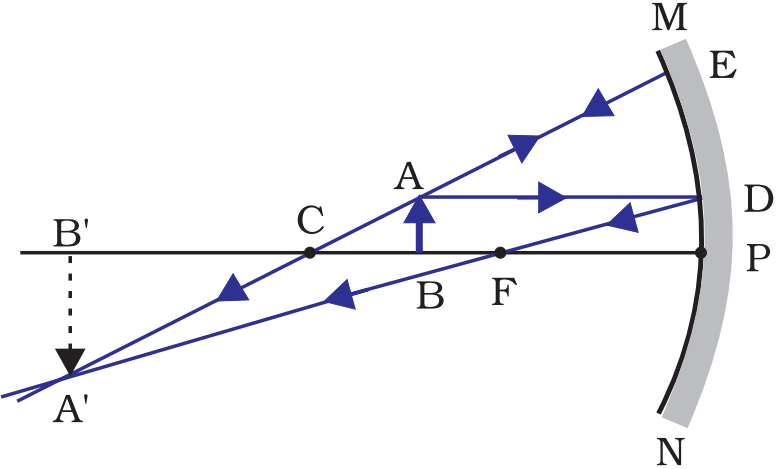
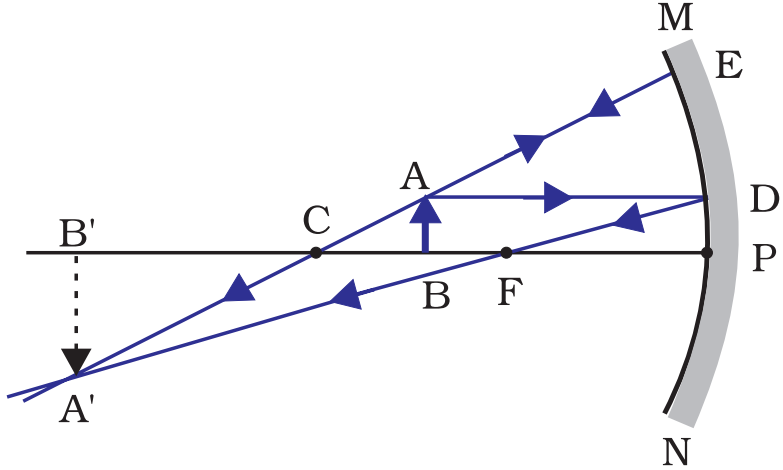
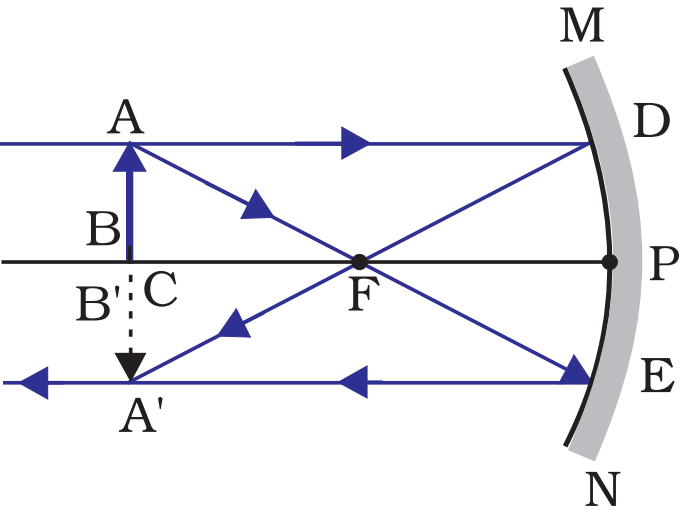
We wish to obtain an erect image of an object, using a concave mirror of focal length 15 cm. What should be the range of distance of the object from the mirror? What is the nature of the image? Is the image larger or smaller than the object? Draw a ray diagram to show the image formation in this case.
Answer
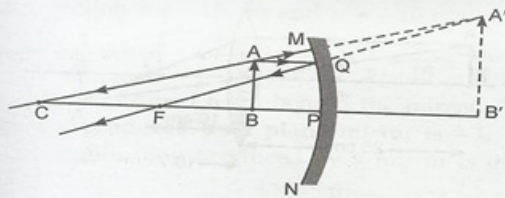
Object must be placed in front of concave mirror between its pole and principal focus at a distance less than 15 cm. The image formed will be virtual and erect. The size of the image is larger the object. The ray diagram is as follows:
View full question & answer
Question 33 Marks
An object of size 7.0 cm is placed at 27 cm in front of a concave mirror of focal length 18 cm. At what distance from the mirror should a screen be placed, so that a sharp focussed image can be obtained? Find the size and the nature of the image.
Answer
Object distance, u = -27 cm

Object height, h = 7 cm

Focal length, f = -18 cm

According to the mirror formula,

$\frac{1}{\text{v}}-\frac{1}{\text{u}}=\frac{1}{\text{f}}$

$\frac{1}{\text{v}}=\frac{1}{\text{f}}-\frac{1}{\text{u}}$

$=\frac{-1}{18}+\frac{1}{27}-\frac{-1}{54}$

v = -54 cm

The screen should be placed at a distance of 54 cm in front of the given mirror.

Magnification, $\text{m}=-\frac{\text{Image Distance}}{\text{Object Distance}}=\frac{-54}{27}=-2$

The negative value of magnification indicates thet the image formed is real.

Magnification, $\text{m}=\frac{\text{Hight of the image}}{\text{Hight of the object}}=\frac{\text{h}_\text{r}}{\text{h}}$

h' = 7 × (-2) = -14 cm.

The negative value of image height indicates that the image formed is inverted.

View full question & answer
Question 43 Marks
An object 5.0 cm in length is placed at a distance of 20 cm in front of a convex mirror of radius of curvature 30 cm. Find the position of the image, its nature and size.
Answer
h0 = +5.0 cm, u = -20 cm,

$\text{f}=\frac{\text{R}}{2}=+15 \ \text{cm}$

Using mirror formula, $\frac{1}{\text{f}}=\frac{1}{\text{v}}+\frac{1}{\text{u}}$, we get

$\frac{1}{\text{v}}=\frac{1}{\text{f}}-\frac{1}{\text{u}}=\frac{1}{15}-\frac{1}{-20}$

$=\frac{20+15}{300}=\frac{35}{300}$

$\text{v}=\frac{300}{35}=\frac{60}{7}=8.57 \ \text{cm}$.

Using $\text{m}=\frac{\text{h}_1}{\text{h}_0}=-\frac{\text{v}}{\text{u}}$, we get

$\text{h}_1=-5\times\frac{8.57}{-20}=2.16 \ \text{cm}$

Since v is +ve, the image is virtual.

since h= 2.16 cm < 5.0 cm, the image is diminished.

View full question & answer
Question 53 Marks
An object is placed at a distance of 10 cm from a convex mirror of focal length 15 cm. Find the position and nature of the image.
Answer
Focal length of convex mirror, f = +15 cm

Object distance, u = - 10 cm

According to the mirror formula,

$\Rightarrow \ \frac{1}{\text{v}}=\frac{1}{\text{f}}-\frac{1}{\text{u}}$

$\Rightarrow \ \frac{1}{\text{v}}=\frac{1}{15}-\frac{1}{(-10)}$

$\Rightarrow \ \frac{1}{\text{v}}=\frac{1}{15}+\frac{1}{10}$

$\Rightarrow \ \frac{1}{\text{v}}=\frac{2+3}{30}$

$\Rightarrow \ \frac{1}{\text{v}}=\frac{5}{30}$

$\Rightarrow \ \text{v}=6 \ \text{cm}$

 Magnification $=\frac{-\text{v}}{\text{u}}=\frac{-6}{-10}=0.6$

The image is located at a distance 6 cm from the mirror on the other side of the mirror.

The positive and value less than 1 of magnification indicates that the image formed is virtual and erect and diminished.

View full question & answer
Question 63 Marks
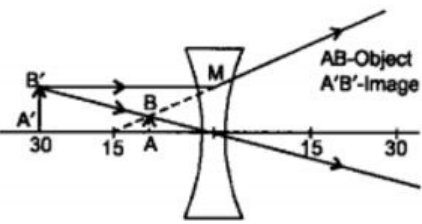
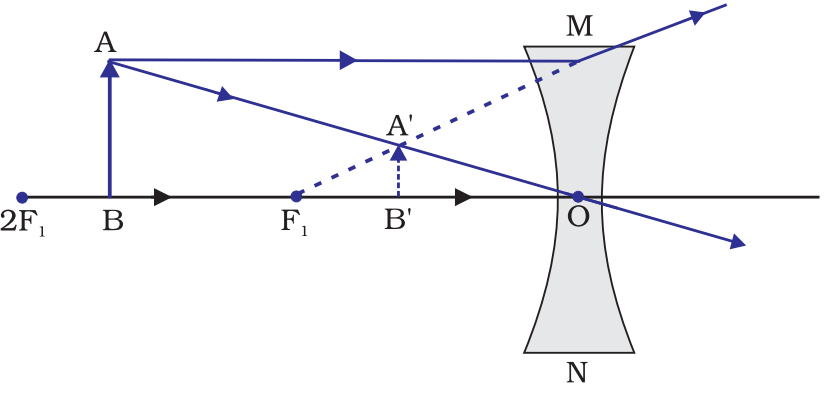
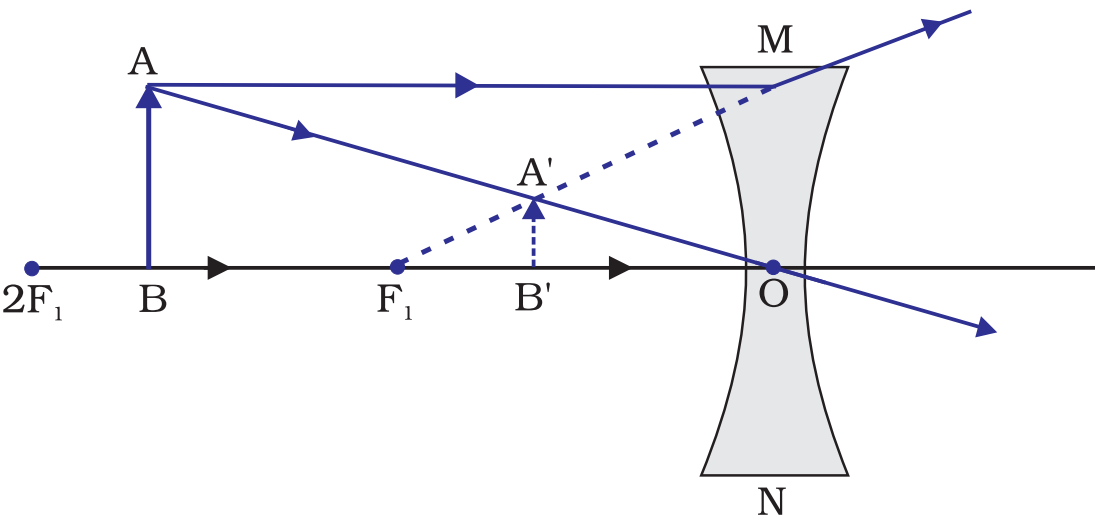
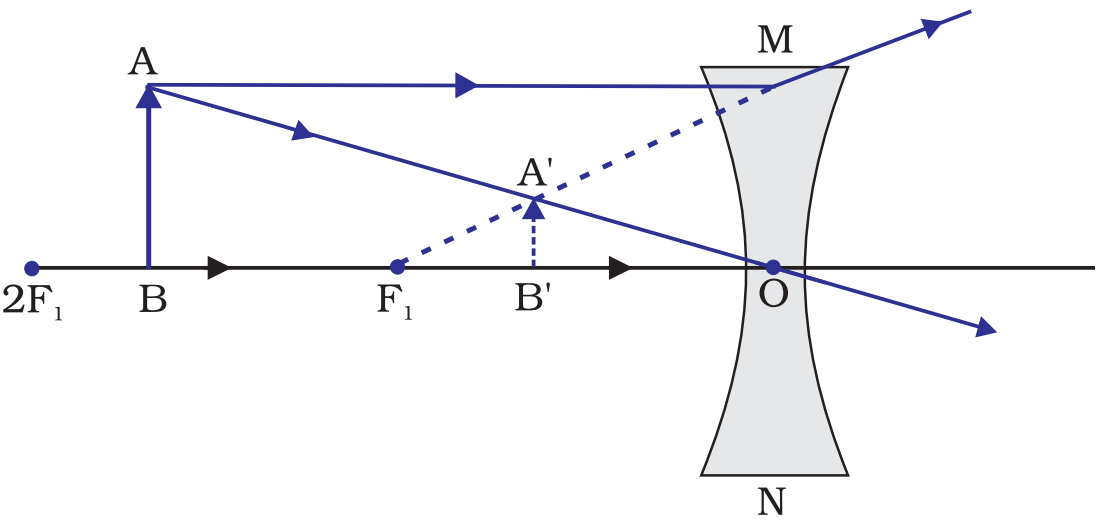
A concave lens of focal length 15 cm forms an image 10 cm from the lens. How far is the object placed from the lens? Draw the ray diagram.
Answer
f = -15 cm, v = -10 cm

Using lens formula, we have

$\frac{1}{\text{f}}=\frac{1}{\text{v}}-\frac{1}{\text{u}}$

$\Rightarrow \ \frac{1}{\text{u}}=\frac{1}{\text{v}}-\frac{1}{\text{f}}$

$\frac{1}{\text{u}}=\frac{1}{-10}-\frac{1}{-15}=\frac{-5}{150}$

$\text{u}=\frac{150}{-5}=-30 \ \text{cm}$

Therefore, the object is placed at 30 cm from the lens. The ray diagram is given as follows:
View full question & answer
Question 73 Marks
(i) Explain why the refractive index of any material with respect to air is always greater 1 .
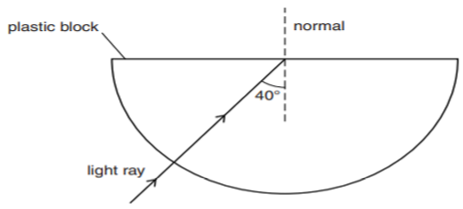
(ii) In the figure below a light ray travels from air into the semi-circular plastic block. Give a reason why the ray does not deviate at the semi-circular boundary of the plastic block.
Image
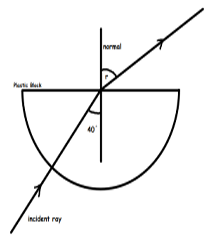
(iii) Complete the ray diagram of the above scenario when the light ray comes out of the plastic block from the top flat end.
Answer
i. The refractive index of a medium with respect to air is given by speed of light in air . Since speed of light in the medium is always less than the speed of light in the medium speed of light in air, hence the above ratio is always greater than 1.
ii. The ray of light is undergoing normalincidence at the air-plastic block interface. And for normal incidence there is no deviation.
iii.
Image
View full question & answer
Question 83 Marks
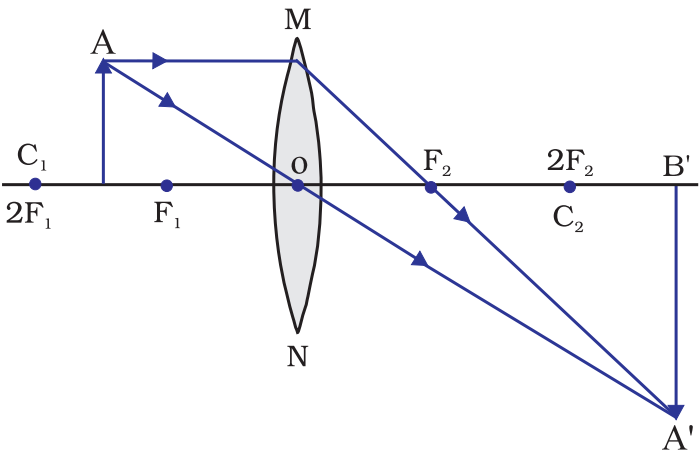
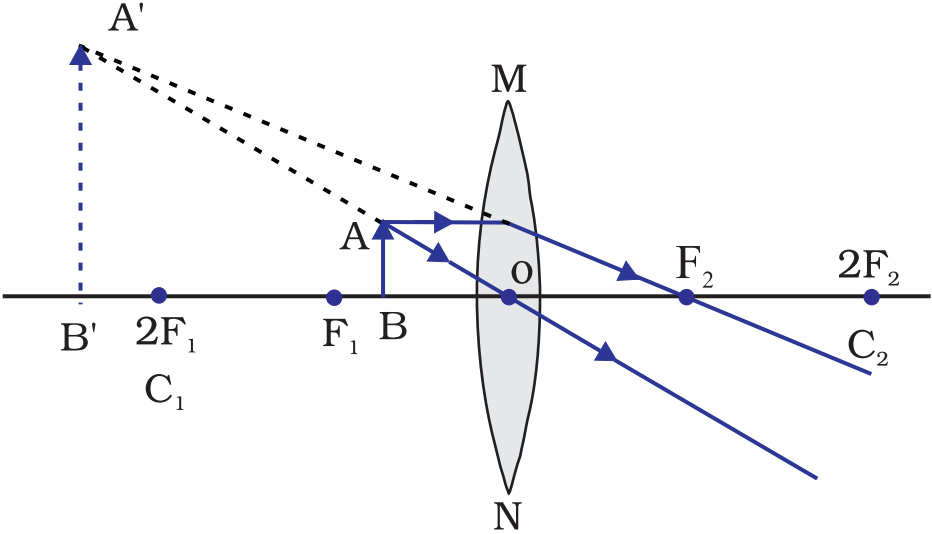
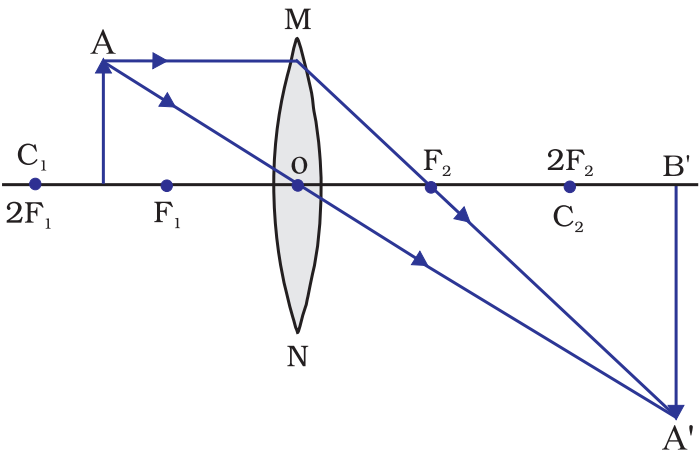
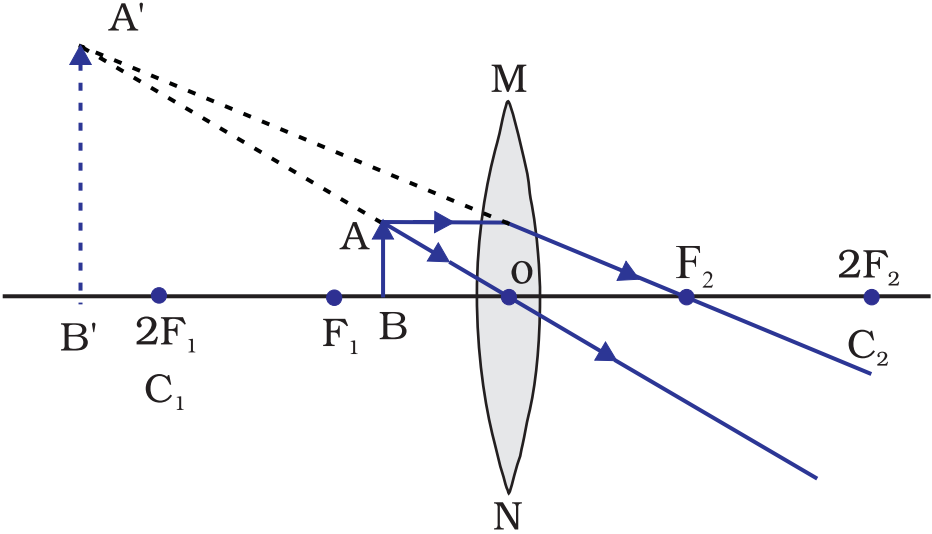
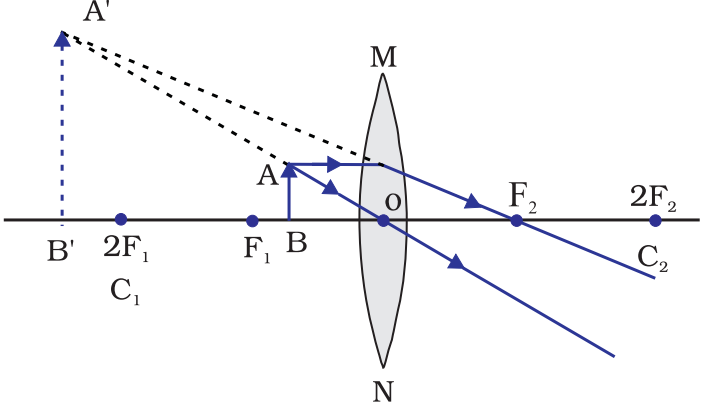
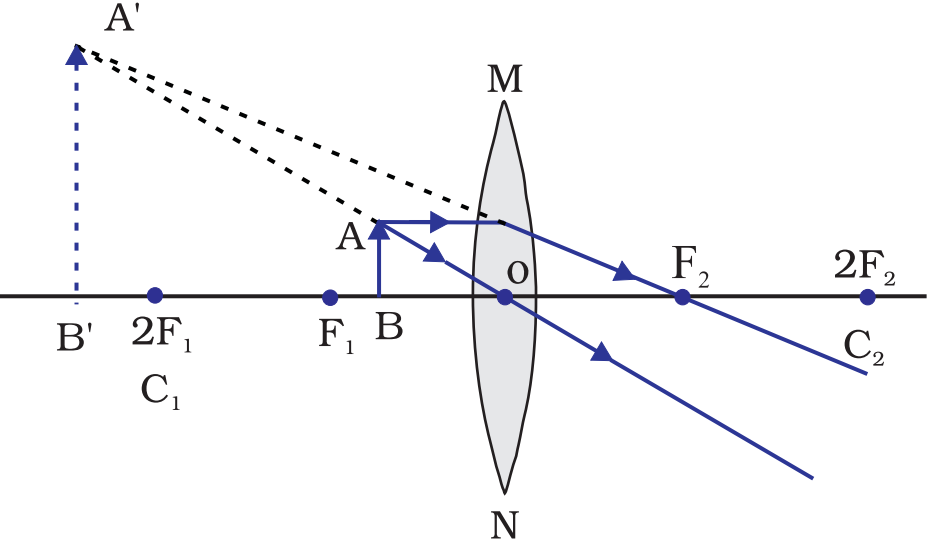
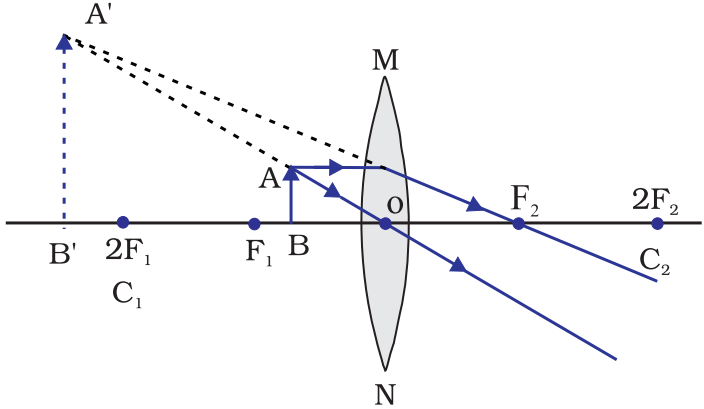
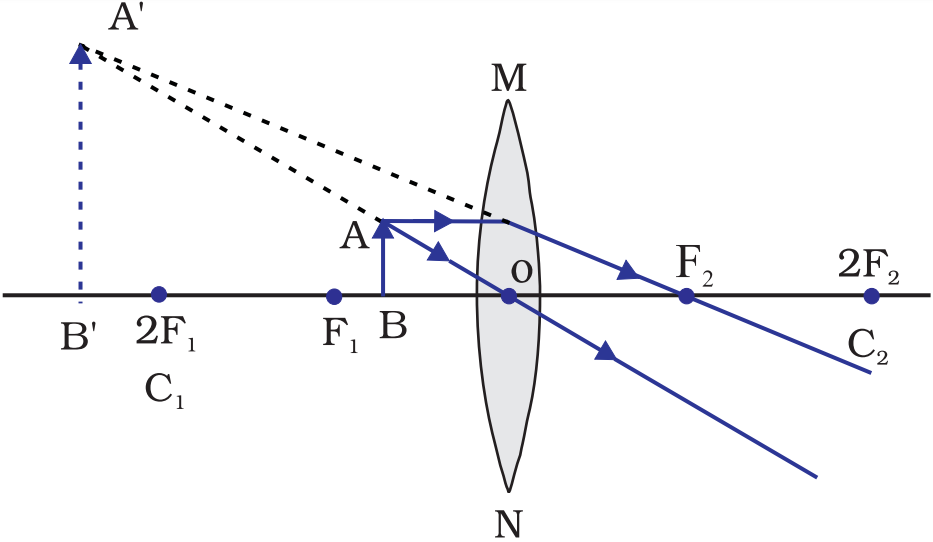
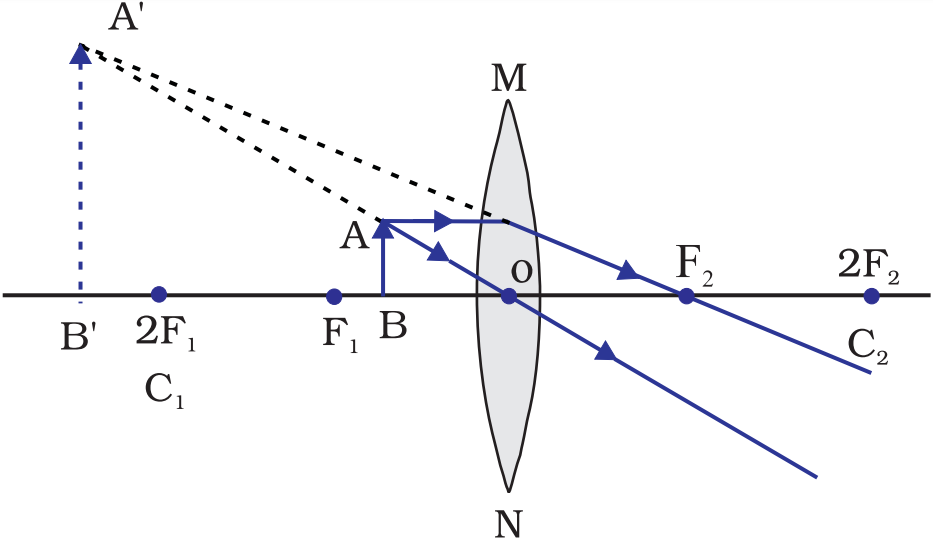
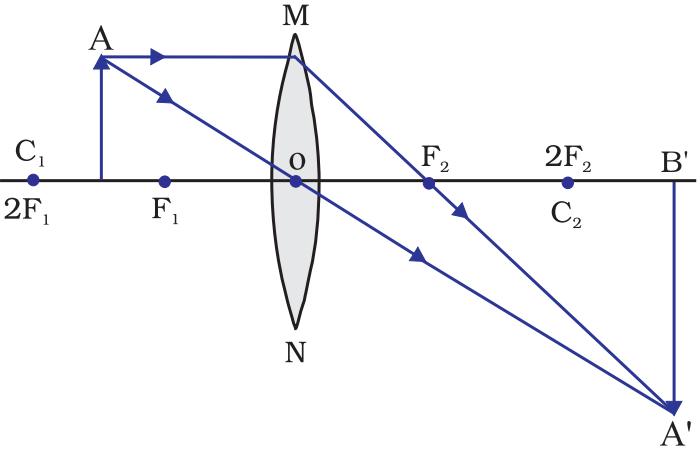
‘‘A lens can form a magnified erect image as well as magnified inverted image of an object placed in front of it.’’ State the nature of this lens and draw ray diagrams to justify the above statement. Mark the positions of O, F and 2F in the diagram.
Answer
  1. The ray diagram for three times magnified real image is shown below:

  1. The ray diagram for three times magnified virtual image is shown below:

View full question & answer
Question 93 Marks
The image formed by a spherical mirror is real, inverted and is of magnification - 2. If the image is at a distance of 30 cm from the mirror, where is the object placed ? Find the focal length of the mirror. List two characteristics of the image formed if the object is moved 10 cm towards the mirror.
Answer
$m = -2$

$\frac{v}{u} = 2$

$v = -30 \text{ cm}$

$u = -15$

$f \frac{uv}{u + v} = \frac{-15 \text{ cm }\times -30 \text{ cm}}{-15 \text{ cm + (-30) cm}} = \frac{450}{-45} = -10 \text{ cm}$

If the object is shifted 10 cm towards the mirror u = −5 cm

Therefore the object is between pole and focus and the image formed is:

  1. Virtual.
  2. Erect.
  3. Magnified.
View full question & answer
Question 103 Marks
An object of height 5 cm is placed perpendicular to the principal axis of a concave lens of focal length 10 cm. If the distance of the object from the optical centre of the lens is 20 cm, determine the position, nature and size of the image formed using the lens formula.
Answer
$h = + 5\text{ cm} \ \ \ \ \ f = -10 \text{ cm} \ \ \ \ \ u = -20 \text{ cm} \ \ \ \ \ v = ?$

$\frac{1}{f} = \frac{1}{v} - \frac{1}{u}$

$\therefore \frac{1}{v} = \frac{1}{f} + \frac{1}{u} = \frac{1}{(-10)} + \frac{1}{(-20)} \ \ \ \ \ \ = \frac{-2-1}{20} = \frac{-3}{20}$

$\therefore v = -\frac{20}{3} \text{ cm}$

Nature – Virtual, erect

$h' = \frac{v}{u} \times h = \bigg(\frac{-20}{3} \times \frac{1}{-20}\times5\bigg) \text{ cm} = + \frac{5}{3} \text{ cm}$

View full question & answer
Question 113 Marks
A student wants to project the image of a candle flame on a screen 90 cm in front of a mirror by keeping the flame at a distance of 15 cm from its pole.
  1. Suggest the type of mirror he should use.
  2. Determine the linear magnification in this case.
  3. Find the distance between the object and its image.
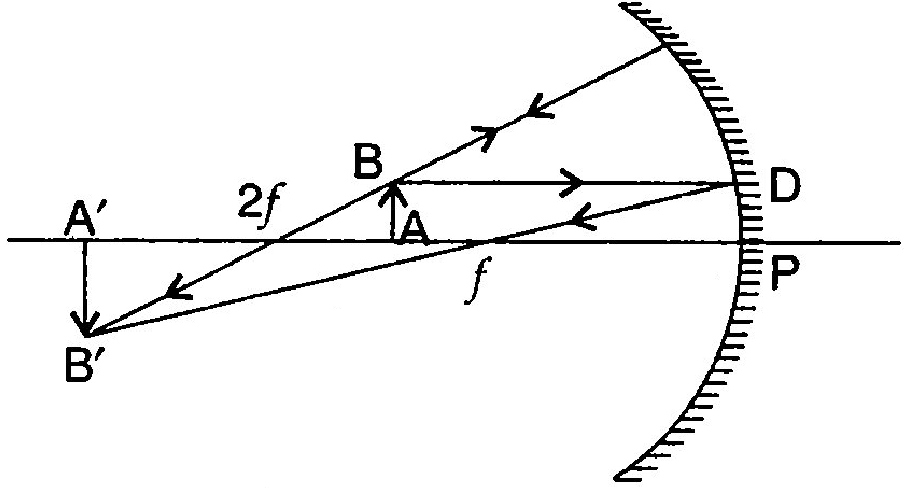
  4. Draw ray diagram to show the image formation in this case.
Answer
  1. Concave mirror.
  2. $\text{Linear magnification} = -\frac{\text{Image distance}}{\text{Object distance}}$

$m = \frac{-v}{u}$

Object distance, u = -15 (u is always negative)

Image distance, v = -90 (-ve sign as the image is formed in front of the mirror on the screen)

$m = -\frac{(- 90)}{(-15)} \ \ \ \ \ \ \ \ \ \ \therefore m = -6$

  1. The distance between the object and its image is 75 cm.
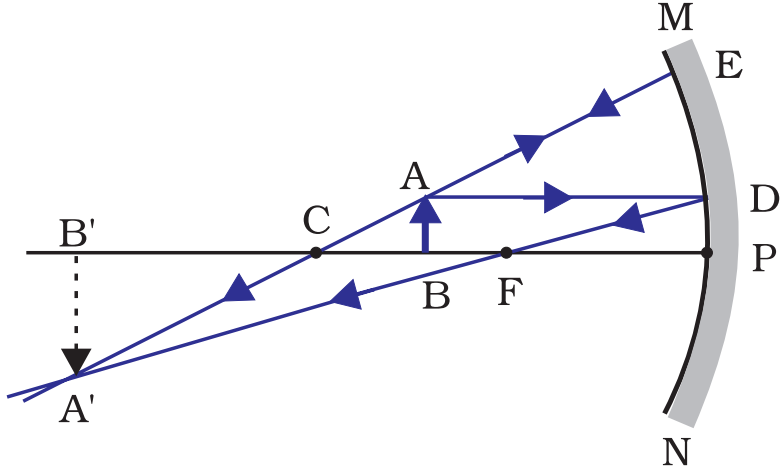
  2. Ray diagram:

View full question & answer
Question 123 Marks
Draw ray diagrams to show the formation of three times magnified (a) real, and (b) virtual image of an object by a converging lens. Mark the positions of O, F and 2F in each diagram.
Answer
  1. The ray diagram for three times magnified real image is shown below:


  1. The ray diagram for three times magnified virtual image is shown below:

View full question & answer
Question 133 Marks
The image of an object formed by a lens is of magnification - 1. If the distance between the object and its image is 60 cm, what is the focal length of the lens? If the object is moved 20 cm towards the lens, where would the image be formed? State reason and also draw a ray diagram in support of your answer.
Answer
Since the object is same size as that of the object therefore the object is placed at 2f and image is formed at 2f'. Therefore, 
4f = 60 cm 
2f = 30 cm 
F = 15 cm 
The magnification of -1 is possible in only convex lens. When the object is moved 20 cm towards the lens, so the new object distance will be = 30 cm -20 cm = 10 cm. Since the new object distance is less than focal length of the lens, thus the image will be virtual, erect and magnified. The image will be formed on the same side as that of the object.

View full question & answer
Question 143 Marks
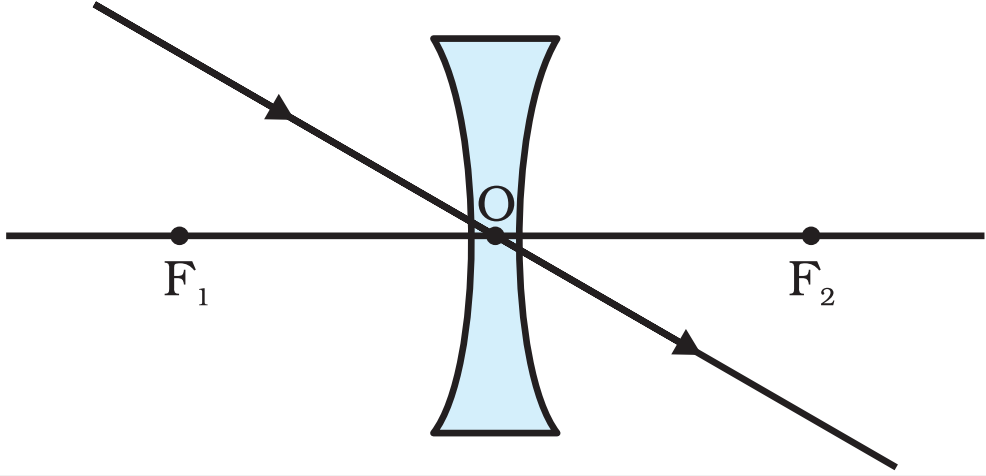
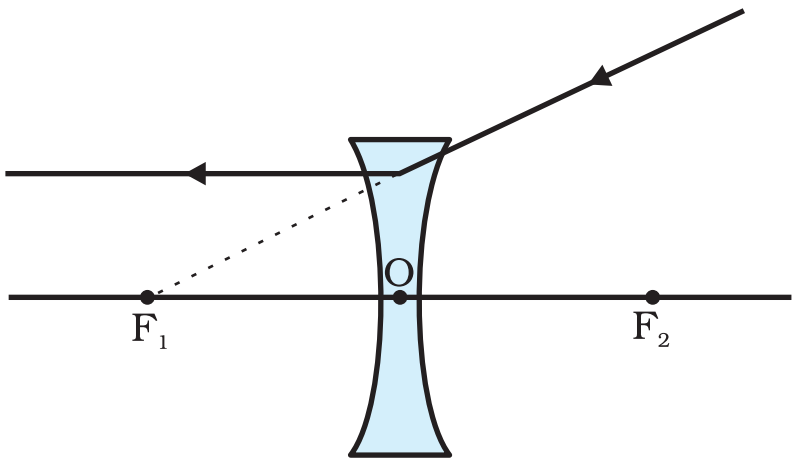
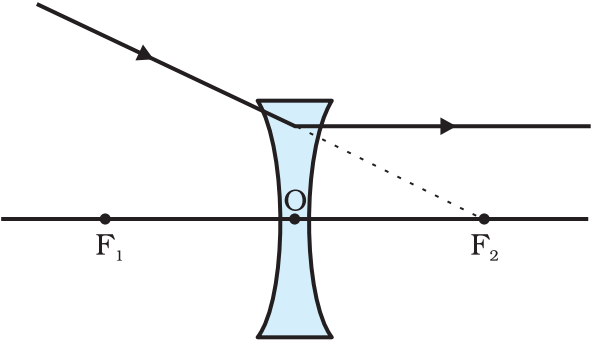
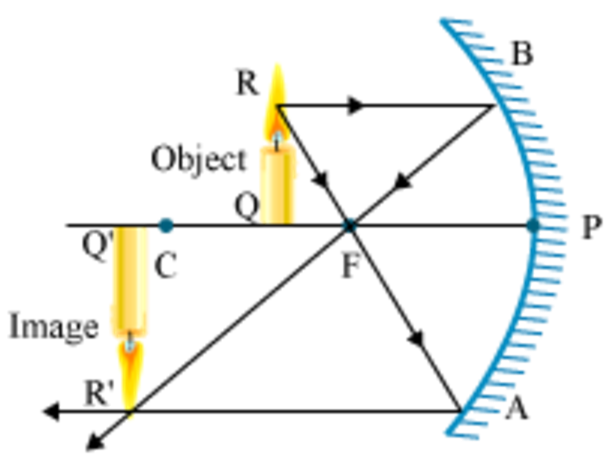
Draw a ray diagram to show the path of the refracted ray in each of the following cases:
A ray of light incident on a concave lens is:
  1. Passing through its optical centre.
  2. Parallel to its principal axis.
  3. Directed towards its principal focus.
Answer
For a concave lens,
  1. The ray diagram for a ray of light passing through the optical centre of the concave lens will emerge without any deviation.


  1. For a ray of light directed towards the principal axis, after refraction from a concave lens, appears to diverge from the principal focus on the same side of the lens.


  1. For a ray of light directed towards its principal focus, goes parallel to its principal axis after refraction through the lens.

View full question & answer
Question 153 Marks
A student wants to project the image of a candle flame on a screen 48 cm in front of a mirror by keeping the flame at a distance of 12 cm from its pole.
  1. Suggest the type of mirror he should use.
  2. Find the linear magnification of the image produced.
  3. How far is the image from its object?
  4. Draw ray diagram to show the image formation in this case.
Answer
  1. He should use a concave mirror, as it forms a real image on the same side of the mirror.
  2. Object distance, u = -12 cm.

Image distance, v = - 48 cm.

Magnification, $m = -\frac{v}{u} = - \frac{(-48)}{(-12)} = -4$

The minus sign in magnification shows that the image formed is real and inverted.

  1. The image is formed at a distance of 36 cm from the object.
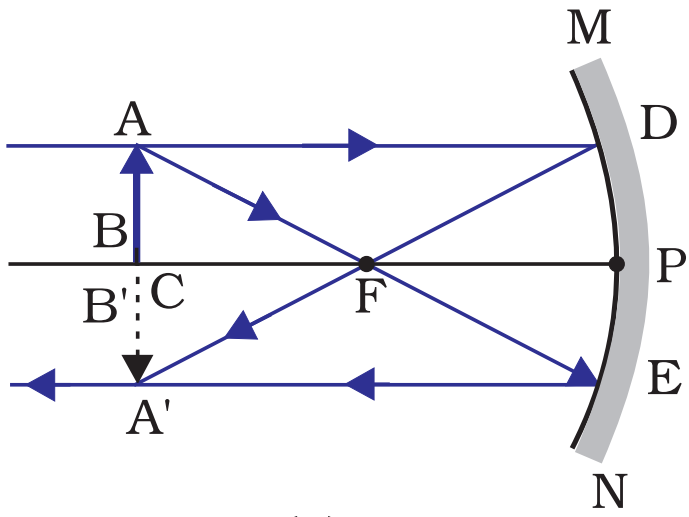
  2.  


In this case, the image is formed beyond the centre of curvature. This image is real, inverted and enlarged.
View full question & answer
Question 163 Marks
If the image formed by a lens for all positions of an object placed in front of it is always erect and diminished, what is the nature of this lens? Draw a ray diagram to justify your answer. If the numerical value of the power of this lens is 10 D, what is its focal length in the Cartesian system?
Answer
Concave/ diverging lens.

Direction of rays
$\text{f}=\frac{1}{\text{P}}$
$\text{P}=-10\text{D},$
$\text{f}=\frac{1}{-10\text{D}}=-0.1\text{m}/-10|\text{cm}$
View full question & answer
Question 173 Marks
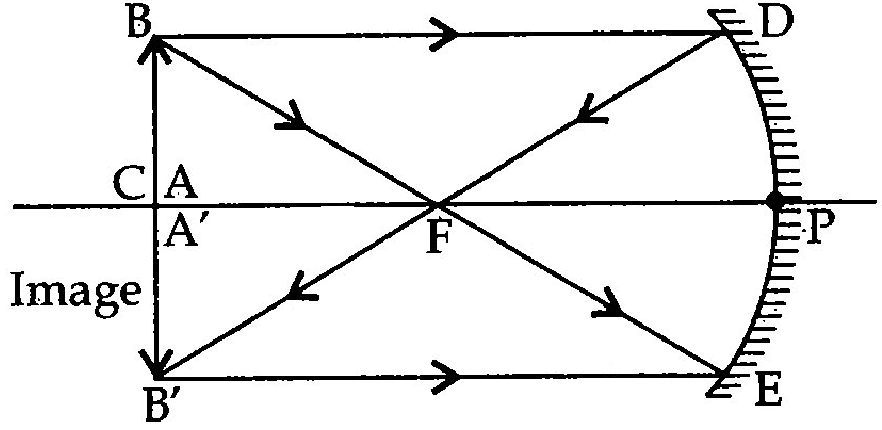
The image of an object formed by a mirror is real, inverted and is of magnification - I. If the image is at a distance of 40 cm from themirror, where is the object placed? Where would the image be if the object is moved 20 cm towards the mirror? State reason and also draw ray diagram for the new position of the object to justify your answer.
Answer
Object position: At C (Centre of curvature)
Object distance = 40cm
Position of the image: at infinity because the focal length of the mirror is 20cm.
If the object is moved 20cm towards the mirror then its new position would be at the focus of the mirror.
View full question & answer
Question 183 Marks
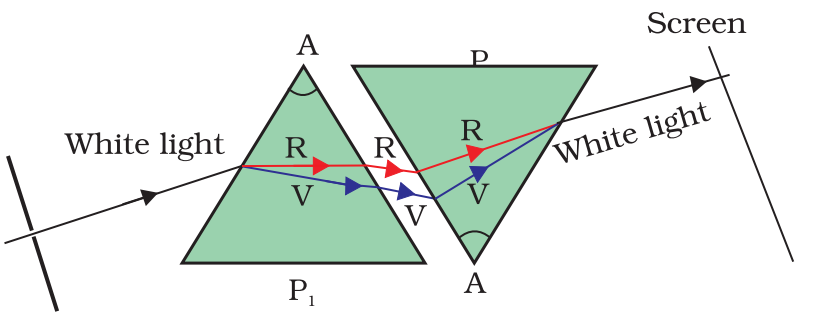
Describe an activity to show that the colours of white light splinted by a glass prism can be recombined to get white light by another identical glass prism. AIso draw ray diagram to show the recombination of the spectrum of white light.
Answer
Different colors of light bend through different angles with respect to the incident ray as they pass through a prism. The red light bends the least, while the violet bends the most. Thus, the rays of each colour emerge along different paths and thus become distinct. This is the cause of dispersion of white light passing through a glass prism.
Isaac Newton used two glass primes, with one prism in inverted position to show that white light of the Sun contains seven colors. The set-up has been shown below:


When white light of the Sun passes through the first prism, it gets dispersed into seven colors. When all the seven colors of the spectrum were passed through the second prism, Newton found a beam of white light emerging from the other side of the second prism. This observation gave Newton the idea that the sunlight is made up of seven colors.
View full question & answer
Question 193 Marks
If the image formed by a mirror for all positions of the object placed in front of it is always erect and diminished, what type of mirror is it? Draw a ray diagram to justify your answer. Where and why do we generally use this type of mirror?
Answer
The two rays chosen for the construction of ray diagram is:

Ray 1: When the incident ray is parallel to the principal axis, the reflected ray will pass through the focus of concave mirror or it appears to pass through the focus of convex mirror.
Ray 2: When the incident ray passes through or appears to pass through the centre of curvature, the light, after reflection from the spherical mirror, reflects back along the same path.
The image formed is real, inverted, magnified and is formed beyond the centre of curvature.
View full question & answer
Question 203 Marks
A student wants to project the image of a candle flame on a screen 60 cm in front of a mirror by keeping the flame at a distance of 15 cm from its pole.
  1. Write the type of mirror he should use.
  2. Find the linear magnification of the image produced.
  3. What is the distance between the object and its image?
  4. Draw a ray diagram to show the image formation in this case.
View full question & answer
Question 213 Marks
Name the type of mirror used:
  1. By dentists.
  2. In solar furnaces. Give two reasons why such mirrors are used in each case.
Answer
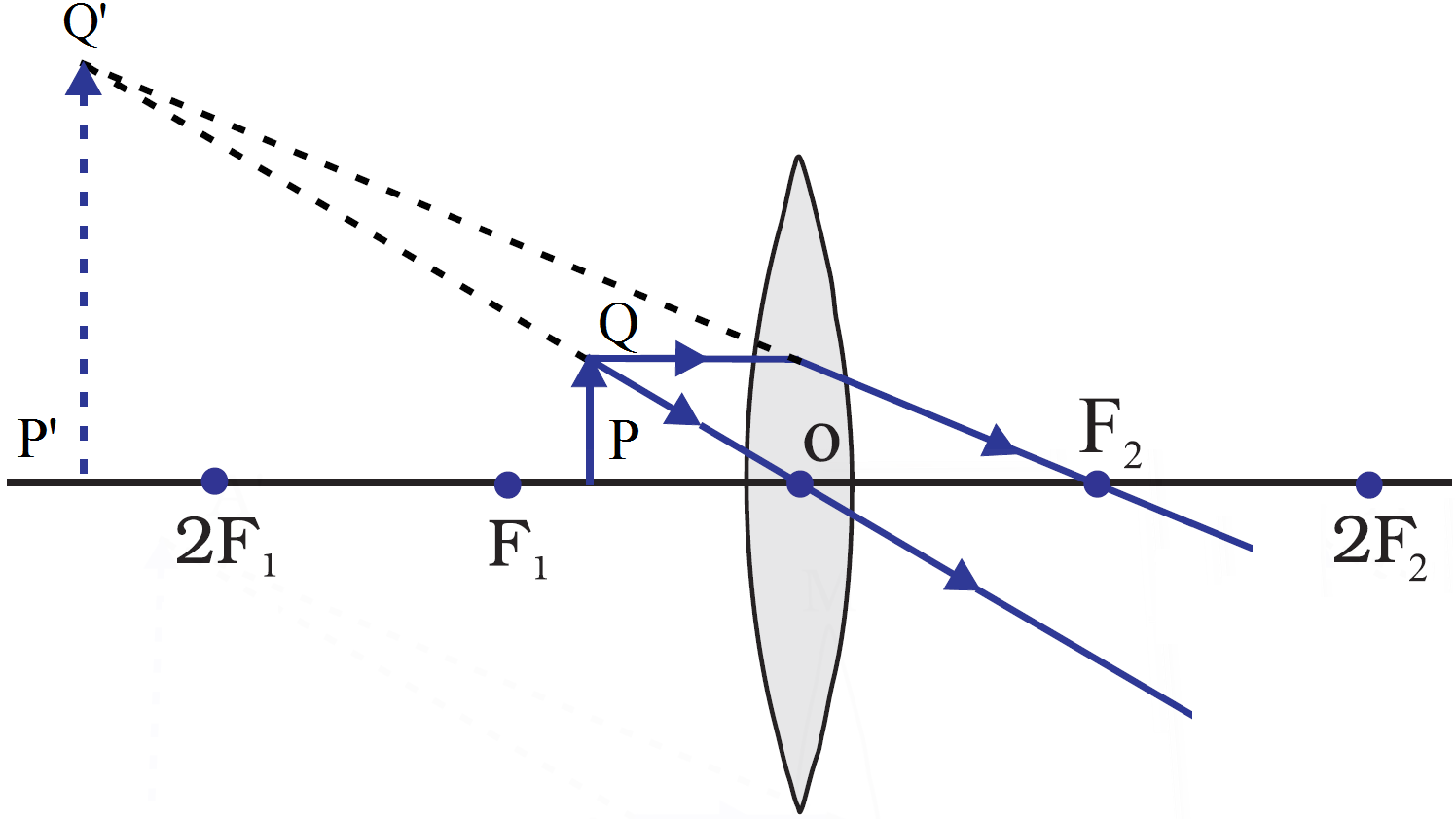
  1.  Concave mirrors are used by dentists to see the large images of the teeth of patients because when a tooth is within the focus of a concave mirror, then an enlarged image of the tooth is seen in the concave mirror. Thus it becomes easier to locate the defect in the tooth.
  2.  Large concave mirrors are used in solar furnaces as reflectors. Solar furnace is placed at the focus of the concave reflector which focusses the Sun’s heat rays on the furnace due to which the solar furnace gets very hot. Even steel can be melted in this solar furnace.
View full question & answer
Question 223 Marks
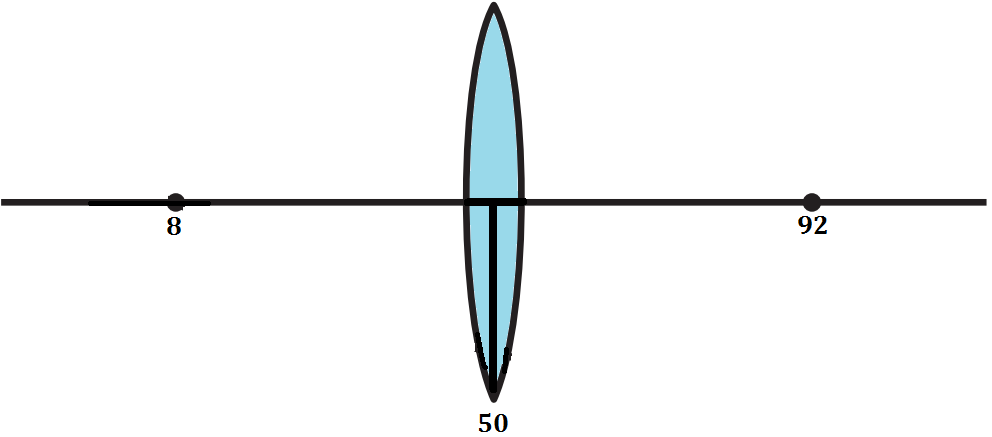
An object placed on a metre scale at 8 cm mark was focussed on a white screen placed at 92 cm mark, using a converging lens placed on the scale at 50 cm mark.
  1. Find the focal length of the converging lens.
  2. Find the position of the image formed if the object is shifted towards the lens at a position of 29.0 cm.
  3. State the nature of the image formed if the object is further shifted towards the lens.
Answer


Object placed at 8 cm mark,
Real image formed at 92 cm mark,
Converging lens is placed at 50 cm mark
This implies that:
Object distance, u = - 42 cm
Image distance, v = + 42 cm
  1. Focal length, f =?

According to lens formula:
$\frac{1}{v}-\frac{1}{u} = \frac{1}{f}$
$\Rightarrow \frac{1}{42}- \frac{1}{-42} = \frac{1}{f}$
$\Rightarrow \frac{1}{f} = \frac{1}{42} + \frac{1}{42} = \frac{2}{42} = \frac{1}{21}$
$\therefore f = + \text{ 21 cm}$
  1.  

$f = \text{ + 21 cm,}$

Object position is at 29 cm

$\Rightarrow u = - \text{21 cm}$

$v = ?$

$\frac{1}{v} = \frac{1}{f} + \frac{1}{u}$

$\Rightarrow \frac{1}{v} = \frac{1}{21} + \frac{1}{-21}$

$\Rightarrow\frac{1}{v} = \frac{1 - 1}{21}$

$\Rightarrow \frac{1}{v} = \frac{0}{21}$

$\therefore v = \frac{21}{0}$

$\Rightarrow v = \frac{21}{0} = \infty$

So image is formed at infinity.

  1. If the object is further shifted towards the lens then a virtual, erect and magnified image will be formed behind the object.

View full question & answer
Question 233 Marks
State the types of mirrors used for,

  1. Headlights.
  2. Rear view mirrors, in cars and motorcycles.

Give reason to justify your answer in each case.

Answer
  1. Concave mirrors are used for headlights as it gives larger area of magnification for the light.
  2. The mirror which is preferred as rear-view mirror in cars and motorcycles is the convex mirror because the image obtained with the help of convex mirror is highly diminished in size and thus gives a wider field of view and helps the driver of the vehicle to view the traffic in much larger area behind the vehicle.
View full question & answer
Question 243 Marks
A 4 cm tall object is placed perpendicular to the principal axis of a convex lens of focal length 24 cm. The distance of the object from the lens is 16 cm. Find the position, size and nature of the image formed, using the lens formula.
Answer
Given: Height of object, h = 4cm

Focal length of convex lens, f = +24cm

Object distance, u = -16cm

Applying the lens formula: $\frac{1}{\text{v}}-\frac{1}{\text{u}}=\frac{1}{\text{f}}$

$\frac{1}{\text{v}}-\frac{1}{-16}=\frac{1}{24}$

On calculating we get, $\frac{1}{\text{v}}=-\frac{1}{48}$

$\text{V}=-48\text{cm}$

Now size of the image can be calculated by:

Magnification is given by: $\frac{\text{v}}{\text{u}}=\text{m}=\frac{\text{h}_2}{\text{h}_1}$

$\frac{\text{h}_2}{4}=-\frac{48}{-16}$

On calculating h2 = 12cm

Therefore, the image will be fornme as virtual, erect and magnified.

View full question & answer
Question 253 Marks
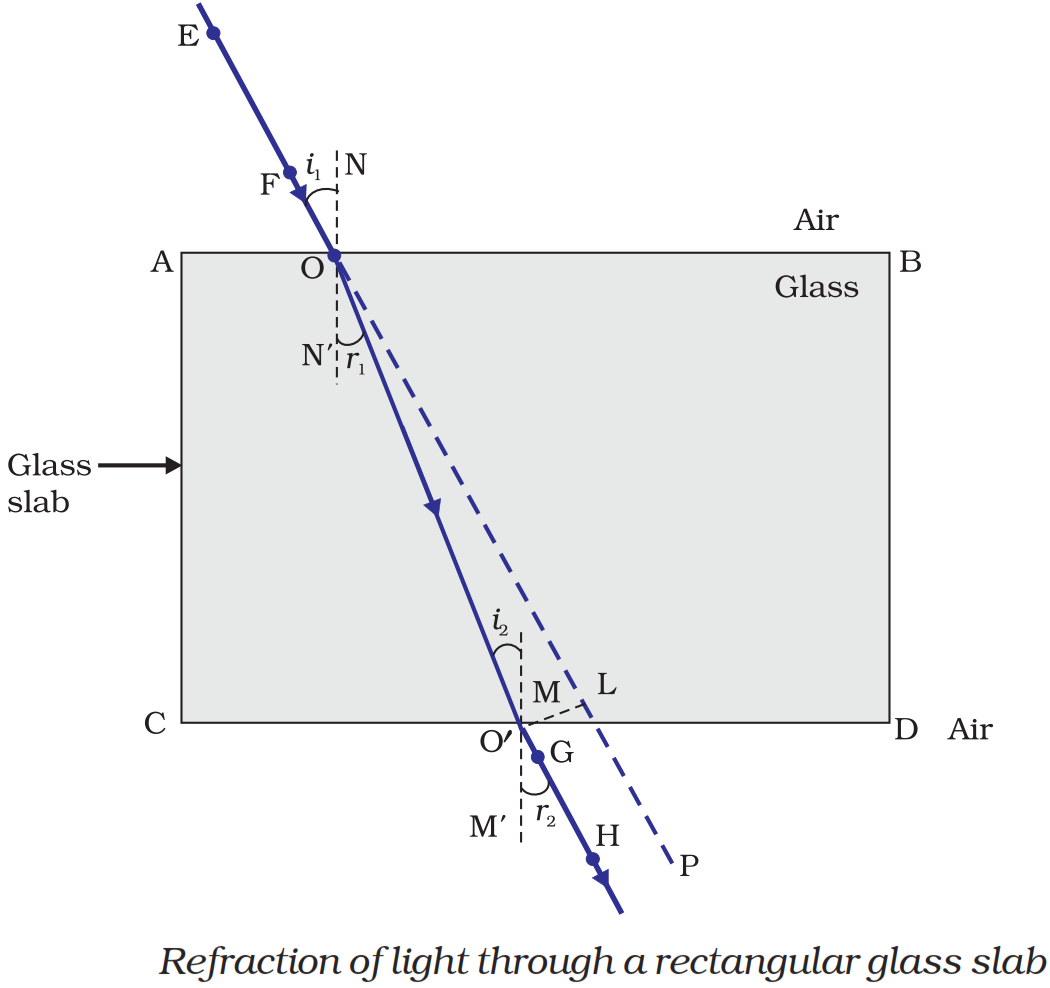
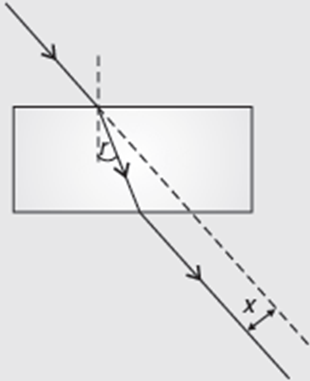
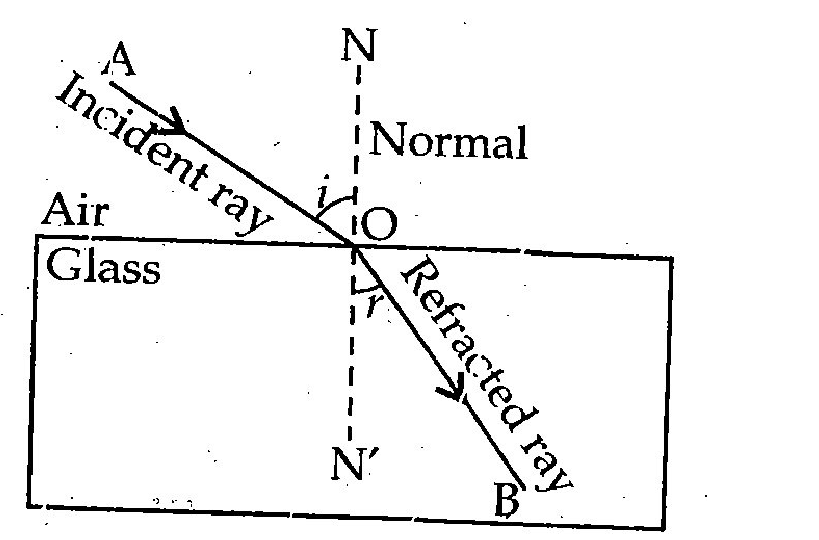
What is the principle of reversibility of light? Show that the incident ray of light is parallel to the emergent ray of light when light falls obliquely on a side of a rectangular glass slab.
Answer
The principle of reversibility of light states that light will follow exactly the same path if its direction of travel is reversed. Here is the diagram that shows the incident ray and the emergent ray when light is obliquely refracted by a glass slab:

As seen in the diagram, the incident ray when extended (dotted line) is found to be parallel to the emergent ray. However, the emergent ray experiences a lateral shift.
View full question & answer
Question 263 Marks
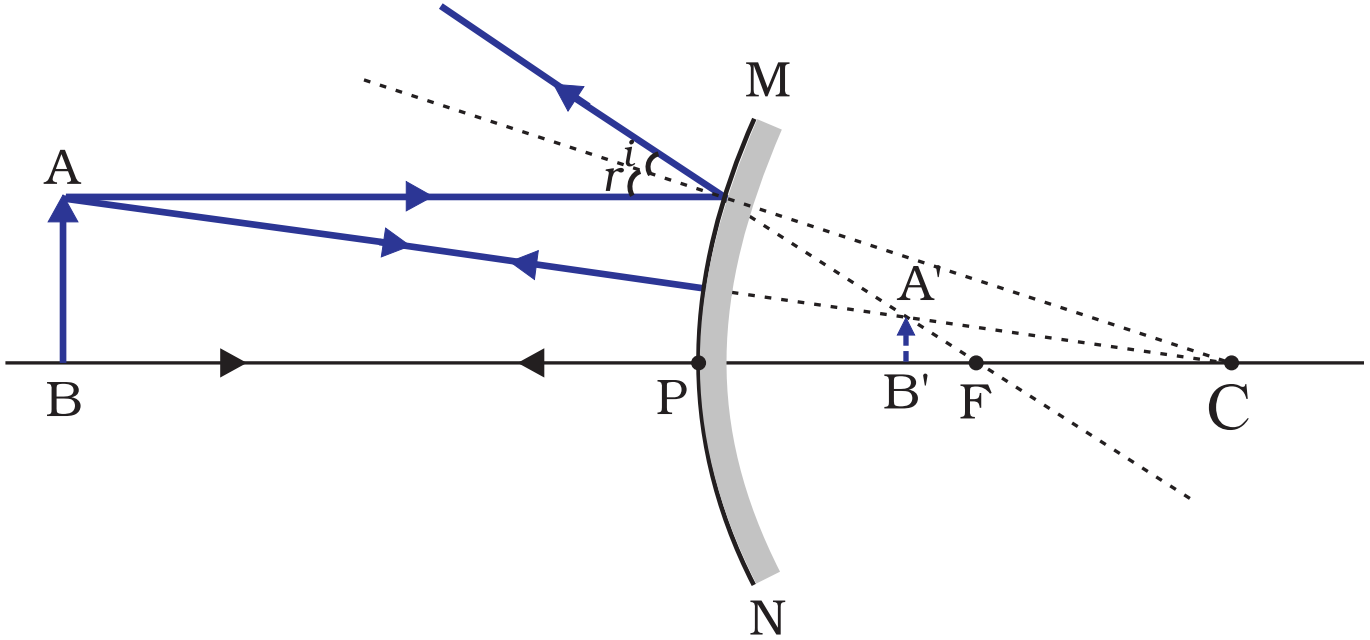
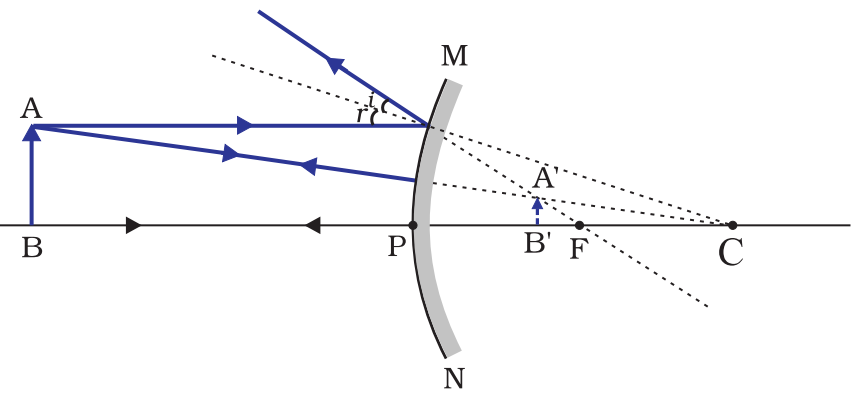
An object is placed between infinity and the pole of a convex mirror. Draw a ray diagram and also state the position, the relative size and the nature of the image formed.
Answer


Position of image: Between P and F, behind the mirror. 
Size: Diminished.
Nature of the image: Virtual and erect.
View full question & answer
Question 273 Marks
How far should an object be placed from a convex lens of focal length 20 cm to obtain its image at a distance of 30 cm from the lens? What will be the height of the image if the object is 6 cm tall?
Answer
$\frac{1}{f} = \frac{1}{v} - \frac{1}{u}$

$\therefore\frac{1}{u } = \frac{1}{v} - \frac{1}{f}$

$= \frac{1}{( + 30)} - \frac{1}{( + 20)}$

$ = \frac{1}{30} - \frac{1}{20} = \frac{2 - 3}{60} = \frac{- 1}{60}$

$\therefore u = - 60 \text{ cm}$

$m = \frac{\text{h}'}{\text{h}} = \frac{v}{u}$

$\therefore \text{h}' = \frac{v}{u}\times \text{h}$

$= \frac{(+ 30)}{( - 60)}\times( + 6)$

$\text{h}' = - 3 \text{ cm}$

View full question & answer
Question 283 Marks
For which position of the object does a convex lens form a virtual and erect image? Explain with the help of a ray diagram.
Answer
Such an image is formed when the object lies between the optical centre and the principal focus. Consider two rays one moving parallel to the principal axis and the other passing through the optical centre. After refraction the two rays seem to meet on the same side as that of the object. Thus, the image lies on the same side as that of the object. The image is virtual, erect and magnified. The ray diagram is as shown.
View full question & answer
Question 293 Marks
The magnification of an image formed by a lens is –1. If the distance between the object and its image is 60cm, what is the distance of the object from the optical centre of the lens? Find the nature and focal length of the lens. If the object is displaced 20cm towards the optical centre of the lens, where would the image be formed and what would be its nature? Draw a ray diagram to justify your answer.
Answer
m = -1, Hence the image is real and the lens convex. As m = -1, u = v

u + v = 60 cm (given) i.e. = 4f = 60 cm.

When object is at 2F, image is also at 2F distance i.e. f = +15 cm

On displacing the object by 20 cm towards the lens u = -10 cm

$\text{As}\text{ }{\frac{1}{f}}=\frac{1}{v}-{\frac{1}{u}},{\text{ }\text{ }\text{ }\text{ }\text{ }\text{ }{\frac{1}{f}}=\frac{1}{v}+{\frac{1}{u}}}$

$\text{Or}\text{ } \frac{1}{v}=\frac{1}{+15{\text{cm}}}+\frac{1}{-10{\text{cm}}}=\frac{-1}{30{\text{cm}}}$


$\text{Or}\text{ }{v}=-30{\text{cm}}$

Nature of the image will be virtual.
View full question & answer
Question 303 Marks
If the image formed by a lens for all positions of the object placed in front of it is always virtual, erect and diminished, state the type of the lens. Draw a ray diagram in support of your answer. If the numerical value of focal length of such a lens is 20 cm, find its power in new cartesian sign conventions.
Answer
Diverging lens/ concave lens

We know that, $\text{P}=\frac{1}{\text{f meter}}$
When we convert 20cm into meter, we get 0.2m
Therefore, $\text{P}=\frac{1}{0.2 \text{ meter}}$
or, P = 5m.
View full question & answer
Question 313 Marks
The magnification of an image formed by a lens is – 1. If the distance of the image from the optical centre of the lens is 35 cm, where is the object placed ? What is the nature and focal length of the lens? If the object is displaced 20 cm towards the optical centre of the lens, where would the image be formed and what will be its nature? Draw a ray diagram to justify your answer.
Answer
  1. (m = - 1, i.e. Image is real, inverted and same size as the object.

and, Object distance = image distance = 2f = 35 cm.

  1. Nature of lens: Convex/ Converging.
  2. As 2f = 35 cm

$\therefore\text{f}=\frac{35}{2}=+17.5\text{cm}$

  1. On displacing the object 20 cm towards the lens, the object distance becomes 15c m (35 cm – 20 cm) i.e. it lies between F and O of the lens. Image formed now is virtual/on the same side of lens as the object.​

View full question & answer
Question 323 Marks
If the image formed by mirror for all positions of the object placed in front of it is always virtual and diminished, state the type of the mirror. Draw a ray diagram in support of your answer. Where are such mirrors commonly used and why?
Answer
A convex mirror forms an erect diminished virtual image for all the positions of the object placed in front of it.

A convex mirror is used as rear view mirrors in automobiles, as reflectors in street light bulbs and in parking lots.
View full question & answer
Question 333 Marks
The magnification of an image formed by a lens is -1. If the distance of the image from the optical centre of the lens is 25 cm, where is the object placed? Find the nature and focal length of the lens. If the object is displaced 15 cm towards the optical centre of the lens, where would the image be formed? Draw a ray diagram to justify your answer.
Answer
  • (m = -1, means that the image is real, inverted and of the same size as the object).

$\therefore$ Object distance = image distance = 2f = 25 cm.

$\therefore\text{f}=\frac{25}{2}=12.5\text{cm}$

  • Nature of the lens is convex/converging.
  • On displacing the object distance by 15 cm, towards the lens, the object distance becomes 10 cm which is less than the focal length. Image formed now is virtual/same side of lens as the object.

View full question & answer
Question 343 Marks
If the image formed by a lens for all positions of the object placed in front of it is always virtual, erect and diminished, state the type of the lens. Draw a ray diagram in support of your answer. If the numerical value of focal length of such a lens is 20cm, find its power in new cartesian sign conventions.
Answer
Diverging lens/ concave lens

We know that, $\text{P}=\frac{1}{\text{f meter}}$
When we convert 20cm into meter, we get 0.2m
Therefore, $\text{P}=\frac{1}{0.2 \text{ meter}}$
or, P = 5m
View full question & answer
Question 353 Marks
The image of a candle flame placed at a distance of 30 cm from a mirror is formed on a screen placed in front of the mirror at a distance of 60 cm from its pole. What is the nature of the mirror? Find its focal length. If the height of the flame is 2.4 cm, find the height of its image. State whether the image formed is erect or inverted.
Answer


Since the image is formed on the screen, the image is real. A concave lens cannot form a real image. Therefore, the lens is convex.
Focal length of the convex lens, f = ?
Object distance, u = 30 cm
Image distance, v = +60 cm

Since

$\frac{1}{\text{f}}-\frac{1}{\text{u}}=\frac{1}{\text{f}}$

$\therefore \frac{1}{\text{f}}=\frac{1}{60}+\frac{1}{-30}$

$\Rightarrow \frac{1}{\text{f}}=\frac{1}{60}+\frac{1}{30}$

$\Rightarrow \frac{1}{\text{f}}=\frac{(1+2)}{60}$

$\Rightarrow \frac{1}{\text{f}}=\frac{3}{60}$

or

f = +20 cm

The magnification of convex lens, m=vu

$\Rightarrow \text{m}=\frac{60}{(-30)}$

$\Rightarrow \text{m} = (-2)$

Magnification, $\text{m}=\frac{\text{h}_\text{i}}{\text{h}_\text{o}}$

Where

hi  = Height of image

ho = Height of object

$\therefore \text{m}=\frac{\text{h}_\text{i}}{2.4}$

$\Rightarrow \text{h}_\text{i}=(-2\times2.4)$

$\Rightarrow \text{h}_\text{i}= (-4.8)$

Here, negative sign indicates that the image formed is inverted.

Therefore, height of image of candle flame is 4.8cm.

View full question & answer
Question 363 Marks
  1. Draw a ray diagram to show the refraction of light through a glass slab and mark angle of refraction and the lateral shift suffered by the ray of light while passing through the slab.
  2. If the refractive index of glass for light going from air to glass is 3/2, find the refractive index of air for light going from glass to air.
Answer
  1.  

Marking $\angle\text{r}$ and x

  1. $_\text{a}\text{n}_\text{g}=\frac{3}{2}$

$\therefore\ _{\text{a}}\text{n}_\text{g}=\frac{1}{_\text{a}\text{n}_\text{g}}=\frac{1}{\frac{3}{2}}=\frac{2}{3}$

Alternately, $\frac{\text{C}_\text{air}}{\text{C}_\text{glass}}=\frac{3}{2}$

$\therefore\ \frac{\text{C}_\text{glass}}{\text{C}_\text{air}}=\frac{2}{3}$

View full question & answer
Question 373 Marks
To construct ray diagrams, two rays of light are generally so chosen that it is easy to determine their directions after reflection from a mirror. Choose two such rays and state the path I direction of these rays after reflection from a concave mirror. Use these two rays to find the position and nature of the image of an object placed at a distance of 8cm from a concave mirror of focal length 12cm.
Answer
The two rays chosen for the construction of ray diagram is:

Ray 1: When the incident ray is parallel to the principal axis, the reflected ray will pass through the focus of concave mirror or it appears to pass through the focus of convex mirror.
Ray 2: When the incident ray passes through or appears to pass through the centre of curvature, the light, after reflection from the spherical mirror, reflects back along the same path.
The image formed is real, inverted, magnified and is formed beyond the centre of curvature.
View full question & answer
Question 383 Marks
A spherical mirror produces an image of magnification -1.0 on a screen placed at a distance of 30 cm from the pole of the mirror.
  1. Write the type of mirror in this case.
  2. What is the focal length of the mirror?
  3. What is the nature of the image formed?
  4. Draw the ray diagram to show the image formation in this case.
View full question & answer
Question 393 Marks
A 3 cm tall object is placed 18 cm in front of a concave mirror of focal length 12 cm. At what distance from the mirror should a screen be placed to see a sharp image of the object on the screen. Also calculate the height of the image formed.
Answer
h1 = + 3cm, f = - 12cm, u = - 18cm, v = ?, h2 = ?

$\frac{1}{\text{f}}=\frac{1}{\text{v}}+\frac{1}{\text{u}}$

$\Rightarrow$ $\frac{1}{\text{v}}=\frac{1}{\text{f}}-\frac{1}{\text{u}}$

$\frac{1}{\text{v}}=\frac{1}{\text{-12cm}}-\frac{1}{\text{-18cm}}$

$\therefore\text{v}=-36\text{cm}$

$\text{m}=\frac{\text{h}_2}{\text{h}_1}=-\frac{\text{v}}{\text{u}}$

$ \because\text{h}_2=\text{-h}_1\times\frac{\text{v}}{\text{u}}$

$=\text{-3cm}-\frac{-36\text{cm}}{-18\text{cm}}$

$=-6\text{cm}$

View full question & answer
Question 403 Marks
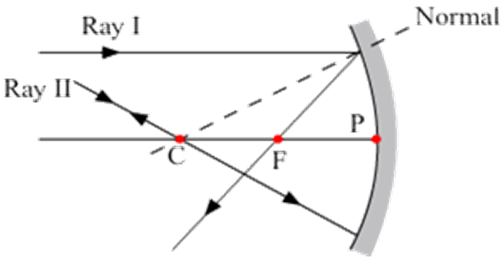
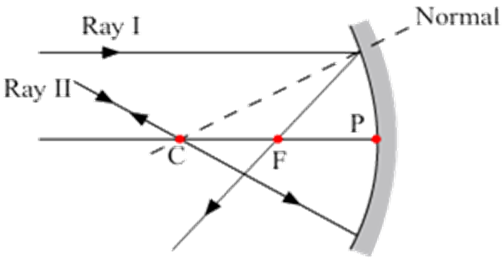
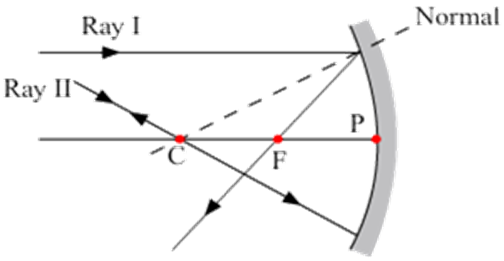
Draw the following diagram, in which a ray of light is incident on a concave/convex mirror, on your answer sheet. Show the path of this ray, after reflection, in each case.
View full question & answer
Question 413 Marks
The two rays chosen for the construction of ray diagram is:

Ray 1: When the incident ray is parallel to the principal axis, the reflected ray will pass through the focus of concave mirror or it appears to pass through the focus of convex mirror.
Ray 2: When the incident ray passes through or appears to pass through the centre of curvature, the light, after reflection from the spherical mirror, reflects back along the same path.
The image formed is real, inverted, magnified and is formed beyond the centre of curvature.
Answer
The candidate may choose any two of the following rays:
  1. A ray parallel to the principal axis, after reflection, will pass through the principal focus of a concave mirror.
  2. A ray passing through the principal focus of a concave mirror after reflection will emerge parallel to the principal axis.
  3. A ray passing through the centre of curvature of a concave mirror after reflection is reflected back along the same path.
  4. A ray incident obliquely to the principal axis towards the pole of a concave mirror is reflected obliquely, making equal angles with the principal axis.
 
View full question & answer
Question 423 Marks
State the laws of refraction of light. If the speed of light in vacuum is  $3 \times 10^{8} \text{ ms}^{-1},$  find the speed of light in a medium of absolute refractive index 1.5.
Answer


Laws of refraction of light:
  1. The incident, the refracted ray and normal at the point of incidence, all lie in the same plane.
  2. The second law of refraction is called snell’s law of refraction. According to snell’s law, “The ratio of sine of angle of incidence to the sine of angle of refraction is a constant for a given pair of mediums”.

$\frac{\sin{\text{i}}}{\sin{\text{r}}} = n$ (constant)

$\frac{\text{Speed of light in vaccum}}{\text{Speed of light in a medium}} = \text{Refractive index of the medium}$

$\Rightarrow \frac{3 \times 10^{8} \text{m/s}}{x} = 1.5$

$\Rightarrow x = \frac{3 \times 10^{8} }{1.5} = 2 \times 10^{8} \text{ m/s}$

$\therefore \text{Speed of light in the medium} = 2 \times10^{8} \text{ m/s}$

View full question & answer
Question 433 Marks
A spherical mirror produces an image of magnification −1 on a screen placed at a distance of 40 cm from the mirror:
  1. Write the type of mirror.
  2. What is the nature of the image formed?
  3. How far is the object located from the mirror?
  4. Draw the ray diagram to show the image formation in this case.
Answer
  1. The mirror is concave.
  2. The image formed is real and inverted and of the same size as that of the object.
  3. In this case, the object is placed at the centre of curvature of the mirror, so the object distance is equal to the image distance. Here, the screen is placed 40 cm from the mirror.

$\therefore$ Image distance = Object distance = 40 cm.

  1.  

View full question & answer
Question 443 Marks
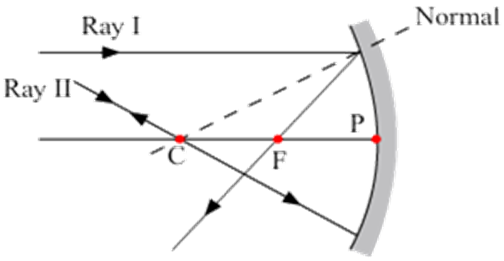
An object 4 cm in height, is placed at 15 cm in front of a concave mirror of focal length 10 cm. At what distance from the mirror should a screen be placed to obtain a sharp image of the object. Calculate the height of the image.
Answer
h1 = + 4cm, f = - 10cm, u = - 15cm, v = ?, h2 = ?

$\frac{1}{\text{f}}=\frac{1}{\text{v}}+\frac{1}{\text{u}}$

$\Rightarrow$ $\frac{1}{\text{v}}=\frac{1}{\text{f}}-\frac{1}{\text{u}}$

$\frac{1}{\text{v}}=\frac{1}{\text{-10cm}}-\frac{1}{\text{-15cm}}$

$\therefore\text{v}=-30\text{cm}$

$\frac{\text{h}_2}{\text{h}_1}=-\frac{\text{v}}{\text{u}}$

$\because\text{h}_2=-\frac{\text{v}}{\text{u}}\times\text{h}_1$

$=-\frac{-30\text{cm}}{-15\text{cm}}\times4\text{cm}$

$=-8\text{cm}$

View full question & answer
Question 453 Marks
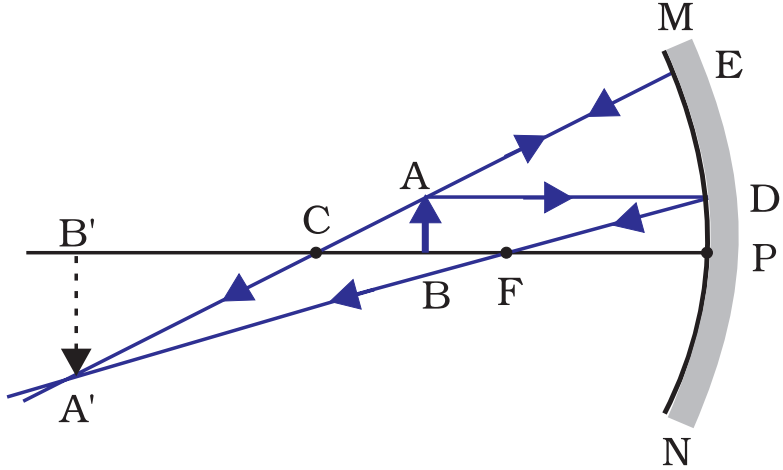
To construct a ray diagram we use two rays of light which are so chosen that it is easy to determine their directions after reflection from the mirror. Choose these two rays and state the path of these rays after reflection from a concave mirror. Use these two rays to find the nature and position of the image of an object placed at a distance of 15cm from a concave mirror of focal length 10cm.
Answer
The two rays chosen for the construction of ray diagram is:

Ray 1: When the incident ray is parallel to the principal axis, the reflected ray will pass through the focus of concave mirror or it appears to pass through the focus of convex mirror.
Ray 2: When the incident ray passes through or appears to pass through the centre of curvature, the light, after reflection from the spherical mirror, reflects back along the same path.
The image formed is real, inverted, magnified and is formed beyond the centre of curvature.

View full question & answer
Question 463 Marks
A spherical mirror produces an image of magnification -1 on a screen placed at a distance of 50cm from the mirror.
  1. Write the type of mirror.
  2. find the distance of the image from the object.
  3. What is the focal length of the mirror?
  4. Draw the ray diagram to show the image formation in this case.
Answer
If magnification,

m = -1

v = 50cm

If the magnification has minus sign, then the image is real and inverted.

$\therefore v = - 50$

$\therefore m = \frac{-v}{u}$

 $\Rightarrow - =1 = \frac{(-50)}{-u}$

$\therefore u = -50 \text{ cm}$

  1. Since image is formed on the screen therefore the mirror formed real image which is formed by concave mirror only.
  2. Image distance = 50cm in front of the mirror.
  3. $\frac{1}{f}=\frac{1}{v}+\frac{1}{u}$

$\Rightarrow \frac{1}{f} = \frac{1}{-50} + \frac{1}{-50}$

$\frac{1}{f} = -\frac{1}{50} - \frac{1}{50}$

$\Rightarrow \frac{-2}{50} = \frac{-1}{25}$

$\therefore f = \text{-25 cm}$

  1.  

View full question & answer
Question 473 Marks
Mention the types of mirrors used as,

  1. Rear view mirrors.
  2. Shaving mirrors.

List two reasons to justify your answers in each case.

Answer
  1. The mirror which is preferred as rear-view mirror in vehicles is the convex mirror because the image obtained with the help of convex mirror is highly diminished in size and thus gives a wider field of view and helps the driver of the vehicle to view the traffic in much larger area behind the vehicle.
  2. The mirror which is used as shaving mirror is concave mirror because the image formed by the concave mirror is large in size and to see the enlarged image of the face, concave mirror is used for the shaving.
View full question & answer
Question 483 Marks
An object of height 6 cm is placed perpendicular to the principal axis of a concave lens of focal length 5 cm. use lens formula to determine the position, size and nature of the image if the distance of the object from the lens is 10 cm.
Answer
We have height of object, $\text{h}_1 = 6 \text{ cm}$, focal length of lens, f = -5 cm and object distance, u = - 10 cm

Using lens formula, we have $\frac{1}{v}-\frac{1}{u}= \frac{1}{f}$

$\Rightarrow\frac{1}{v}-\frac{1}{(-10)}=\frac{1}{(-5)} \Rightarrow\frac{1}{v}+\frac{1}{10}= -\frac{1}{5}\Rightarrow\frac{1}{v}= -\frac{1}{5}-\frac{1}{10}$

$\Rightarrow v= -\frac{10}{3}= -3.33 \text{ cm}$

$\text{Magnification, M} = \frac{v}{u} = -\frac{10}{3}\times\bigg(-\frac{1}{10}\bigg)=\frac{1}{3}$

$\text{Again, Magnification, M} = \frac{v}{u}= \frac{\text{h}_{2}}{\text{h}_{1}} \Rightarrow \frac{\text{h}_{2}}{6}= \frac{1}{3}\Rightarrow \text{h}_{2} = \frac{6}{3} = 2 \text{ cm }$

Thus the image will be formed in front of the lens at a distance of 3.33 cm from the lens, virtual and erect of size 2 cm.

View full question & answer
Question 493 Marks
The image of a candle flame placed at a distance of 45 cm from aspherical lens is formed on screen placed at a distance of 90 cm from the lens. Identify the type of lens and calculate its focal length If the height of the flames 2cm, find the height of its image.
Answer
Convex lens

$\frac{1}{f} = \frac{1}{v}-\frac{1}{u}$

$\frac{1}{f} =\frac{1}{(\text{+ 90)}}-\frac{1}{(\text{- 45)}}$

$ f\text{ =} + 30 \text{ cm}$

Now,

$m= \frac{h'}{h} = \frac{v}{u}$

$m= \frac{h'}{2} = \frac{90}{-45}$

$\therefore h' = - \text{ 4} \text{ cm}$

Height of flame image is -4cm.

View full question & answer
Question 503 Marks
State the type of mirror preferred as,
  1. Rear view mirror in vehicles.
  2. Shaving mirror. Justify your answer giving two reasons in each case.
Answer
  1. The mirror which is preferred as rear-view mirror in vehicles is the convex mirror because the image obtained with the help of convex mirror is highly diminished in size and thus gives a wider field of view and helps the driver of the vehicle to view the traffic in much larger area behind the vehicle.
  2. The mirror which is used as shaving mirror is concave mirror because the image formed by the concave mirror is large in size and to see the enlarged image of the face, concave mirror is used for the shaving.
View full question & answer
Answer the questions.[Phy-3M] - Science STD 10 Questions - Vidyadip