Question
Distinguish between concave and convex lens.

Answer

Convex lens Concave lens
1. A convex lens is thicker in the middle and thinner at its edges. 1. A concave lens is thicker at the edges and thinner in the middle
2. A light beam converges on passing through a convex lens. 2. A light beam diverges on passing through a concave lens.
3. The convex lens produces a real image that is inverted and is smaller and can be obtained on screen. 3. A concave lens always forms a virtuall image, the image is magnified and cannot be obtaiined on screen.

Need a full question paper?

Generate a complete, print-ready paper with questions like this in minutes — across 16+ boards, with answer keys.
Start Generating Free

Similar questions

What happens to the power if the time for doing work is reduced from t second to t/10 second?
(a) Is it possible for a hydrogen ( ${ }^{( H )}$ ) nucleus to emit an alpha particle? Give a reason for your answer.
(b) (i) Define nuclear fission.
(ii) Rewrite and complete the following nuclear reaction by filling in the atomic number of Ba and mass number of Kr :
$\text { 238U }+bn \longrightarrow{ }_{144} Ba+{ }_{36} Kr+3 dn+\text { Energy }$
(c) (i) Why is a nuclear fusion reaction called a thermo nuclear reaction?
(ii) Complete the reaction:
${ }^3 He_2+{ }^2 H_1 \longrightarrow{ }^4 He_2+\ldots \ldots \ldots \ldots \ldots+\text { Energy }$
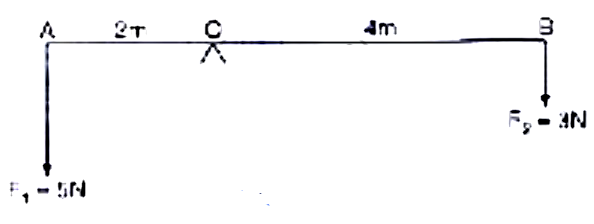
QUESIION The diagram in the figure shows two forces $F 1=5 N$ and $F 2=3 N$ acting at point A and B of a rod pivoted at a point O , such that $O A=2 m$ and $O B=4 m$

Calculate:
1) Moment of force $F_1$​​​​​​​ about $O$
2) Moment of force $F_2​​​​​​​$ about $O$
3) Total moment of the two forces about $O$
A uniform metre rule balances horizontally on a knife edge placed at the 58 cm mark when a weight of 20gf is suspended from one end.
  1. Draw a diagram of the arrangement.
  2. What is the weight of the rule?
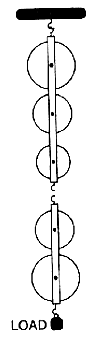
In following figure , draw a tackle to lift the load by applying the force in the downward direction. Mark the position of load and effort.
(a) If the load is raised by 1 m, through what distance will the effort move?
(b) State how many strands of tackle are supporting the load?
(c) What is the mechanical advantage of the system?
A ray of light, after refraction through a concave lens emerges parallel to the principal axis. (a) draw a ray diagram to show the incident ray and its corresponding emergent ray. (b) The incident ray when produces meets the principal axis at a point. Name the point.
A lever of length 9 cm has its load arm 5 cm long and the effort arm is 9 cm long.
Draw diagram of the lever showing the position of fulcrum F and directions of both the load L and effort E.
Draw a diagram to show the wave pattern of high pitch note and a low pitch note, but of the same loudness.
Point out the difference between a convex lens and a concave lens.
Define watt-hour. How many joules are equal to 1 watt-hour?