Question
Distinguish between conduction, convection and radiation.

Answer

S. No
Conduction
Convection
Radiation
1.
It is the transfer of heat by direct physical contact.
It is the transfer of heat by the motion of a fluid.
It is the transfer of heat by electromagnetic waves.
2.
It is due to temperature difference. Heat flows from high temperature region to low temperature region.
It is due to difference in density. Heat flows from low density region to high density region.
It occurs from all bodies at temperatures above 0K.
3.
It occurs in solids through molecular collisions, without actual flow of matter.
It occurs in fluids by actual flow of matter.
It can take place at large distances and does not heat the intervening medium.
4.
It is a slow process.
It is also a slow process.
It propagates at the speed of light.
5.
It does not obey the laws of reflection and refraction.
It obeys the laws of reflection and refraction.

Need a full question paper?

Generate a complete, print-ready paper with questions like this in minutes — across 16+ boards, with answer keys.
Start Generating Free

Similar questions

A man of mass $70kg$ stands on a weighing scale in a lift which is:
  1. Moving upwards with a uniform speed of $10m/ s$.
  2. Moving down with a uniform acceleration of $5m/ s^2$.
  3. Freely falling under gravity.
What would be reading on the scale in each case?
What is the ratio of maxmimum acceleration to the maximum velocity of a simple harmonic oscillator?
Write the dimensions of:
  1. Linear density.
  2. Power.
  3. Impulse.
  4. Velocity gradien.
  5. Mass per unit area.
  6. Kinetic energy.
  7. Angular acceleration.
  8. Couple.
  9. Moment of force.
  10. Work done.
A black body at 2000K emits maximum energy at a wavelength of $1.56\mu\text{m}.$ At what temperature will it emit maximum energy at a wavelength of $1.8\mu\text{m}\ ?$
A monkey of mass 40 kg climbs on a rope which can stand a maximum tension 600 N . In which of the following cases will the rope break?
The monkey
a. climbs up with an acceleration of $6 m / s ^2$
b. climbs down with an acceleration of $4 m / s ^2$
c. climbs up with a uniform speed of $5 m / s$
d. falls down the rope freely under gravity. Take $g=10 m / s ^2$ and ignore the mass of the rope.
The sap in trees, which consists mainly of water in summer, rises in a system of capillaries of radius $\mathrm{r}=2.5 \times 10^{-5} \mathrm{~m}$. The surface tension of sap is $\mathrm{T}=7.28 \times 10^{-2} \mathrm{~N} \mathrm{~m}^{-1}$ and the angle of contact is $0^{\circ}$. Does surface tension alone account for the supply of water to the top of all trees?
Explain why: Two bodies at different temperatures $T_1$ and $T_2$ if brought in thermal contact do not necessarily settle to the mean temperature $(T_1 + T_2 )/2$.
What are the different properties of the material used in heat thermometer?
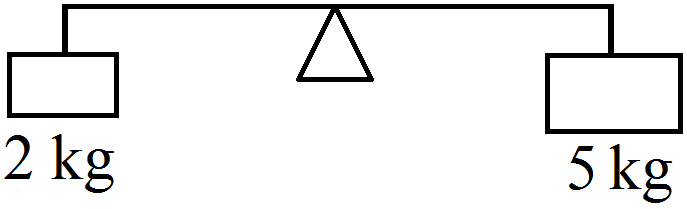
A light rod of length 1m is pivoted at its centre and two masses of 5kg and 2kg are hung from the ends as shown in figure. Find the initial angular acceleration of the rod assuming that it was horizontal in the beginning.
Give a formula for mean free path of the molecules of a gas. Briefly explain, how its value is affected by $(i)$ change in temperature and $(ii)$ change in pressure.