Question
Explain why: Two bodies at different temperatures $T_1$ and $T_2$ if brought in thermal contact do not necessarily settle to the mean temperature $(T_1 + T_2 )/2$.

Answer

When two bodies at different temperatures $T_1$ and $T_2$ are brought in thermal contact, heat flows from the body at the higher temperature to the body at the lower temperature till equilibrium is achieved, i.e., the temperatures of both the bodies become equal. The equilibrium temperature is equal to the mean temperature $(T_1 + T_2)/2$ only when the thermal capacities of both the bodies are equal.

Need a full question paper?

Generate a complete, print-ready paper with questions like this in minutes — across 16+ boards, with answer keys.
Start Generating Free

Similar questions

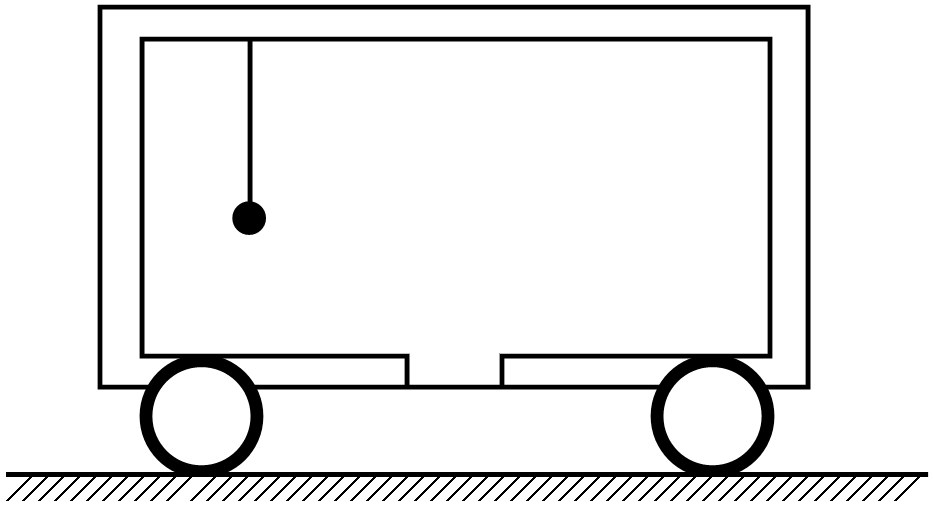
A cart of mass M is at rest on a frictionless horizontal surface and a pendulum bob of mass m hangs from the roof of the cart. The string breaks, the bob falls on the floor, makes several collisions on the floor and finally lands up in a small slot made in the floor. The horizontal distance between the string and the slot is L. Find the displacement of the cart during this process.
A candle flame 1.6cm high is imaged in a ball bearing of diameter 0.4cm. If the ball bearing is 20cm away from the flame, find the location and the height of the image.
Show that there are two values of time for a projectile when it is at same height. Also show that the sum of these two times is equal to the time of flight.OR
Prove the following relations by calculus method:
  1. $\text{s}=\text{ut}+\frac{1}{2}\text{at}^2$
  2. $\text{v}^2-\text{u}^2=2\text{as}$
The potential energy function for a particle executing linear simple harmonic motion is given by $\text{V(x)} = \frac{\text{kx}^2}{2},$ where k is the force constant of the oscillator. For $k = 0.5Nm^{-1}$, the graph of V(x) versus x is shown in Show that a particle of total energy $1J$ moving under this potential must ‘turn back’ when it reaches $\text{x} =\pm 2\text{m}.$
A violin player riding on a slow train plays a $440Hz$ note. Another violin player standing near the track plays the same note. When the two are close by and the train approaches the person on the ground, he hears $4.0$ beats per second. The speed of sound in air $= 340m/s$.
  1. Calculate the speed of the train.
  2. What beat frequency is heard by the player in the train?
Explain the conservation of mechanical energy in the oscillation of a body suspended from a spring.
Explain the difference between beats and interfrence.
An experimenter's diary reads as follows: "A charged particle is projected in a magnetic field of $(7.0\vec{\text{i}}-3.0\vec{\text{j}})\times10^{-3}\text{T}.$ The acceleration of the particle is found to be $(\vec{\text{i}}+7.0\vec{\text{j}})\times10\text{m/s}^{2\text{n}}.$ The number to the left of $\vec{\text{i}}$ in the last expression was not readable. What can this number be?
The ends of a metre stick a.re maintained at $100^{\circ} \mathrm{C}$ and $0^{\circ} \mathrm{C}$. One end of a rod is maintained at $25^{\circ} \mathrm{C}$. Where should its other end be touched on the metre stick so that there is no heat current in the rod in steady state?