Question
Distinguish between: Directional, Stabilizing and Disruptive selection.

Answer

Directional selectionStabilizing selectionDisruptive selection
1. Natural selection operating in a linear direction is called directional selection.1. Natural selection operating to balance or stabilize the population is called stabilizing selection.1. Natural selection which disrupts the mean characteristics of a population is called disruptive selection.
2. In directional selection, more individuals acquire characters other than the mean character value.2. In stabilizing selection, more individuals of a population acquire a mean character value.2. In disruptive selection, more number of individuals acquire extreme or peripheral character value.
3. Directional selection eliminates one of the extremes of the phenotypic range and favour the other.3. Stabilizing selection tends to favour the intermediate forms and eliminate both the phenotypic extremes.3. Disruptive selection favours extreme phenotypes and eliminate intermediate.
4. It streamlines variations.4. It reduces variations.4. It increases variations.
5. This kind of selection is the most common.5. This kind of selection is common.5. This kind of selection is rare.
6. Directional selection operates for many generations, it results in an evolutionary trend within a population and shifting a peak in one direction.E.g. Industrial melanism, DDT resistance in mosquito, etc.6. This selection leads to evolutionary change but tend to maintain phenotypic stability within population.E.g. All the populations which have adapted to their environment.6. It ensures the effect on the entire gene pool of a population, considering all mating types or systems.E.g. African seed cracker finches with different sized beaks

Need a full question paper?

Generate a complete, print-ready paper with questions like this in minutes — across 16+ boards, with answer keys.

Start Generating Free

Similar questions

Read the following and answer any four questions from (i) to (v) given below:
A 23 year old Sahil has been diagnosed with an infection of reproductive tract caused by bacteria. He complains about burning sensation during urination, pus-containing discharge and pain around genitalia. This infection has incubation period of 2-5 days but can be cured.
  1. From which disease is Sahil suffering?
  1. Chlamydiasis.
  2. Herpes.
  3. Gonorrhoea.
  4. Syphilis.
  1. Which among the following reproductive tract infections is transmitted by bacteria?
  1. Trichomoniasis.
  2. Chancroid.
  3. Genital warts.
  4. Both (a) and (b).
  1. Which mode of treatment would be useful for Sahil?
  1. Cryosurgery.
  2. Use of Podophyllum preparation.
  3. Use of antibiotic ampicillin.
  4. It cannot be treated.
  1. What technique was used to diagnose Sahil's disease?
  1. Gram staining of discharge and culture.
  2. ELISA Test.
  3. Antibody detection.
  4. Antigen test.
  1. Find the odd one out.
  1. Treponema pallidum.
  2. Neisseria gonorrhoeae.
  3. Haernophilus ducreyi.
  4. Trichomonas vaginalis.
Column I (Organic Acids]Column II (Microbial source)
(1) Citric acid (a) Rhizopus arrhizus
(2) Fumaric acid(b) Acetobacter aceti
(3) Gluconic acid(c) Aspergillus niger
(4) Acetic acid(d) Aspergillus niger
Read the following and answer any four questions from (i) to (v) given below:
The first menstruation is called menarche, that usually occurs between 12 and 15 years. In human females, menstruation is repeated at an average interval of about 28/29 days and is called menstrual cycle. It is regulated by certain hormones, as pituitary gland is stimulated by releasing factors produced in the hypothalamus. The hormones produced by pituitary gland influence the ovaries. The hormones secreted by the ovaries affect the walls of the uterus.
  1. The breakdown of endometrium is characteristic of:
  1. Proliferative phase.
  2. Luteal phase.
  3. Ovulatory phase.
  4. Menstrual phase.
  1. Which days of the menstrual cycle marks the proliferative phase?
  1. 1-5
  2. 15-28
  3. 6-13
  4. 10-14
  1. Which of the following occurs during secretory phase?
  1. Empty Graafian follicle changes into corpus luteum.
  2. Primary follicle changes into Graafian follicle.
  3. Endometrium rebuilds and estrogen secretion increases.
  4. LH surge, inducing release of an ovum.
  1. Identify the hormones that attain peak level during ovulatory phase.
  1. FSH.
  2. Progesterone.
  3. LH.
  4. Both (a) and (c).
  1. Withdrawal of which hormone causes degeneration of corpus luteum?
  1. FSH.
  2. LH.
  3. Progesterone.
  4. Estrogen.
Read the following and answer any four questions from (i) to (v) given below: Unlike animals, plants cannot runaway for their defence, therefore, they have evolved an astonishing variety of morphological and chemical defences against herbivores. Thorns are the most common morphological means of defence. Many plants produce and store chemicals that make the herbivore sick when they are eaten, inhibit feeding or digestion, disrupt its reproduction or even kill it. Some plants produce highly poisonous chemicals and that is why no cattle or goats browse on those plants. A wide variety of chemical substances that we extract from plants on a conunercial scale are produced by them actually as defence against grazers and browsers.
  1. Why you never see cattle or goats browsing on weed Calotropisl?
  1. It produces highly poisonous tannins.
  2. It produces quinine which is bitter in taste.
  3. It produces poisonous cardiac glycosides.
  4. It bears prickles.
  1. What could be the possible reason for invasive growth of the prickly pear cactus introduced in Australia?
  1. Absence of predators.
  2. New mycorrhizal association.
  3. Abundant water availability.
  4. All of these.
  1. Which of the following is most likely to sick by consuming chemicals produced by plants?
  1. Frog
  2. Goat
  3. Human
  4. Pigeon
  1. Plant evolve variety of morphological and chemical defences against.
  1. Prey
  2. Predator
  3. Commenal
  4. Mutualist
  1. Assertion: Some plant functions as predator in nature.
Reason: Phytoph ago us insects feed on plant sap.
  1. Both assertion and reason are true and reason is the correct explanation of assertion.
  2. Both assertion and reason are true but reason is not the correct explanation of assertion.
  3. Assertion is true but reason is false.
  4. Both assertion and reason are false.
Read the following and answer any four questions from (i) to (v) given below:
Haemophilia is a sex linked disease which is also known as bleeder's disease as the patient will continue to bleed even from a minor cut since he or she does not possess the natural phenomenon of blood clotting due to absence of anti -haemophilic globulin or factor VIII and plasma thromboplastin factor IX essential for it. As a result of continuous bleeding the patient may die of blood loss. Colour blindness is another type of sex linked trait in which the eye fails to distinguish red and green colours. Vision is however, not affected and the colour blind can, lead a normal life, reading, writing and driving (distinguishing traffic lights by their position).
  1. If a haemophilic man marries a woman whose father was haemcphihc and mother was normal then which of the following holds true for their progenies?
  1. Of the total number of daughters, 50% daughters are carrier and $50 \%$ are haemophilic.
  2. All the daughters are haemophilic.
  3. All sons are haemophilic and all daughters are normal.
  4. All sons are normal, all daughters are carriers.
  1. A man whose father was colourblind and mother was normal marries a woman whose father was haemophilic and mother was normal. Which of the following is true for their progenies? [Note: Percentage is from the total number of progenies]
  1. $25 \%$ female progenies carry the gene for both haemophilia and colourblindness.
  2. $25 \%$ male progenies carry only the gene of colourblindness.
  3. $25 \%$ female progenies carry only the gene of colourblindness.
  4. $25 \%$ male progenies and 25% female progenies carry the gene of haemophilia.
  1. Which of the following statements is incorrect regarding haemophilia?
  1. It is a dominant disease.
  2. A single protein involved in clotting of blood is affected.
  3. It is recessive disease.
  4. It is Mendelian disorder.
  1. Anup is having colourblindness and is married to Soni who is normal. What is the chance that their son will have the disease?
  1. $100 \%$
  2. $50 \%$
  3. $25 \%$
  4. $0 \%$
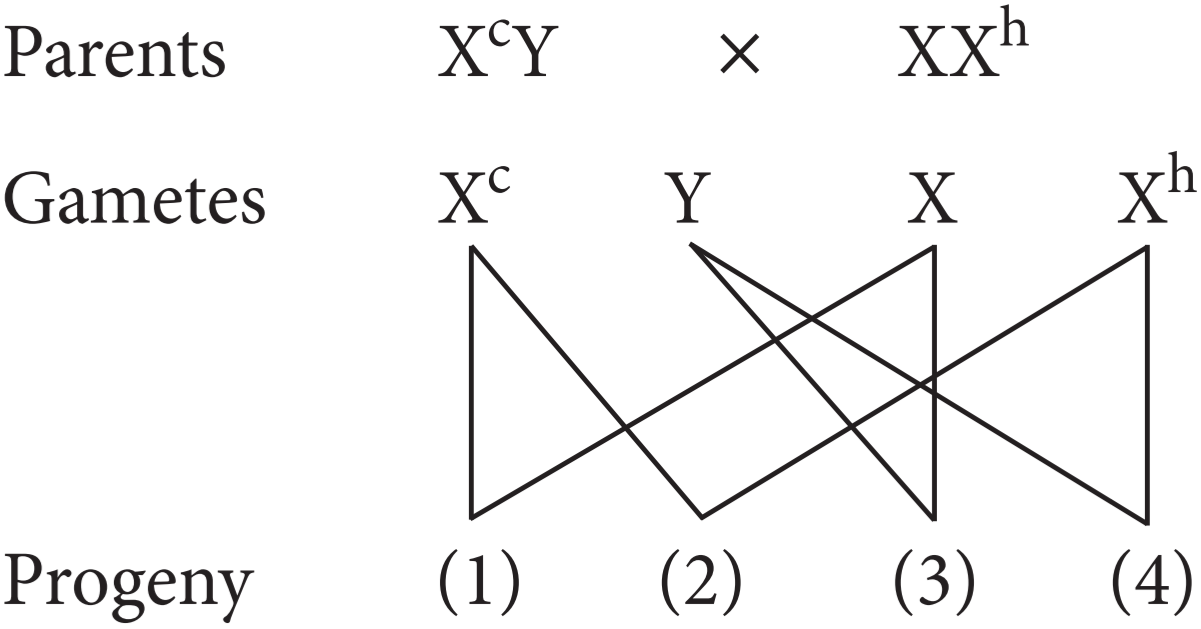
  1. Refer to the given cross?


Select the correct option regarding $1, 2, 3$ and $4$.
  1. The options are as follow:
  1. Colourblind carrier female.
  2. Colourblind haemophilic female.
  3. Normal male.
  4. Haemophilic male
  1. The options are as follow:
  1. Colourblind people
  2. Haemophilic female.
  3. Normal male
  4. Haemophilic male
  1. The options are as follow:
  1. Colourblind female
  2. Colourblind and haemophilic female
  3. Normal male
  4. Normal male.
  1. The options are as follow:
  1. Colourblind carrier female.
  2. Normal female.
  3. Normal male.
  4. Haemophilic male.
Column I (Structure Before seed formation)Column II (Structure After seed formation)
A. Funiculusi. Hilum
B. Scar of Ovuleii. Tegmen
C. Zygoteiii. Testa
D. Inner Integumentiv. Stalk of Seed
 v. Embryo
Distinguish between : FSH and LH
Distinguish between : Cerebrum and cerebellum
Read the following and answer any four questions from (i) to (v) given below:
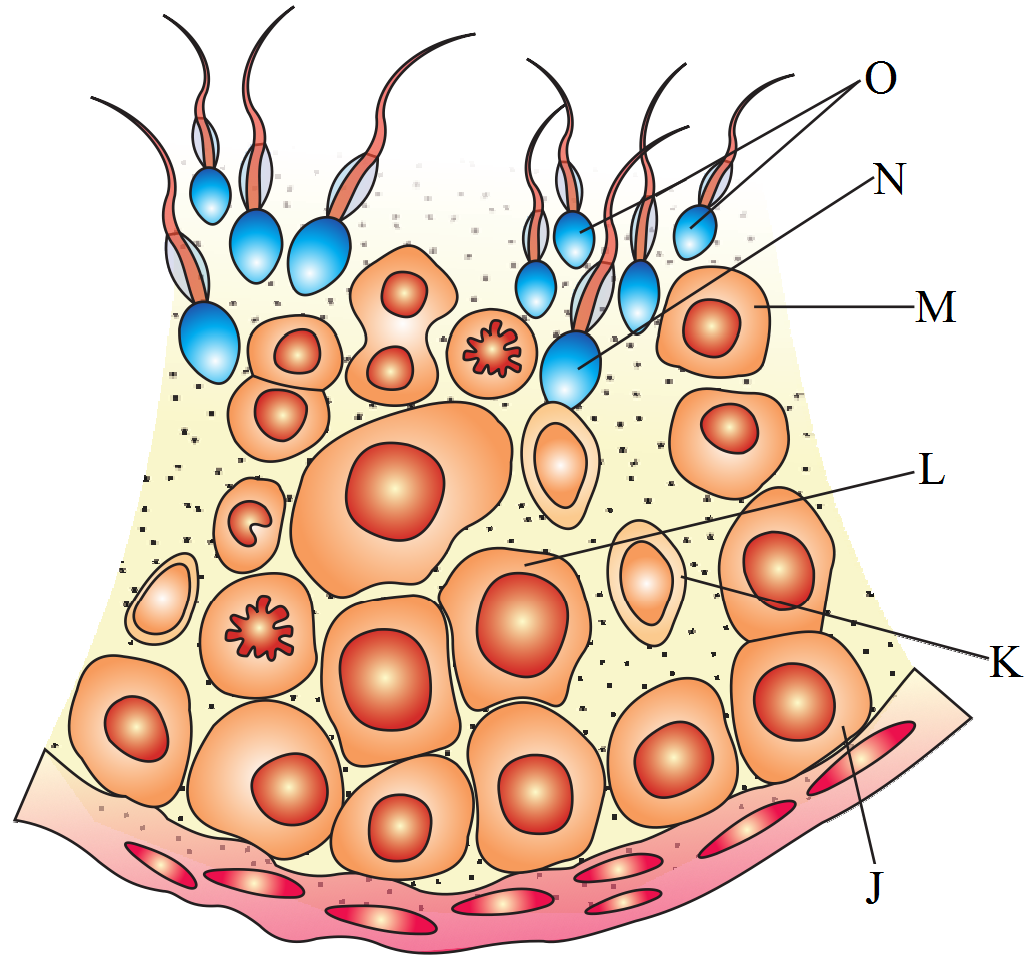
Each testicular globule of testis contains one to three highly coiled seminiferous tubules. Wall of each seminiferous tubule is formed of single layered germinal epithelium. Majority of cells in this epithelium are cuboidal, called male germ cells. Study the transverse section of part of seminiferous tubule and answer the following questions.
  1. What is the characteristic of K?
  1. K is spermatogonium which grows into primary spermatocyte.
  2. K is Sertoli cell which provides nutrition to spermatids.
  3. K is secondary spermatocyte which undergo meiosis II to form spermatid.
  4. K is spermatid being converted into sperm.
  1. Which of the following cell undergo reduction division to form secondary spermatocyte?
  1. J
  2. M
  3. L
  4. K
  1. How many among the following have 46 chromosomes?
  1. 2
  2. 4
  3. 5
  4. 3
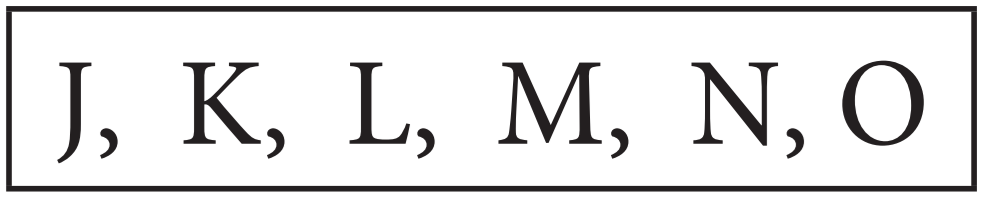
  1. Select an option that correctly identifies different labels.
  1. L- Primary spermatocyte, N - Spermatozoa, M - Secondary spermatocyte.
  2. J - Spermatogonium, K - Sertoli cell, O - Spermatozoa.
  3. L- Primary spermatocyte, M - Secondary spermatocyte, N - Spermatozoa.
  4. J - Spermatogonium, K - Primary spermatocyte, N - Spermatid.
  1. Which hormone initiates spermatogenesis at puberty?
  1. FSH
  2. ICSH
  3. ABP
  4. GnRH
What is meant by chromosomal mutation?