Question
Distinguish between : External respiration and Internal respiration.

Answer

External respiration Internal respiration
$1.$ The respiratory processes occurring in lungs is called external respiration. $1.$ The respiratory processes that occur in tissues is called internal respiration.
$2.$ During external respiration $O_2$ from the lungs enters into the lung capillaries by diffusion. $2.$ During internal respiration $O_2$ from the blood enters the tissue cells.
$3.$ During external respiration $CO_2$ from the lung capillaries diffuse into the lungs. $3.$ During internal respiration $CO_2$ from the tissues enters into the blood.
$4.$ During external respiration exchange of gases takes place between the air and the lungs. $4.$ During internal respiration exchange of gases take place between the blood and the tissue.
$5.$ Formation of oxyhaemoglobin takes place during external respiration. $5.$ Oxyhaemoglobin dissociates into oxygen and haemoglobin during internal respiration.
$6.$ During external respiration $CO_2$ is released. $6.$ During internal respiration carbamino haemoglobin is formed which is carried to the lungs.

Need a full question paper?

Generate a complete, print-ready paper with questions like this in minutes — across 16+ boards, with answer keys.
Start Generating Free

Similar questions

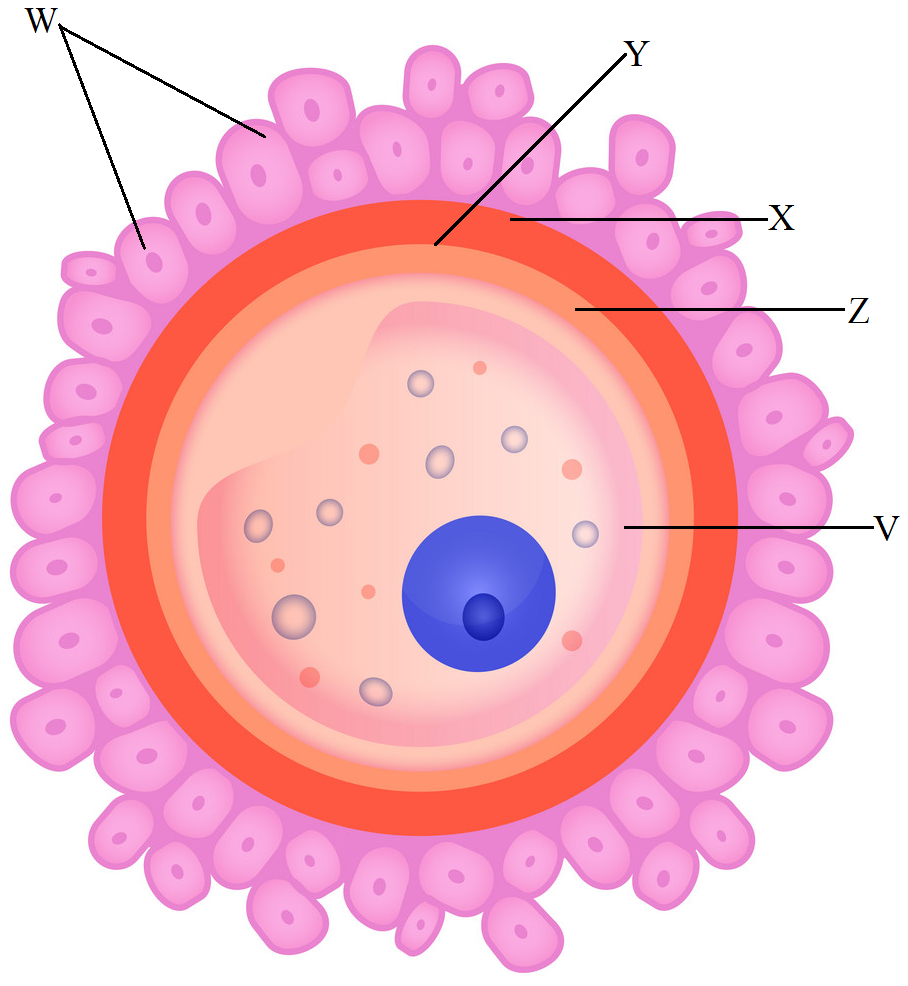
Read the following and answer any four questions from (i) to (v) given below: The mature ovum or a female gamete is spherical in shape. The human ovum is almost free of yolk and is said to be alecithal. Human ovum loses its ability to be fertilised about 24 hours after ovulation. Refer to the given structure of ovum and answer the following questions.
  1. Thick cellular layer formed of radially elongated follicular cells is:
  1. Zona pellucida.
  2. Plasma membrane.
  3. Perivitelline membrane.
  4. Corona radiata.
  1. In humans, at which stage does ovum get released from ovary?
  1. Secondary oocyte.
  2. Oogonium.
  3. Primary oocyte.
  4. First polar body.
  1. Cytoplasm of an ovum is enveloped by _____.
  1. Zona pellucida.
  2. Corona radiata.
  3. Cell membrane.
  4. Perivitelline space.
  1. Select the correct option:
S. No
V
W
X
(a)
Cytoplasm
Zona pellucida
Plasma membrane
(b)
Cortical granules
Corona radiata
Zona pellucida
(c)
Cortical granules
Plasma membrane
Corona radiata
(d)
Cytoplasm
Corona radiata
Zona pellucida
  1. Which of the following is not a characteristic of an ovum?
  1. Nucleus of an ovum has prominent nucleolus.
  2. Only one ovum formed from one oogonium.
  3. It lacks centrioles.
  4. It has very small amount of ooplasm.
Read the following and answer any four questions from (i) to (v) given below:
Translation is the process of polymerisation of amino acids to form a polypeptide. The order and sequence of amino acids are defined by the sequence bases in the mRNA. The amino acids are joined by a bond called peptide bond. Ribosome is the site of protein synthesis.
  1. Which ion is essential for association of both units of ribosome at the time of protein formation?
  1. $Mg^{2+}$
  2. $Mn^{2+}$
  3. $CI^-$
  4. $Ca^{2+}​​​​​​​$​​​​​​​
  1. During translation, how many initiation factors are required in eukaryotes for initiation reactions?
  1. 3
  2. 6
  3. 7
  4. 9
  1. Which part of mRNA contains untranslated regions (UTR)?
  1. 3' end
  2. 5' end
  3. Either 3' or 5' end
  4. Both 5' end and 3' end
  1. Name the enzyme that helps in combining amino acid to its particular tRNA?
  1. Activating enzyme
  2. Amino-acyl tRNA-synthetas
  3. PeptidyI transferase
  4. Both (a) and (b)
  1. From the given list, select the translation machinery.
  1. mRNA
  2. Ribosomes
  3. Amino acids
  4. tRNAs
  5. Peptidyl transferase
  6. Amino acyl tRNA synthetase
  7. Pyrophosphatase
  1. (1), (2), (3), (4) and (6)
  2. (1), (2), (3), (4) and (5)
  3. (1), (2), (3), (4), (5) and (6)
  4. (1), (2), (3), (4), (5), (6) and (7)
Distinguish between: Asexual reproduction and Sexual reproduction.
Distinguish between : Glucocorticoids and mineralcorticoids
Restriction enzymeRecognition sequence
(1) Alu I(a) 5′ G-A-A-T-T-C 3′ 3′ C-T-T-A-A-G 5’
(2) Bam HI(b) 5′ G-T-C-G-A-C3′ 3′ C-A-G-C-T-G 5′
(3) Eco RI (c) 5′ A-G-C-T 3′ 3′ T-C-G-A5′
(4) Hind II(d) 5′ G-G-A-T-T-C 3′ 3′ C-C-T-A-A-G 5′
Read the following and answer any four questions from (i) to (v) given below:
Cleavage is the series of rapid mitotic divisions in zygote and forms blastula. The 2, 4, 8, 16 daughter cells are called blastomeres. Embryo with 64 blastomeres is known as blastocyst and has blastocoel cavity. Blastocyst gets implanted in uterine wall and leads to pregnancy.
  1. Solid mass of cells with 16 blastomeres is called:
  1. Morula.
  2. Blastula.
  3. Gastrula.
  4. Zygote.
  1. At which stage of embryonic development, trophoectoderm develops?
  1. Zygote.
  2. Morula.
  3. Blastula.
  4. Gastrula.
  1. Site of implantation is:
  1. Endometrium of uterus.
  2. Cervix.
  3. Uterine fundus.
  4. Infundibulum of oviduct.
  1. Correct sequence of various structures formed during embryonic development is:
  1. Morula → Embryo → Gastrula → Blastula.
  2. Zygote → Embryo → Morula → Blastula.
  3. Blastula → Morula → Gastrula → Embryo.
  4. Zygote → Morula → Blastula → Gastrula.
  1. Assertion: Side of blastocyst with inner cell mass is called animal pole.
Reason: Inner cell mass gives rise to embryo.
  1. Both assertion and reason are true, and reason is the correct explanation of assertion.
  2. Both assertion and reason are true, but reason is not the correct explanation of assertion.
  3. Assertion is true, but reason is false.
  4. Both assertion and reason are false.
Read the following and answer any four questions from (i) to (v) given below:
During copulation, semen is released by the penis into the vagina. 'The motile sperms swim rapidly, fuse with ovum in the ampullary region, resulting in fertilisation. Haploid nucleus of sperm fuse with that of ovum to form diploid zygote.
  1. In female genital tract, sperms are made capable of fertilising the egg. This phenomenon of sperm activation is called:
  1. Amphimixis.
  2. Cortical reaction.
  3. Capacitation.
  4. Acrosomal reaction.
  1. Select the correct sequence of various physical and chemical events that take place during fertilisation.
  1. Fusion of cortical granules with plasma membrane of secondary oocyte.
  2. Formation of fertilisation cone to receive sperm.
  3. Release of sperm lysin from acrosome.
  4. Mixing up of chromosomes of a sperm and an ovum.
  1. R → Q → P → S
  2. Q → S → R → P
  3. Q → R → S → P
  4. R → P → Q → S
  1. Assertion: Only one sperm can fertilise an ovum.
Reason: The secretion of acrosome help the sperm to enter into cytoplasm of ovum through zona pellucida and plasma membrane.
  1. Both assertion and reason are true, and reason is the correct explanation of assertion.
  2. Both assertion and reason are true, but reason is not the correct explanation of assertion.
  3. Assertion is true, but reason is false.
  4. Both assertion and reason are false
  1. What is the significance of fertilisation?
  1. It restores haploid number of chromosomes.
  2. It produces offspring genetically identical to parents.
  3. It initiates cleavage.
  4. Both (b) and (c).
  1. Site of fertilisation in humans is:
  1. Endometrium of uterine cavity.
  2. Ampullary isthmic junction of oviduct.
  3. Cervix of uterus.
  4. Infundibulum of fallopian tube.
Read the following and answer any four questions from (i) to (v) given below:
Wetlands are called Ramsar sites because the first international convention on their conservation was held in Ramsar in Iran in 1971. Wetlands or Ramsar sites are low lying marshy areas which get filled up during rains due to runoff and overflow from other water bodies. They are often considered to be waste lands which are used as dumping areas and filled up to recover land for various constructions activities. As a result, a large number of wetlands have disappeared.
  1. Select the incorrect match of wetland and its location.
 
Wetland
Location
(a)
Harike
Punjab
(b)
Chandra Tai
H.P.
(c)
Bhoj
M.P.
(d)
Ashtamudi
Odisha
  1. Migratory bird flamingo breeds in which of the following wetlands?
  1. Bhitarkanika Mangroves.
  2. Rann of Kutch.
  3. Harike.
  4. Chandra Tal.
  1. Which of the following is not an importance of wetlands?
  1. They are an important source of recharging groundwater.
  2. They provide protection from floods.
  3. They are good source of siltation and purification of water.
  4. None of these.
  1. Which of the following wetland ecosystem is highly acidic and has a accumulation of decomposed plants known as peat?
  1. Bog
  2. Mangrove
  3. Estuary
  4. Watershed
  1. The mangroves of Bhitarkanika are famous for:
  1. Rare migratory waterbirds.
  2. Nesting sites for endangered olive ridley turtles.
  3. Prawn cultivation.
  4. All of these.
Distinguish between : Adenohypophysis and neurohypophysis.
Active absorption and Passive absorption.