Question
Distinguish between: Gene flow and Genetic drift.

Answer

Gene flowGenetic drift
1. Gene flow is the alteration in the gene frequency due to migrations.1. Genetic drift is alteration in the gene frequency by pure chance.
2. Gene flow occurs due to exchange of genes in the adjacent populations through interbreeding.2. Genetic drift occurs due to accidental and sudden elimination of a particular gene.
3. Larger populations tend to show more migrations and hence more gene flow.3. Smaller populations have greater chances of genetic drift.
4. Gene flow occurs due to emigration and immigration.4. Genetic drift occurs only within the specified population.

Need a full question paper?

Generate a complete, print-ready paper with questions like this in minutes — across 16+ boards, with answer keys.
Start Generating Free

Similar questions

Read the following and answer any four questions from (i) to (v) given below:
Green manuring is the fanning practice where a leguminous plant which has derived enough benefits from its association with appropriate species of Rhizobium, is ploughed into the field soil and then a non-legume is sown and allowed to get benefitted from the already present nitrogen fixer. Some legumes, such as, Crotolaria juncea, Sesbania rostrata, Lencaena leucocephala, etc. are used as green manure. Rhizobia, that fix atmospheric nitrogen in the form of nitrate, live in the roots ofleguminous plants. These nutrients are used by non-leguminous plants through the practice of green manuring.
  1. Green manures mainly provide nutrient enriched in:
  1. Magnesium.
  2. Sulphur.
  3. Nitrogen.
  4. Both (a) and (b).
  1. Which of the following plants is used as green manure in crop fields?
  1. Saccharum.
  2. Dichanthium.
  3. Phyllonthus.
  4. Crotolaria.
  1. Green manure plants belong to the Family:
  1. Lamiaceae.
  2. Papilionaceae.
  3. Liliaceae.
  4. Poaceae.
  1. Due to excess use of chemical fertilisers rich in nitrate, ________ disease occurred in children.
  1. Jaundice.
  2. Septicemia.
  3. Methemoglobinemia.
  4. Botulism.
  1. A green manure is:
  1. Rice.
  2. Maize.
  3. Sorghum.
  4. Sesbania.
Distinguish between: Homologous organs and Analogous organs.
A regulatory body working under MoEF for the release of transgenic crop is ____________:
  1. NBPGR
  2. NSC
  3. NIPGR
  4. GEAC
Read the following and answer any four questions from (i) to (v) given below:
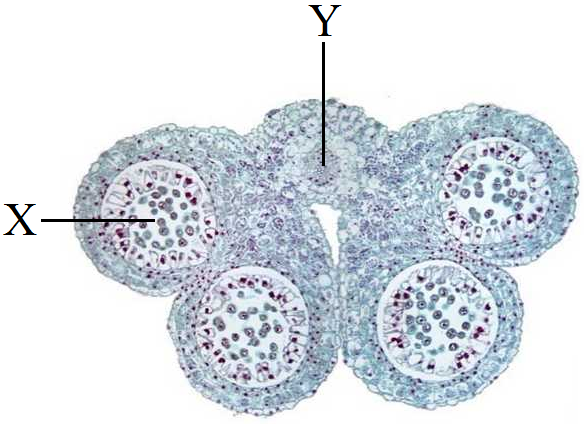
Many adaptations are found in flowers to achieve certain kind of pollination. The pollination achieved by insects is known as entomophily. The given diagram shows the cross-section of an anther of an insect pollinated flower.
  1. Which of the following is/ are the function(s) of structure Y?
  1. To carry waste products away from the anther.
  2. To supply oxygen to the cells of the anther.
  3. To transport food and mineral salts to the anther.
  4. To supply water to the anther.
  1. Conly.
  2. C and D only.
  3. A, B and D only.
  4. A, B, C and D.
  1. Which of the following most accurately describes the structures found in compartment X?
  1. They contain two haploid nuclei resulting from meiosis.
  2. They contain two haploid nuclei resulting from mitosis.
  3. They contain two haploid male gametes, resulting from mitosis.
  4. They contain a vegetative nucleus and pollen tube nucleus.
  1. Which of the following is a distinctive characteristic of insect-pollinated flower?
  1. All of them have nectar guides on their flowers.
  2. They produce sugary fruit.
  3. Their pollen grains tend to have rough surfaces.
  4. They produce abundant quantities of pollen to make up for pollen grains that might be removed by the wind.
  1. Which of the following are likely characteristics of the structures found in X and stamens of this plant?
S. No
Structure of X
Stamens
(a)
Abundant and light
Pendulous
(b)
Rough surfaces
Non-pendulous
(c)
Light and sticky
Pendulous
(d)
Coarse and sticky
Protrude outside the flower
  1. Spiny or sticky pollen grains and large, attractively coloured flowers are associated with:
  1. Hydrophily.
  2. Entomophily.
  3. Ornithophily.
  4. Anemophily.
Distinguish between: Morula and Blastula.
Image
Distinguish Between: Incomplete dominance and Co$-$dominance.
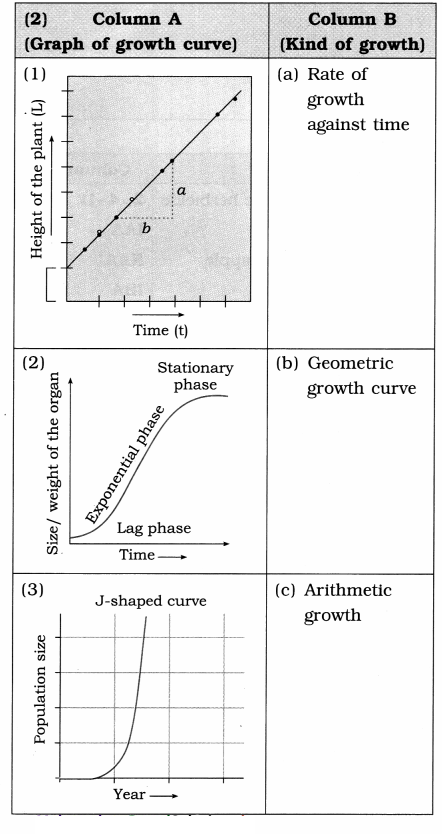
Column AColumn B (Symptoms observed)
(1) Deficiency of Cu(a) Malformed leaves
(2) Deficiency of Bo(b) Leaves with yellow edges
(3) Deficiency of Zn(c) Brown heart disease
(4) Deficiency of K(d) Die back of shoot
Column A (Artificial Vegetative Propagation)Column B (Examples)
(1) Leaf cutting(a) Blackberry
(2) Stem cutting(b) Apple
(3) Grafting(c) Bougainvillea
(4) Root cutting(d) Sansevieria
Read the following and answer any four questions from (i) to (v) given below:
Haemophilia is a sex linked disease which is also known as bleeder's disease as the patient will continue to bleed even from a minor cut since he or she does not possess the natural phenomenon of blood clotting due to absence of anti -haemophilic globulin or factor VIII and plasma thromboplastin factor IX essential for it. As a result of continuous bleeding the patient may die of blood loss. Colour blindness is another type of sex linked trait in which the eye fails to distinguish red and green colours. Vision is however, not affected and the colour blind can, lead a normal life, reading, writing and driving (distinguishing traffic lights by their position).
  1. If a haemophilic man marries a woman whose father was haemcphihc and mother was normal then which of the following holds true for their progenies?
  1. Of the total number of daughters, 50% daughters are carrier and $50 \%$ are haemophilic.
  2. All the daughters are haemophilic.
  3. All sons are haemophilic and all daughters are normal.
  4. All sons are normal, all daughters are carriers.
  1. A man whose father was colourblind and mother was normal marries a woman whose father was haemophilic and mother was normal. Which of the following is true for their progenies? [Note: Percentage is from the total number of progenies]
  1. $25 \%$ female progenies carry the gene for both haemophilia and colourblindness.
  2. $25 \%$ male progenies carry only the gene of colourblindness.
  3. $25 \%$ female progenies carry only the gene of colourblindness.
  4. $25 \%$ male progenies and 25% female progenies carry the gene of haemophilia.
  1. Which of the following statements is incorrect regarding haemophilia?
  1. It is a dominant disease.
  2. A single protein involved in clotting of blood is affected.
  3. It is recessive disease.
  4. It is Mendelian disorder.
  1. Anup is having colourblindness and is married to Soni who is normal. What is the chance that their son will have the disease?
  1. $100 \%$
  2. $50 \%$
  3. $25 \%$
  4. $0 \%$
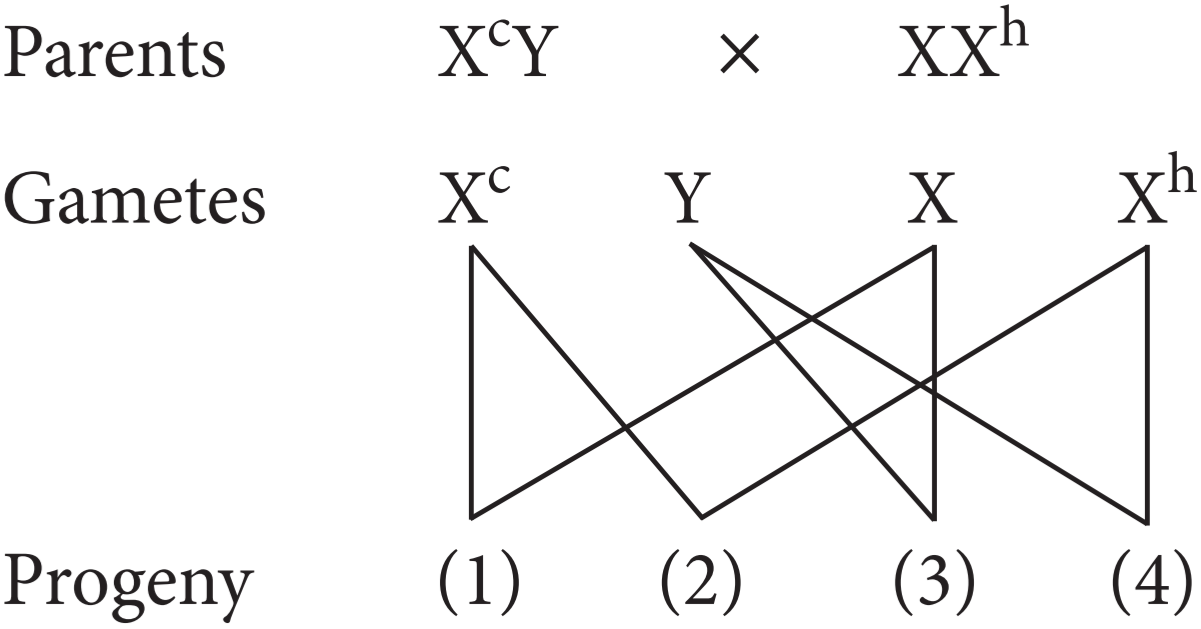
  1. Refer to the given cross?


Select the correct option regarding $1, 2, 3$ and $4$.
  1. The options are as follow:
  1. Colourblind carrier female.
  2. Colourblind haemophilic female.
  3. Normal male.
  4. Haemophilic male
  1. The options are as follow:
  1. Colourblind people
  2. Haemophilic female.
  3. Normal male
  4. Haemophilic male
  1. The options are as follow:
  1. Colourblind female
  2. Colourblind and haemophilic female
  3. Normal male
  4. Normal male.
  1. The options are as follow:
  1. Colourblind carrier female.
  2. Normal female.
  3. Normal male.
  4. Haemophilic male.