Question
Distinguish Between: Incomplete dominance and Co$-$dominance.

Answer

Incomplete dominance Co-dominance
$1.$ Incomplete dominance is seen when the phenotypes of the two parents blend together to create a new phenotype for their offspring. $1.$ Co$-$dominance is seen when the two parent phenotypes are expressed together in the offspring.
$2.$ Both the genes of an allelomorphic pair express themselves partially in $F_1$ hybrids. $2.$ Both the genes of an allelomorphic pair express themselves equally in $F_1$ hybrids.
$3.$ In incomplete dominance, a mixture of the alleles in the genotype is seen in the phenotype. $3.$ In co$-$dominance, both alleles in the genotype are seen in the phenotype.
$4.$ The phenotypic effect of one allele is more prominent than the other. $4.$ The phenotypic effect of both the alleles is equally prominent.
$5.$ Blending or intermixing of two alleles can be observed. A white flower and a red flower alleles mix and produce pink flowers.Example : Pink flowers in Mirabilis jalapa. $5.$ No intermixing or blending effect of two alleles is observed. The colours don’t mix but are seen in patches.Example : Roan colour in cattle.

Need a full question paper?

Generate a complete, print-ready paper with questions like this in minutes — across 16+ boards, with answer keys.

Start Generating Free

Similar questions

Read the following and answer any four questions from (i) to (v) given below:
A woman unable to conceive after many years of regular unprotected coitus went to specialised infertility clinic. On complete examination, woman was found to be normal, while male partner was diagnosed with infertility. Male partner is unable to copulate the female. Couple was advised to opt for assisted reproductive technology (ART).
  1. Which ART could have been useful for this couple?
  1. ZIFT
  2. IUT
  3. AI
  4. GIFT
  1. In which of the following infertility issues could this technique be used?
  1. Anovulation.
  2. Oligospermia.
  3. Low fructose content in seminal fluid.
  4. All of these.
  1. Which among the following techniques is useful to conceive when there is very low sperm count?
  1. GIFT
  2. Test-tube baby
  3. IUT
  4. JCSI
  1. Assertion: Artificial insemination (AI) is intra-uterine insemination.
Reason: In Al, sperms collected from donor are introduced into the uterus.
  1. Both assertion and reason are true, and reason is the correct explanation of assertion.
  2. Both assertion and reason are true, but reason is not the correct explanation of assertion.
  3. Assertion is true, but reason is false.
  4. Both assertion and reason are false
  1. Success rate of artificial insemination technique is:
  1. 20-40%
  2. 60-70%
  3. 40-50%
  4. 5-7%
Read the following and answer any four questions from (i) to (v) given below:
Ananya is a biologist, her research guide assigned project, i.e., to determine the effect ofin tra-specific competition on the growth of sapling of Eucalyptus. For this, she designed an experiment in which two sets of pots were used. ln the first set (set A) only I sapling was planted per pot and in the other set (set B) $16$ saplings were planted per pot. To check for the effect of intra-specific competition on allocation of resources, a decreasing amount of water was added to each set. The results have been graphically indicated. Which of the following conclusions can indicated as follows:
  1. Which of the following statements can be concluded from the given study?
  1. More resources are allocated to the root during low water conditions.
  2. Competition for water among individuals of a population causes more root growth as compared to individuals who are growing alone.
  3. Lesser leaves are formed under low water conditions.
  4. Root growth is higher in individual grown singly as compared to individuals in populations.
  1. Which of the following associations is an example of competitions?
  1. Cuscuta and hedge plant.
  2. Balanus and Cathamalus.
  3. Cactus and moth.
  4. Orchid and mango.
  1. If '+' sign is assigned to beneficial interaction, '-' sign to detrimental and O sign to neutral interaction, then the population interaction of competition refers to:
  1. +, +
  2. -, -
  3. +, -
  4. +, 0
  1. lntraspecific competition is more severe due to:
  1. similar needs.
  2. similar adaptations.
  3. common resources.
  4. all of these.
  1. Assertion: Two members of a competing species may co-exist.
Reason: Different individuals of a species have different resource requirements.
  1. Both assertion and reason are true and reason is the correct explanation of assertion.
  2. Both assertion and reason are true but reason is not the correct explanation of assertion.
  3. Assertion is true but reason is false.
  4. Both assertion and reason are false.
Column AColumn B (New Terminology)
(1) D.P.D.(a) Osmotic potential
(2) O.E(b) Pressure potential
(3) T.P(c) Water potential
Read the following and answer any four questions from (i) to (v) given below:
The endosperm makes the main source of food for the embryo. Generally the endosperm nucleus divides after the division of the oospore, but in several cases the endosperm is formed to a great extent even before the first division of the oospore. There are three general types of endosperm formation: (a) nuclear type, (b) cellular type and (c) helobial type. The endosperm is usually triploid, but haploid endosperm is also found. Endosperm may either be completely consumed by the developing embryo before seed maturation, or it may persist in the mature seed.
  1. Haploid endosperm is found in:
  1. Pin us.
  2. Cauliflower.
  3. Sunflower.
  4. Pea.
  1. Persistent endosperm is found in:
P. Pea Q. Castor R. Bean S. Coconut T. Groundnut.
  1. Q and S.
  2. P and T.
  3. R, S and T.
  4. P, S and T.
  1. Milk of tender coconut represents (A) and the surrounding white coconut meal represents (B).
S. No
A
B
(a)
Cellular endosperm
Free- nuclear endosperm
(b)
Free-nuclear endosperm
Cellular endosperm
(c)
Helobial endosperm
Cellular endosperm
(d)
Free-nuclear endosperm
Helobial endosperm
  1. If an endosperm cell of a gymnosperm contains 12 chromosomes, the number of chromosomes in each cell of the root will be:
  1. 4
  2. 24
  3. 16
  4. 6
  1. In angiosperms, normally after fertilization:
  1. The zygote divides earlier than the primary endosperm nucleus.
  2. The primary endosperm nucleus divides earlier than the zygote.
  3. Both the zygote and primary endosperm nucleus divide simultaneously.
  4. Both the zygote and primary endosperm nucleus undergo a resting period.
Distinguish between : Systolic blood circulation and Diastolic blood circulation.
Read the following and answer any four questions from (i) to (v) given below:
ln a plant species that follows Mendelian inheritance yellow flower colour is dominant over white and round fruits shape is dominant over elongated. Crossing was performed between two purelines-one having yellow-flower and round fruit and another with white flower and elongated fruits. About 20 plants survived in $F_1$ progeny. Plants of $F_1$ were allowed to self fertilise and about 960 plants survived in $F_2$
  1. How many plants would have yellow flower and round fruit in $F_1$ generation?
  1. 20
  2. 10
  3. 5
  4. 0
  1. How many plants would have yellow flower and round fruit in $F_2$​​​​​​​ generation?
  1. 960
  2. 540
  3. 180
  4. 60
  1. Which of the following is correct for the condition when plant heterozygous for yellow flower and round fruit is back crossed with the double recessive parent?
  1. 9 : 3 : 3 : 1 ratio of phenotype only.
  2. 9 : 3 : 3 : 1 ratio of genotype only.
  3. 1 : 1 : 1 : 1 ratio of phenotype only.
  4. 1 : 1 : 1 : 1 ratio of phenotype and genotype.
  1. When the plant heterozygous for yellow flower and round fruit are self crossed, then the plant with yellow flower and elongated fruit will be represented by the genotype?
  1. YyRr, YyRR, YYRr
  2. Yyrr, YYrr, yyrr
  3. yyRr, yyRR
  4. Yyrr, YYrr
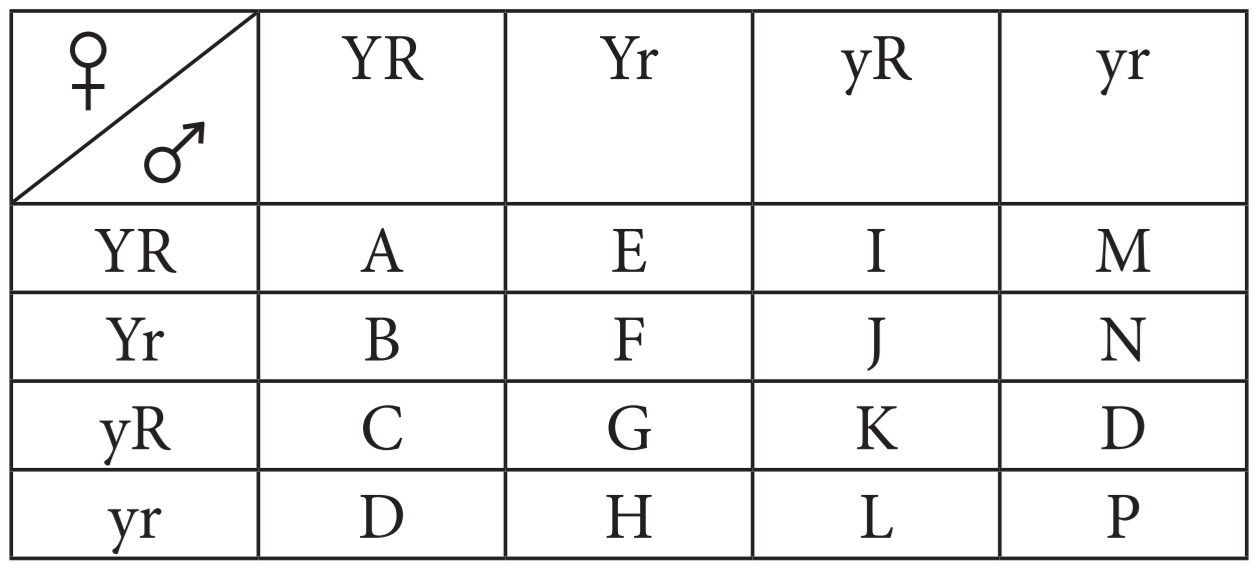
  1. 'Tile given Punnett's square represents the pattern of inheritance in a dihybrid cross where yellow flower and round fruit (R) condition is dominant over white flower (y) and elongated fruit (r) condition.


Plant 'C' will produce fruits with the genotype identical to fruits produced by the plant of
  1. type H
  2. type E
  3. type K
  4. type 1
Distinguish between: Morula and Blastula.
Disease Vector species
(a) Dengue(i) Anopheles
(b) Malaria(ii) Housefly
(c) Filaria(iii) Culex
(d) Typhoid(iv) Aedes
Read the following and answer any four questions from (i) to (v) given below:
A typical angiospermic ovule is a small structure attached to the placenta by means of a stalk called funicle. The body of the ovule fuses with funicle in the region called hilum. Each ovule has one or two protective envelopes called integuments. Integuments encircle the nucellus except at the tip where a small opening called the micropyle is formed. Mature ovules are classified on the basis of funiculus. It can be orthotropous, anadromous, hernitropous, campylotropous, etc.
  1. The body of the ovule consists of a mass of parenchymatous cells called:
  1. Integuments.
  2. Nucellus.
  3. Hilum.
  4. Funiculus.
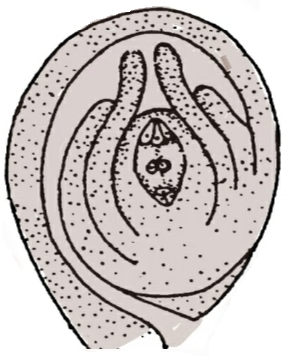
  1. Refer to the given figure and select the correct statement regarding it.
  1. This type of ovule is found in cactus.
  2. The micropyle comes to lie close to the funiculus due to unilateral growth of ovule.
  3. It is most common type of ovule found in the members of Chenopodiaceae.
  4. It is half inverted ovule.
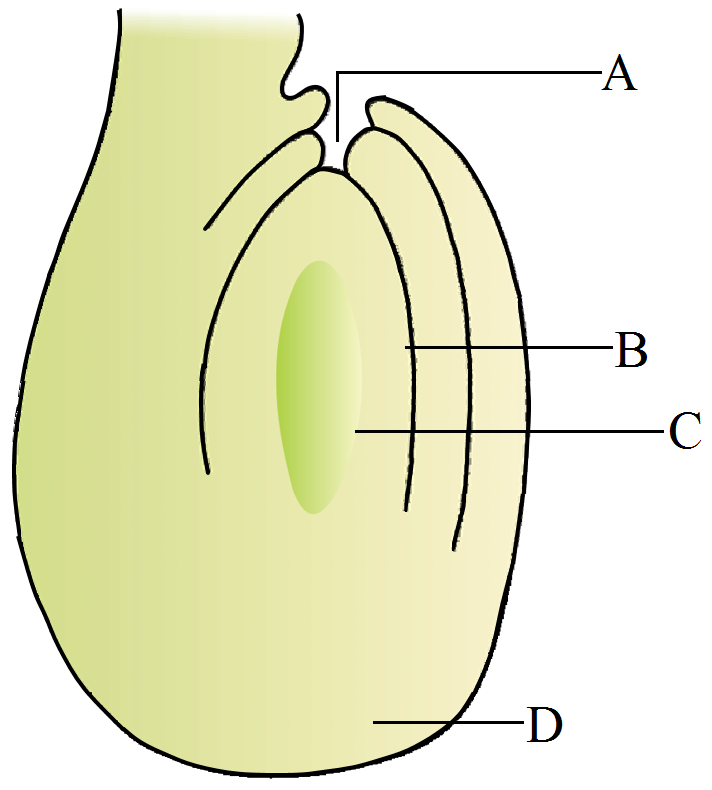
  1. Identify the parts labelled as A, B, C and D in the given figure and select the correct option.
S. No A B C D
(a) Chalaza Female gametophyte Embryo sac Micropyle
(b) Chalaza NuceIIus Embryo sac Micropyle
(c) Micropyle Egg Embryo sac Chalaza
(d) Micropyle Nucellus Embryo sac Chalaza
  1. Mature ovules are classified on the basis of funiculus. If micropyle lie close to the funiculus, the ovule is termed as:
  1. Orthotropous.
  2. Anatropous.
  3. Hemitropous.
  4. Campylotropous.
  1. In Asphodel us, ovule is:
  1. Unitegmic.
  2. Tritegmic.
  3. Bitegmic.
  4. Ategmic.
Column A (Scientist)Column B (Theory)
(1) Dixon and Joly(a) Starch-sugar inter conversion
(2) Steward(b) Osmotic absorption theory
(3) Atkins and Pristley(c) Non-osmotic absorption theory
(4) Kramer and Thimann(d) Cohesion tension theory