Distinguish between longitudinal and transverse waves.
Download our app for free and get started
Longitudinal wave: A wave in which the particles of the medium vibrate back and forth in the ‘same direction’, in which the wave is moving, is called a longitudinal wave.
These waves can be produced in all the three media: solids, liquids and gases.
Transverse wave: A wave in which the particles of the medium vibrate up and down, ‘at right angles’ to the direction in which the wave is moving, is called a transverse wave.
It can be produced in solids and liquids but not in gases.
These waves can be produced in all the three media: solids, liquids and gases.
Transverse wave: A wave in which the particles of the medium vibrate up and down, ‘at right angles’ to the direction in which the wave is moving, is called a transverse wave.
It can be produced in solids and liquids but not in gases.

Download our appand get started for free
Experience the future of education. Simply download our apps or reach out to us for more information. Let's shape the future of learning together!No signup needed.*
Similar Questions
- 1Three different vibrating objects produce three types of sounds $X$, $Y$ and $Z$. Sounds $X$ and $Y$ cannot be heard by a man having normal range of hearing but sound $Z$ can be heard easily. The sound $X$ is used in hospitals to break kidney stones of a patient into fine grains whioch then get flushed out with urine. The sound $Y$ is similar to that which is produced during an earthquake before the main shock wave is generated.View Solution
- What t$Y$pe of sounds are $(i) X, (ii) Y$, and $(iii) Z$?
- Name one device which can produce sound like $X$.
- Name one device in a science laboratory which can produce sound like $Y$.
- Name one device in our homes which can produce sound like $Z$.
- What is the frequency range of sounds like $Z$?
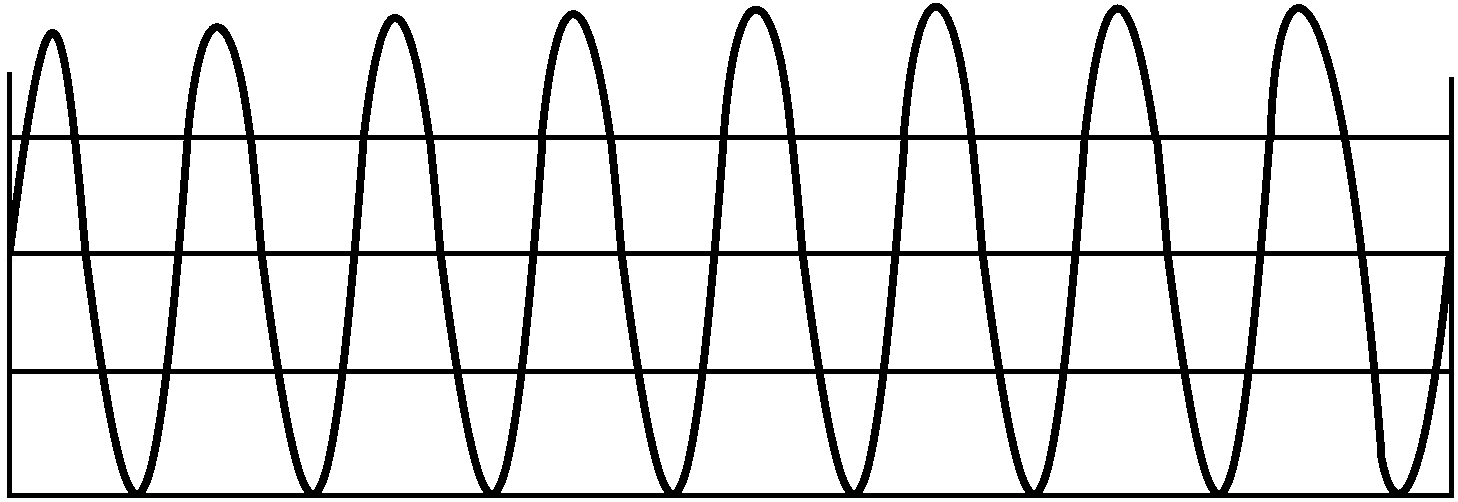
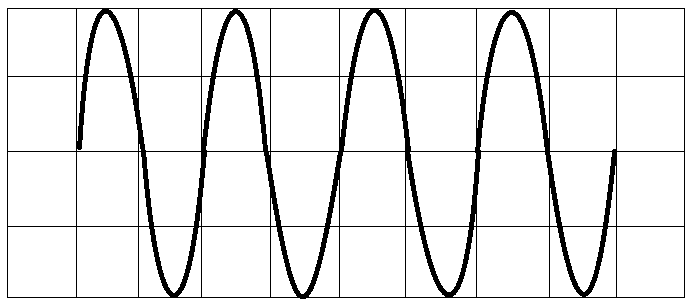
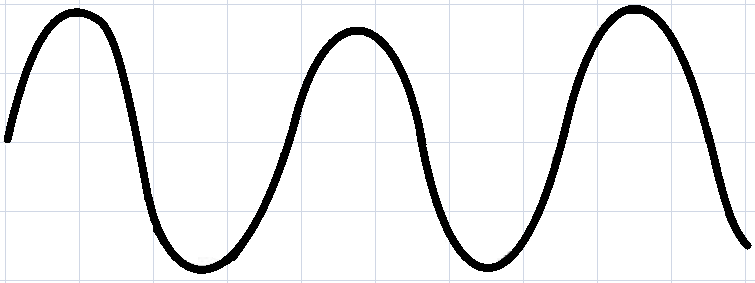
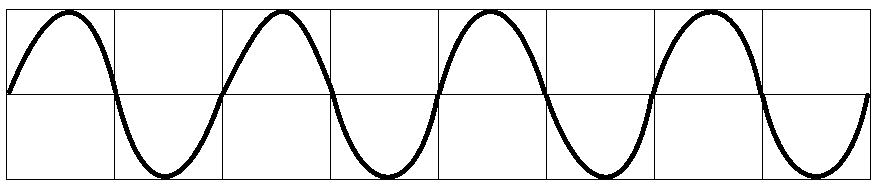
- 2Consider the following sound waves marked $A, B, C$ and $D:$View Solution
- Which two waves represent sounds of the same loudness but different pitch$?$
- Which two waves represent sounds of the same frequency but different loudness?
- State whether all these sound waves have been produced by the same vibrating body or different vibrating bodies?
- Which vibrating body/bodies could have generated the sound waves shown here?
- 3View SolutionIn an experiment, Anhad studies sound waves. He sets up a loudspeaker to produce sound as shown below:
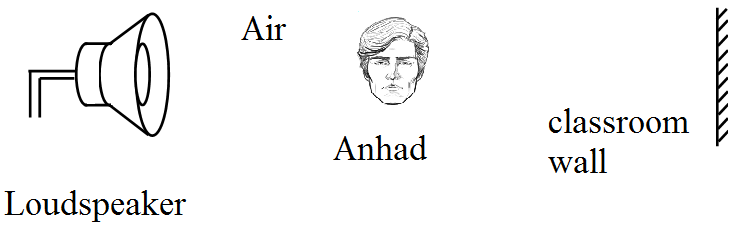
Anhad adjusts the signal to the loudspeaker to give a sound of frequency 200Hz.- What happens to the air in-between Anhas and the loudspeaker?
- Explain how Anhad receives sound in both ears.
- 4What is kidnapped, blindfolded and imprisoned in a big room. How could the man tell if he was in: $(a)$ a city $(b)$ a village $(c)$ a bare room $(d)$ a furnished room.View Solution
- 5View SolutionHow could you convince a small child that when ou speak, it is not necessary for air to travel from your mouth to the ear of a listener?
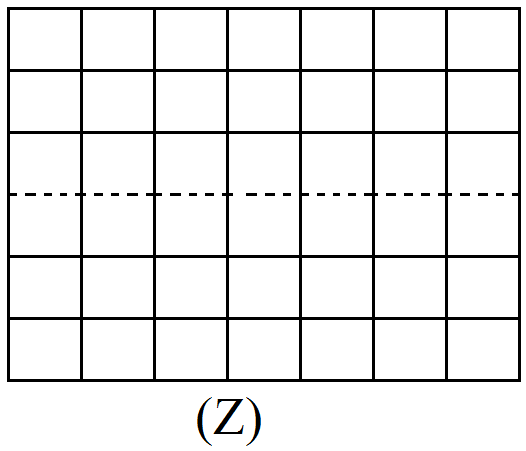
- 6Figure $X$ showa a trace of a sound wave produced by a particular tuning fork:View Solution
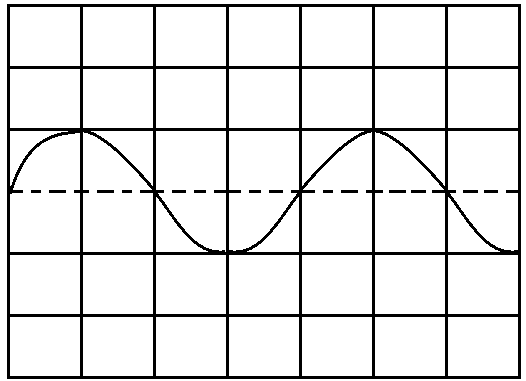
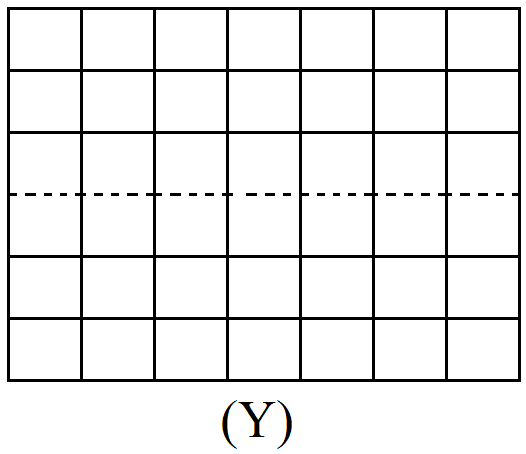
- On the graph paper given in Figure $Y,$ draw a trace of the sound wave which has higher frequency than that shown in Figure $X.$
- On the graph paper shoen in Figure $Z,$ draw a trace of the sound wave which has a larger amplitude than that shown in Figure $X.$
- 7View SolutionHow does sound from a sound producing body travel through air to reach our ears? Illustrate your answer with the help of a labelled diagram.
- 8View SolutionHow can reverberations in a big hall or auditotium be reduced?`
- 9View SolutionWhat is the difference between a compression and a rarefaction in a sound wave? Illustrate your answer with a sketch.
- 10View SolutionDescribe a simple experiment to show that the prongs of a sound producing tuning fork are vibrating.