How could you convince a small child that when ou speak, it is not necessary for air to travel from your mouth to the ear of a listener?
Download our app for free and get started
There is no actual movement of air from the sound-producing body to our ear. The air layers only vibrate back and forth, and transfer the sound energy from one layer to the next layer till it reaches our ear.
Example: If we turn on a gas tap for a few seconds, a person standing a few metres away will hear the sound of escaping gas first and the smell of gas reaches him afterwards. The sound of gas travels through the vibrations of air layers so it reaches first, but the smell of gas reaches the person through the actual movement of the air layers, which takes more time. So, it is clear that the sound is not being transmitted by the actual movement of air from the gas tap to person, otherwise he would hear and smell the gas at the same time.
Example: If we turn on a gas tap for a few seconds, a person standing a few metres away will hear the sound of escaping gas first and the smell of gas reaches him afterwards. The sound of gas travels through the vibrations of air layers so it reaches first, but the smell of gas reaches the person through the actual movement of the air layers, which takes more time. So, it is clear that the sound is not being transmitted by the actual movement of air from the gas tap to person, otherwise he would hear and smell the gas at the same time.

Download our appand get started for free
Experience the future of education. Simply download our apps or reach out to us for more information. Let's shape the future of learning together!No signup needed.*
Similar Questions
- 1View SolutionHow can reverberations in a big hall or auditotium be reduced?`
- 2A sound producing body is at considerable distance from a man. There can be four different media $W, X, Y$ and $Z$ between the sound producing body and the man. The medium $X$ brings the sound to man most quickly whereas medium $Z$ takes the maximum time. The time taken by medium $W$ in bringing sound to man is less than that of $X$ but more than that of $Z.$ The medium $Y,$ however, fails to bring the sound from the sound producing body to the man. Which medium could be the one:View Solution
- Having no fixed shape and no fixed volume$?$
- Having a fixed volume but no fixed shape$?$
- Having the same composition as that on the moon$?$
- Having a fixed shape and a fixed volume$?$
- 3Consider the following sound waves marked $A, B, C$ and $D:$View Solution
- Which two waves represent sounds of the same loudness but different pitch$?$
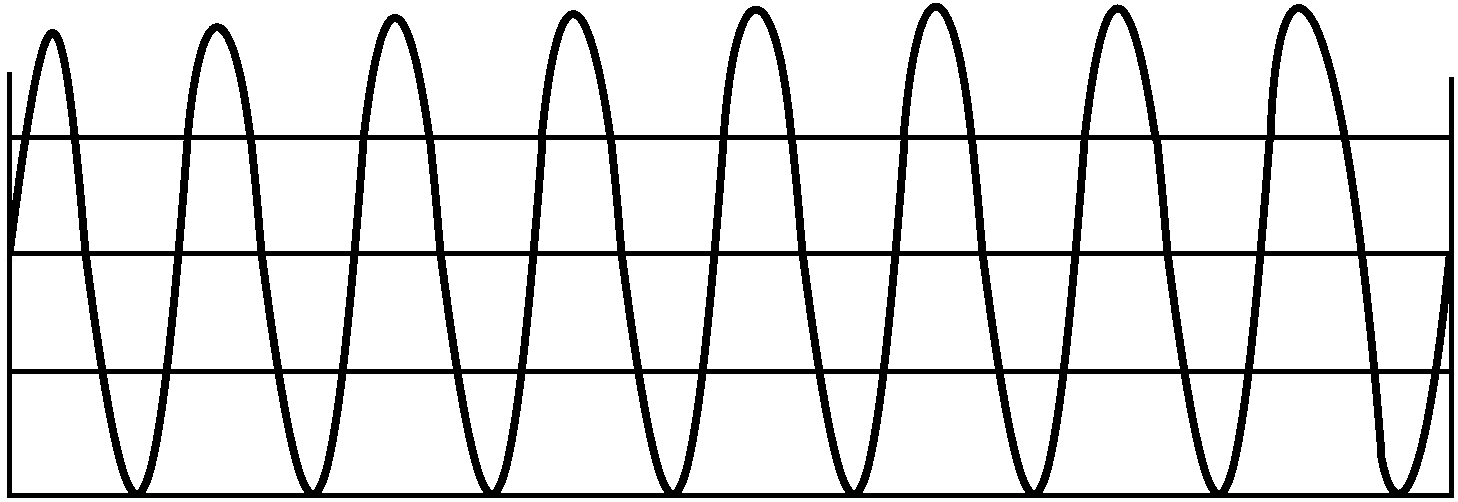
- Which two waves represent sounds of the same frequency but different loudness?
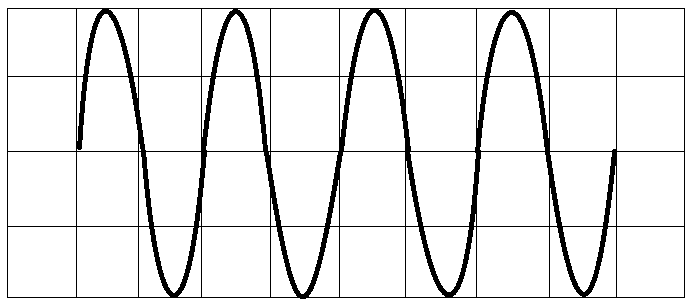
- State whether all these sound waves have been produced by the same vibrating body or different vibrating bodies?
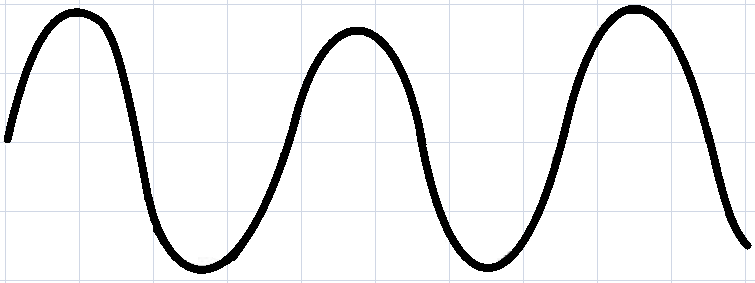
- Which vibrating body/bodies could have generated the sound waves shown here?
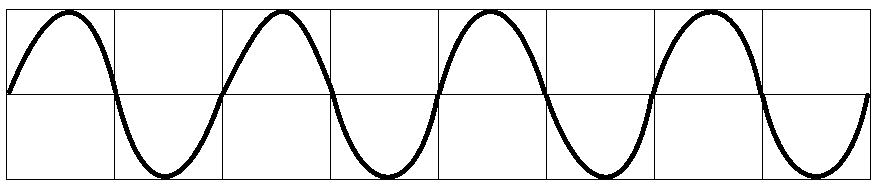
- 4View SolutionIn an experiment, Anhad studies sound waves. He sets up a loudspeaker to produce sound as shown below:
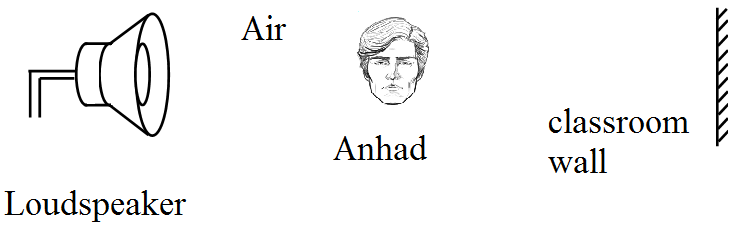
Anhad adjusts the signal to the loudspeaker to give a sound of frequency 200Hz.- What happens to the air in-between Anhas and the loudspeaker?
- Explain how Anhad receives sound in both ears.
- 5View SolutionGive two examples each of longitudinal waves and transverse waves.
- 6What is kidnapped, blindfolded and imprisoned in a big room. How could the man tell if he was in: $(a)$ a city $(b)$ a village $(c)$ a bare room $(d)$ a furnished room.View Solution
- 7View SolutionWhat is a soundboard? Explain the working of a soundboard with the help of a labelled diagram.
- 8View SolutionWhat is the difference between a compression and a rarefaction in a sound wave? Illustrate your answer with a sketch.
- 9View SolutionDistinguish between longitudinal and transverse waves.
- 10View SolutionDescribe an experiment to show that sound cannot pass through vacuum.