How does sound from a sound producing body travel through air to reach our ears? Illustrate your answer with the help of a labelled diagram.
Download our app for free and get started
When an object vibrates (and makes sound), then the air layers around it also start vibrating in exactly the same way and carry sound waves from the sound producing object to our ears. Suppose a tuning fork is vibrating and producing sound waves in air. Since the prongs of the tuning fork are vibrating, the individual layers of air are also vibrating. Sound travels in the form of longitudinal waves in which the back and forth vibrations of the air layers are in the same direction as the movement of sound wave.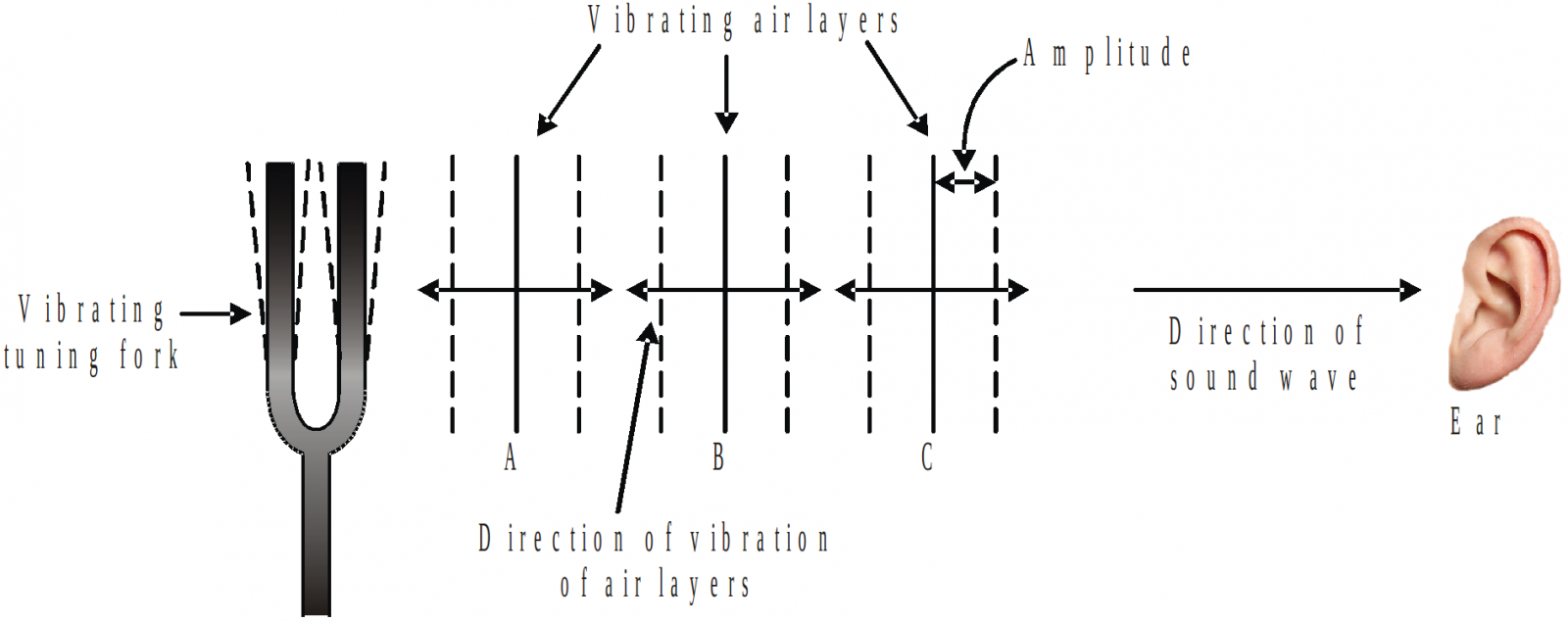

Download our appand get started for free
Experience the future of education. Simply download our apps or reach out to us for more information. Let's shape the future of learning together!No signup needed.*
Similar Questions
- 1View SolutionGive two examples each of longitudinal waves and transverse waves.
- 2View SolutionHow can reverberations in a big hall or auditotium be reduced?`
- 3View SolutionDraw a neat and labelled diagram of the human ear. With the help of this diagram, explain the construction and working of the human ear.
- 4View SolutionIn an experiment, Anhad studies sound waves. He sets up a loudspeaker to produce sound as shown below:

Anhad adjusts the signal to the loudspeaker to give a sound of frequency 200Hz.- What happens to the air in-between Anhas and the loudspeaker?
- Explain how Anhad receives sound in both ears.
- 5View SolutionDescribe an experiment to show that sound cannot pass through vacuum.
- 6View SolutionExplain the terms 'compression' and 'rarefactions' of a wave. What type of waves consist of compressions and rarefactions?
- 7View SolutionDescribe a simple experiment to show that the prongs of a sound producing tuning fork are vibrating.
- 8View SolutionDistinguish between longitudinal and transverse waves.
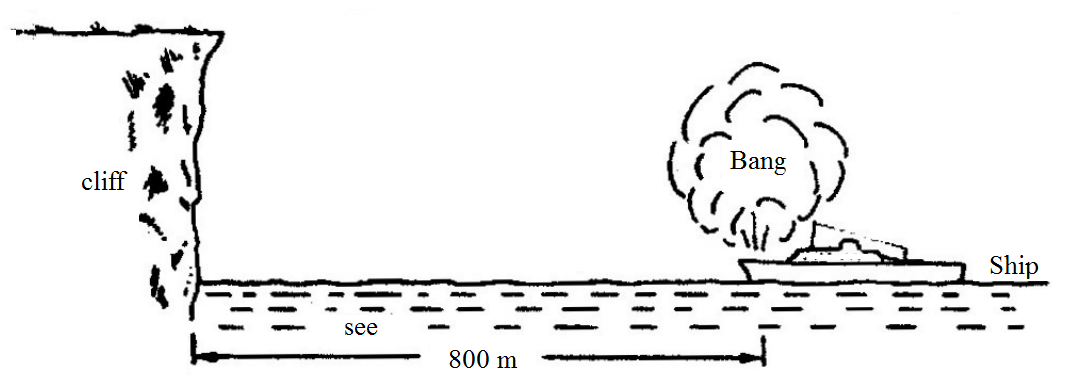
- 9The drawing shoes a ship $800\ m$ from a cliff. A gun is fired on the ship. After $5$ seconds the people at the front of the ship hear the sound of the gun again.View Solution
- 10Figure $X$ showa a trace of a sound wave produced by a particular tuning fork:View Solution
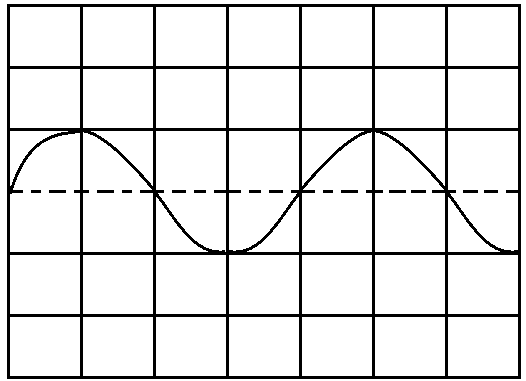


- On the graph paper given in Figure $Y,$ draw a trace of the sound wave which has higher frequency than that shown in Figure $X.$
- On the graph paper shoen in Figure $Z,$ draw a trace of the sound wave which has a larger amplitude than that shown in Figure $X.$