Question
Distinguish between longitudinal and transverse waves.

Answer

Longitudinal wave: A wave in which the particles of the medium vibrate back and forth in the ‘same direction’, in which the wave is moving, is called a longitudinal wave.
These waves can be produced in all the three media: solids, liquids and gases.
Transverse wave: A wave in which the particles of the medium vibrate up and down, ‘at right angles’ to the direction in which the wave is moving, is called a transverse wave.
It can be produced in solids and liquids but not in gases.
Need a full question paper?

Generate a complete, print-ready paper with questions like this in minutes — across 16+ boards, with answer keys.

Start Generating Free

Similar questions

With the help of a labelled diagram, describe the method of separating ammonium chloride from a mixture of ammonium chloride and common salt. Mention the difference in the properties of ammonium chloride and sodium chloride which has made this separations possible.
Give the formulate of the compounds formed from the following sets of elements:
  1. Calcium and fluorine.
  2. Hydrogen and sulphur.
  3. Nitrogen and hydrogen.
  4. Carbon and chlorine.
  5. Sodium and oxygen.
  6. Carbon and oxygen.
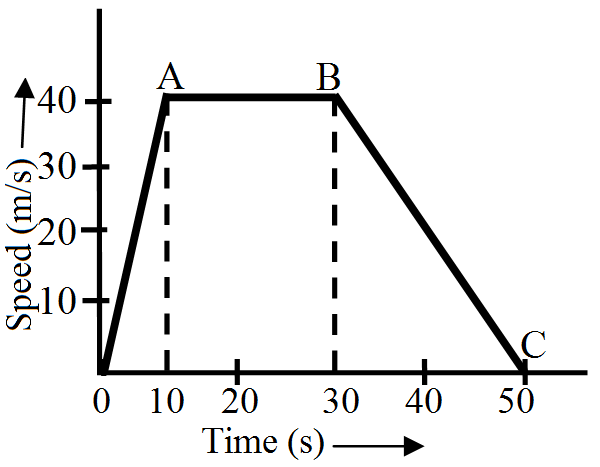
Study the speed-time graph of a car given alongside and answer the following questions:
  1. What type of motion is represented by OA?
  2. What type of motion is represented by AB?
  3. What type of motion is represented by BC?
  4. What is the acceleration of car from O to A?
  5. What is the acceleration of car from A to B?
  6. What is the retardation of car from B to C?
Write the formulae of the following compounds. Also name the elements present in them.
  1. Water.
  2. Ammonia.
  3. Methane.
  4. Sulphur dioxide.
  5. Ethanol.
Describe Bohr’s model of the atom. How did Neils Bohr explain the stability of atom?
Two objects having equal masses are moving with uniform velocities of 2m/s and 6m/s respectively. Calculate the ratio of their kinetic energies.
An atom of element E contains $3$ protons, $3$ electrons and $4$ neutrons:
  1. What is its atomic number?
  2. What is its mass number?
  3. Write the electronic configuration of the element E.
  4. State whether element E is a metal or non-metal. Why?
  5. What type of ion, cation or anion, will be formed by an atom of element E? Why?
  6. Write the symbol of the ion formed by an atom of element E.
  7. What could element X be?
The mass of one atom of an element $X$ is $2.0 \times 10^{-23}g.$
  1. Calculate the atomic mass of element $X.$
  2. What could element $X$ be?
A ball $X$ of mass 1 kg travelling at $2 m / s$ has a head-on collision with an identical ball $Y$ at rest. $X$ stops and $Y$ moves off. Calculate the velocity of $Y$ after the collision.
Explain how, nitrogen, oxygen and argon gases are separated form air.