Question
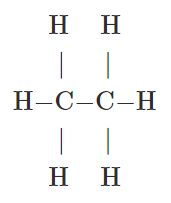
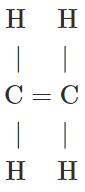
Distinguish between the saturated hydrocarbon ethane and the unsaturated hydrocarbon ethene by drawing their structural formulae.

Answer

EthaneEthene
ImageImage
It has carbon - carbon single bond.It has carbon - carbon double bond
It is saturated.It is unsaturated
Alkanes undergo a substitution reaction.Alkenes undergo addition reaction.

Need a full question paper?

Generate a complete, print-ready paper with questions like this in minutes — across 16+ boards, with answer keys.
Start Generating Free

Similar questions

The following Question refer to the electrolysis of copper sulphate solution with copper electrodes:
(a) Compare the change in mass of the anode
(b) What is seen to happen to the colour of the copper sulphate solution if platinum electrodes are used? Explain the observation.
(c) What is the practical application of the electrolysis of copper sulphate solution? Briefly, describe one such application.
Using Sodium hydroxide solution, how would you distinguish: Ammonium sulphate from sodium sulphate.
Write the observations and balanced equations for the following reactions :
(i) Sodium hydroxide is added drop by drop, till in excess, in a solution of zinc sulphate.
(ii) Ammonium hydroxide is added first in small quantity and then in excess to a solution of copper sulphate.
(iii) Excess of ammonium hydroxide is added to a substance obtained by the action of hydrochloric acid in silver nitrate.
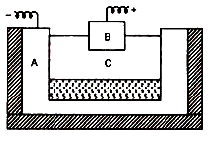
The following is a sketch of an electrolytic cell used in the extraction of aluminium :

(a) What is the substance of which the electrode A and B are made?
(b) At which electrode (A or B) is aluminium formed?
(c) What are the two aluminium compounds in the electrolyte C?
(d) Why is it necessary for electrode B to be continuously replaced?
From the given list :
NaCl, NaOH, $H_2O$ (pure), $NH_4OH$, urea, dil.$H_2SO_4$, glucose, acetic acid, $H_2CO_{3.}$
Select :
a) Substances which will behave as strong electrolytes.
b) Substances which will behave as weak electrolytes.
c) Substances which are non-elctrolytes.
A compound made up of two elements $X$ and $Y$ has an empirical formula $X_2Y.$ if the atomic weight of $X$ is $10$ and that $Y$ is $5$ and the compound has a vapour density $25,$ find its molecular formula.
Explain the following :
(i) Carbon tetrachloride does not conduct electricity.
(ii) During electrolysis of lead bromide, graphite anode is peferred to other electrodes.
(iii) The electrical conductivity of acetic acid is less in comparison to electrical conductivity of dilute sulphuric acid at a given concentration.
On adding dilute ammonia solution to a colourless solution of a salt, a white gelatinous precipitate appears. This precipitate however dissolves on addition of excess of ammonia solution. Identify (Choose from Na, l, Zn, Pb, Fe)
(a) Which metal salt solution was used?
(b) What is the formula of white gelatinous precipitate obtained?
The reaction: $4N_2O + CH_4 \rightarrow CO_2 + 2H_2O + 4N_2$ takes place in the gaseous state. If all volumes are measured at the same temperature and pressure, calculate the volume of dinitrogen oxide ($N_2O$) required to give $150 cm^3​​​​​​​$​​​​​​​ of steam.
Hydrogen chloride dissolves in water to form an acidic solution.
Give three distinct tests (apart from using an indicator) you would carry out with this solution to illustrate the typical properties of an acid.