Question
Divide 57 into two parts whose product is 680.

Answer

Let the one part be x.
Then, the other part will be (57 - x).
Thus, we have
$x(57 - x) = 680$
$\Rightarrow 57x - x^2= 680$
$\Rightarrow x^2 - 57x + 680 = 0$
$\Rightarrow x^2 - 17x - 40x + 680 = 0$
$\Rightarrow x(x - 17) - 40(x - 17) = 0$
$\Rightarrow (x - 17)(x - 40) = 0$
$\Rightarrow x - 17 = 0 or x - 40 = 0$
$\Rightarrow x = 17 or x = 40$
Hence, the two parts are 17 and 40.

Need a full question paper?

Generate a complete, print-ready paper with questions like this in minutes — across 16+ boards, with answer keys.
Start Generating Free

Similar questions

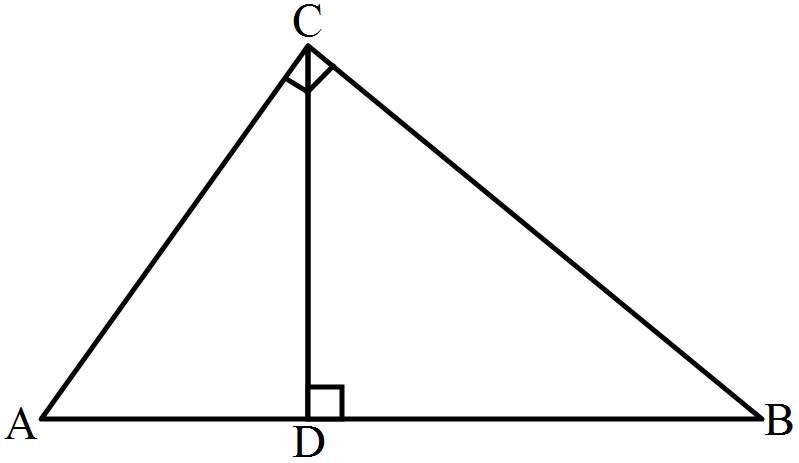
In the given figure, $\angle\text{ACB}=90^\circ$ and $\text{CD}\perp\text{AB}.$
Prove that $\frac{\text{BC}^2}{\text{AC}^2}=\frac{\text{BD}}{\text{AD}}.$
Find the roots of the following equations, if they exist, by applying the quadratic formula:
$x^2 - 2ax + (a^2 - b^2) = 0$
Use Euclid's algorithm to find HCF of 1190 and 1445. express the HCF in the form 1190m + 1445n.
An aircraft has 120 passenger seats. The number of seats occupied during 100 flights is given in the following table:
Number of seats
100-104
104-108
108-112
112-116
116-120
Frequency
15
20
32 18 15
Determine the mean number of seats occupied over the flights.
A building is in the form of a cylinder surmounted by a hemispherical dome. The base diameter of the dome is equal to $\frac{2}{3}$ of the total height of the building. Find the height of the building, if it contains $67 \frac{1}{21} m^3$ of air.
In a cyclic quadrilateral ABCD, it is given that $\angle\text{A}=(\text{2x}+4)^\circ,\ \angle\text{B}=(\text{y}+3)^\circ,$ $\angle\text{C}=(\text{2y}+10)^\circ$ and $\angle\text{D}=(\text{4x}-5)^\circ$ Find the four angles.
A train takes $2$ hours less for a journey of $300 \ km$ if its speed is increased by $5 \ km/hr$ from its usual speed. Find the usual speed of the train.
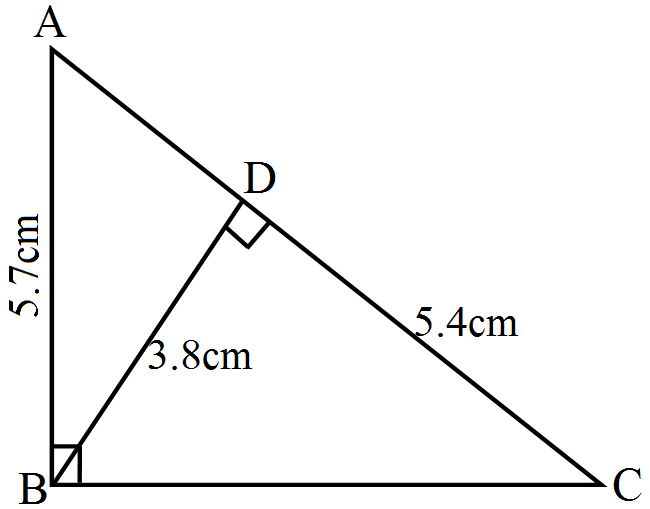
In the given figure, $\angle\text{ABC}=90^\circ$ and $\text{BD}\perp\text{AC}.$ If AB = 5.7cm, BD = 3.8cm, and CD = 5.4cm find BC.
Solve the following quadratic equation:
$\frac{\text{a}}{(\text{x}-\text{b})}+\frac{\text{b}}{(\text{x}-\text{a})}=2,$ $\text{x}\neq-\text{b},\ \text{a}$
Solve the following systems of equations:
$\frac{1}{2\text{x}}+\frac{1}{3\text{y}}=2$
$\frac{1}{3\text{x}}+\frac{1}{2\text{y}}=\frac{13}{6}$