MCQ
Does not vary from point to point in space Which pair of the following forces will never give resultant force of $2N?$
  • A
    $1N$ and $3N$
  • B
    $2N$ and $2N$
  • C
    $1N$ and $1N$
  • $1N$ and $4N$

Answer

Correct option: D.
$1N$ and $4N$
$1N$ and $4N$ will never give $2N$
mind it, if the side lengths of a triangle is $a, b, c$
$a + b > = c$
$b + c > = a$
$c + a > = b$

Need a full question paper?

Generate a complete, print-ready paper with questions like this in minutes — across 16+ boards, with answer keys.
Start Generating Free

Similar questions

A ball is thrown vertically up ward. It has a speed of $10\;m/sec$ when it has reached one half of its maximum height. How high ($m$ માં) does the ball rise? (Take $g = 10 \;m/s^2$)
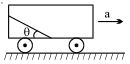
A smooth rod of length $l$ is kept inside a trolley at an angle $\theta$ as shown in the figure. What should be the acceleration a of the trolley so that the rod remains in equilibrium with respect to it?
The maximum and minimum distances of a comet from the Sun are $1.6 \times 10^{12}\, m$ and $8.0 \times 10^{10}\, m$ respectively. If the speed of the comet at the nearest point is $6 \times 10^{4}\, ms ^{-1},$ the speed at the farthest point is ......... $\times 10^{3}\, m / s$
The Bernoulli's equation is given by $p +\frac{1}{2} \rho v ^{2}+ h \rho g = k$

where $p =$ pressure, $\rho =$ density, $v =$ speed, $h =$ height of the liquid column, $g=$ acceleration due to gravity and $k$ is constant. The dimensional formula for $k$ is same as that for
A uniform string oflength $20\ m$ is suspended from a rigid support. A short wave pulse is introduced at its lowest end. It starts moving up the string. The time taken to reach the supports is (take $g= 10 $ $ms^{-2}$ )
A sphere of diameter $7\,\, cm$ and mass $266.5 \,\,gm$ floats in a bath of a liquid. As the temperature is raised, the sphere just begins to sink at a temperature $35^o C$. If the density of a liquid at $0^o C$ is $1.527 \,\,gm/cc$, then neglecting the expansion of the sphere, the coefficient of cubical expansion of the liquid is$f$ :
Water of volume $2$ litre in a container is heated with a coil of $1\,kW$ at $27\,^\circ C$. The lid of the container is open and energy dissipates at rate of $160\,J/s.$ In how much time temperature will rise from $27\,^\circ C$ to $77\,^\circ C$ [Given specific heat of water is $4.2\,kJ/kg$]
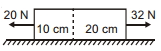
Figure shows a uniform rod of length $30 \,cm$ having a mass $3.0 \,kg$. The rod is pulled by constant forces of $20 \,N$ and $32 \,N$ as shown. Find the force exerted by $20 \,cm$ part of the rod on the $10 \,cm$ part (all surfaces are smooth) is ......... $N$
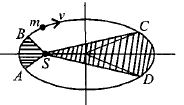
The figure shows elliptical orbit of a planet $m$ about the sun $S.$ The shaded area $SCD$ is twice the shaded area $SAB.$ If $t_1$ is the time for the planet to move from $C$ to $D$ and $t_2$ is the time to move from $A$ to $B$ then
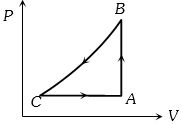
A sample of an ideal gas is taken through a cycle a shown in figure. It absorbs $50J$ of energy during the process $AB$, no heat during $BC$, rejects $70J$ during $CA.$ $40J$ of work is done on the gas during $BC$. Internal energy of gas at $A$ is $1500J$, the internal energy at $C$ would be ........ $J$