Question
Does the speed increase, decrease or remain constant when a planet comes closer to the sun?

Answer

The speed of the planet increases when it comes closer to the sun.

Need a full question paper?

Generate a complete, print-ready paper with questions like this in minutes — across 16+ boards, with answer keys.

Start Generating Free

Similar questions

A particle is vibrating in SHM when the displacements of the particle from its equilibrium position are x1 and x2, it has velocities v1 and v2 respectively. Show that its time period is given by $\text{T}=2\pi\sqrt{\frac{\text{x}_1^2-\text{x}_2^2}{\text{v}_2^2-\text{v}_1^2}}$.
How many newton make one kg wt.?
A force $\Big(\frac{\text{mv}^2}{\text{r}^2}\Big)$ is acting on a body of mass m moving with a velocity v in a circle of radius r. What is the work done by the force in moving the body over half the circumference of the circle?
  1. $\frac{\text{mv}^2}{\text{r}}\times\pi\text{r}$
  2. $\text{Zero}$
  3. $\frac{\text{mv}^2}{\text{r}^2}$
  4. $\frac{\pi\text{r}^2}{\text{mv}^2}$
Why does an engine work in isothermal conditions can't do gainful work?
In a real gas the internal energy depends on temperature and also on volume. The energy increases when the gas expands isothermally. Looking into the derivation of CP - Cv = R, find whether CP - Cv will be more than R, less than R or equal to R for a real gas.
The magnitude of linear momentum of a particle moving at a relativistic speed v is proportional to:

  1. $\text{v}$

  2. $\sqrt{1-\frac{\text{v}^2}{\text{c}^2}}$

  3. $1-\frac{\text{v}^2}{\text{c}^2}$

  4. None of these.

If a particle is moving on a straight line passing through the origin, then what will be its angular momentum relative to the origin?
Moving in a circular path of radius R, what will be the angular momentum of a particle of mass m and velocity v to the center of the circle?
A bolt of mass 0.3kg falls from the ceiling of an elevator moving down with an uniform speed of 7ms-1. It hits the floor of the elevator (length of the elevator = 3m) and does not rebound. What is the heat produced by the impact? Would your answer be different if the elevator were stationary?
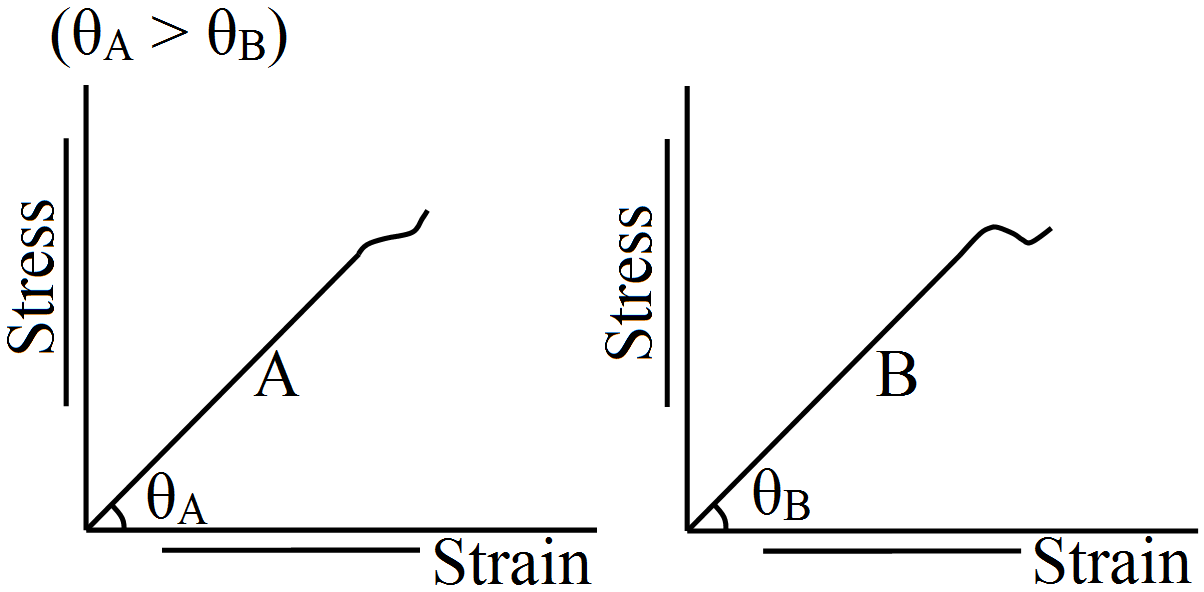
The stress-strain graph for material A and B are shown in the figure (drawn on same scale). Which of the two is stronger material? Justify your answer.