Questions · Page 1 of 3

1 Marks Question

Take a timed test

50 questions · self-marked practice — reveal the answer and mark yourself.

Question 11 Mark
Choose the correct alternative:
Acceleration due to gravity increases/ decreases with increasing depth (assume the earth to be a sphere of uniform density).
Answer
Decreases.
View full question & answer
Question 21 Mark
Choose the correct alternative:
The formula $-\text{G Mm}\Big(\frac{1}{\text{r}_2}-\frac{1}{\text{r}_1}\Big)$ is more/ less accurate than the formula mg(r2 - r1) for the difference of potential energy between two points r2 and r1 distance away from the centre of the earth.
Answer
More.
View full question & answer
Question 31 Mark
Choose the correct alternative:
Acceleration due to gravity increases/ decreases with increasing altitude.
Answer
Decreases.
View full question & answer
Question 41 Mark
Choose the correct alternative:
Acceleration due to gravity is independent of mass of the earth/ mass of the body.
Answer
Mass of the body.
View full question & answer
Question 51 Mark
A comet orbits the sun in a highly elliptical orbit. Does the comet have a constant (a) linear speed, (b) angular speed, (c) angular momentum, (d) kinetic energy, (e) potential energy, (f) total energy throughout its orbit? Neglect any mass loss of the comet when it comes very close to the Sun.
Answer
A comet while going on elliptical orbit around the Sun has constant angular momentum and total energy at all locations but other quantities vary with locations.
View full question & answer
Question 61 Mark
Express the constant k of Eq. (7.38) in days and kilometres. Given $k =10^{-13} s ^2 m ^{-3}$. The moon is at a distance of $3.84 \times 10^5 km$ from the earth. Obtain its time-period of revolution in days.
Answer
Given
$
k=10^{-13} s ^2 m ^{-3}
$
$
\begin{array}{l}
=10^{-13}\left[\frac{1}{(24 \times 60 \times 60)^2} d ^2\right]\left[\frac{1}{(1 / 1000)^3 km ^3}\right] \\
=1.33 \times 10^{-14} d ^2 km ^{-3}
\end{array}
$
Using Eq. (7.38) and the given value of k, the time period of the moon is
$
\begin{array}{l}
T^2=\left(1.33 \times 10^{-14}\right)\left(3.84 \times 10^5\right)^3 \\
T=27.3 d
\end{array}
$
View full question & answer
Question 71 Mark
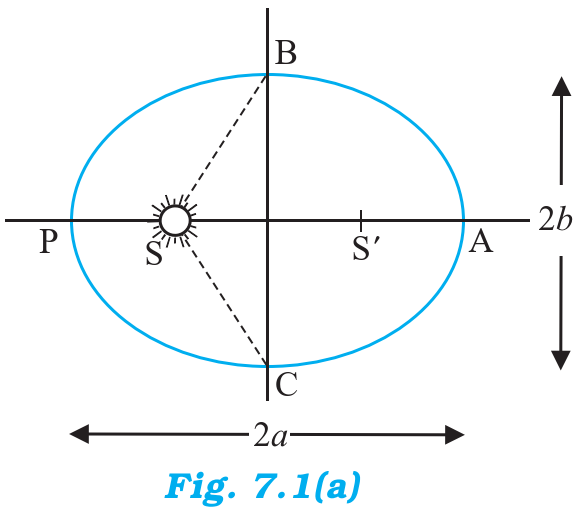
Let the speed of the planet at the perihelion $P$ in Fig. 7.1 (a) be $v_p$ and the Sun-planet distance SP be $r_p$ Relate $\left\{r_P, V_P\right\}$ to the corresponding quantities at the aphelion $\left\{r_A, V_A\right\}$. Will the planet take equal times to traverse $B A C$ and $C P B$ ?
Image
Answer
The magnitude of the angular momentum at $P$ is $L_p=m_p r_p V_p$, since inspection tells us that $r _p$ and $v _p$ are mutually perpendicular. Similarly, $L_A=m_p r_A V_A$. From angular momentum conservation
$
\begin{array}{l}
m_p r_p V_p=m_p r_A V_A \\
\text { or } \quad \frac{v_p}{v_A}=\frac{r_A}{r_p}
\end{array}
$
View full question & answer
Question 81 Mark
Two particles of masses m, and m, attract each other gravitationally and are set in motion under the influence of the gravitational force? Will the centre of mass move?
Answer
Since, gravitational force is an internal force, therefore the centre of mass would not move.
View full question & answer
Question 91 Mark
What is the relation between the orbital and escape velocity?
Answer
If ve is escape and v0 is orbital velocity, then
$\text{v}_\text{e}=\sqrt{2}\text{v}_0$
View full question & answer
Question 101 Mark
Acceleration due to gravity above earth surface at height his same as below earth surface at distance _________.
Answer
Acceleration due to gravity above earth surface at height his same as below earth surface at distance 2h.
View full question & answer
Question 111 Mark
Why is the atmosphere much rarer on the moon than on the earth?
Answer
The value of escape velocity on the moon is small as compared to the value of the earth only 2.5k ms-1. So, the molecules of air escape easily from the surface of moon, hence there is no atmosphere.
View full question & answer
Question 121 Mark
Value of g is largest at the poles due to _________.
Answer
Value of g is largest at the poles due to polar radius is smaller than equatorial radius.
View full question & answer
Question 141 Mark
Where does a body weigh more; at the surface of the earth or in a mine?
Answer
The value of g in mine is less than that on the surface of the earth.
View full question & answer
Question 151 Mark
Why a body weighs more at poles and less at equator?
Answer
The value of g is more at poles than at the equator.
Therefore, a body weighs more at poles than at equator.
View full question & answer
Question 161 Mark
What is parking orbit?
Answer
The orbit at which the satellite will remain static according to earth (as a frame).
View full question & answer
Question 171 Mark
Where does a body weigh more at the surface of the earth or in a mine?
Answer
Since value of g in a mine is lesser than at the surface of the Earth, so weight of body in a mine is lesser than the weight of the body on the surface of the earth.
View full question & answer
Question 201 Mark
The gravitational potential energy of a body at a distance r from the centre of earth is U. What is the weight of the body at that point?
Answer
$\text{U}=\frac{\text{GMm}}{\text{r}}=\Big(\frac{\text{GM}}{\text{r}^2}\Big)\text{rm}=\text{grm}$

$\Rightarrow\ \text{U}=\text{mgr}$

$\text{mg}=\frac{\text{U}}{\text{r}}$ (weight of the body).

View full question & answer
Question 211 Mark
If a satellite is revolving around a planet of density $\rho,$ show that the entity $\rho\text{T}^2$ is a universal constant. When a satellite is orbiting close to earth, then.
Answer
$\frac{\text{GMm}}{\text{R}^2}=\text{mR}\omega^2$

$\frac{\text{G}\frac{4}{3}\pi\text{R}^3\rho\text{m}}{\text{R}^2}=\text{m R}\frac{4\pi^2}{\text{T}^2}$

$\rho\text{T}^2=\frac{3\pi}{\text{G}}=\text{a constant}.$

View full question & answer
Question 221 Mark
How much energy is required by a satellite to keep it orbiting? Neglect air resistance.
Answer
No energy is required. This is because the work done by centripetal force is zero.
View full question & answer
Question 231 Mark
Give two characteristics of gravitational force.
Answer
  1. Conservative force.
  2. Acts on the line joining the masses.
View full question & answer
Question 241 Mark
Two planets are at distances R1 and R2 from the Sun. What will be the ratio of the squares of their periods?
Answer
$\frac{\text{R}_1^3}{\text{R}_2^3}.$
View full question & answer
Question 251 Mark
Define the effect of shape of the earth on the value of g.
Answer
At the surface of the earth, g is maximum at the poles and minimum at the equator i.e. the value of g decreases from poles to equator.
View full question & answer
Question 261 Mark
What is the apparent weight of a man of 60kg who is standing in a lift which is moving up with a uniform speed?
Answer
Apparent weight = mg = 60 × 10N = 600N
View full question & answer
Question 271 Mark
Draw graph showing the variation of acceleration due to gravity with (a) height above the earth's surface (b) depth below the earth's surface.
View full question & answer
Question 281 Mark
The square of the period of revolution of a planet around the sun is proportional to the ________ of the semimajor axis of its elliptical orbit.
Answer
The square of the period of revolution of a planet around the sun is proportional to the cube of the semimajor axis of its elliptical orbit.
View full question & answer
Question 291 Mark
Is potential energy on the surface of earth always zero?
Answer
No, It is $-\frac{\text{GM}}{\text{R}}$
View full question & answer
Question 301 Mark
What is the height at which the satellite is to be parked for it to be a geostationary satellite?
Answer
Approximately 36,000Km.
View full question & answer
Question 321 Mark
Gravitational force with which a body is attracted towards the centre of the earth is __________ of the body.
Answer
Gravitational force with which a body is attracted towards the centre of the earth is weight of the body.
View full question & answer
Question 331 Mark
Why does a person in a satellite feels weightlessness?
Answer
Since no reaction is experienced by the person, he feels weightlessness.
View full question & answer
Question 341 Mark
When the reaction of the supporting surface is zero then apparent weight of the body become equal to _________.
Answer
When the reaction of the supporting surface is zero then apparent weight of the body become equal to zero.
View full question & answer
Question 351 Mark
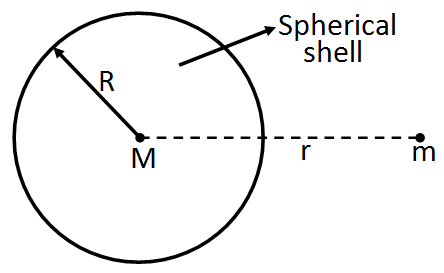
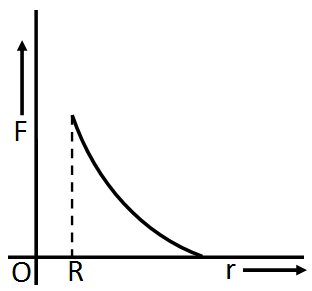
The gravitational force between a hollow spherical shell (of radius R and uniform density) and a point mass is F. Show the nature of F vs r graph where r is the distance of the point from the centre of the hollow spherical shell of uniform density.
Answer
Let us consider the diagram of spherical shell having uniform density (p).

$\text{M}=(\text{p})\times\frac{4}{3}\pi\text{R}^3$

Therefore, gravitational force between hollow shell and point mass is

$\text{F}=\frac{\text{GMm}}{\text{r}^2}$

where M is the mass of the hollow spherical shell and m is the mass of point mass.

Therefore, the mass is distributed on the surface of the sphere only, then F = 0 for $0<\text{r}<\text{R}$ (i.e., force inside the shell is zero)

And $\text{F}=\frac{\text{GM}}{\text{r}^2}$ for $\text{r}>\text{R}$

The variation of F versus r is shown in the diagram. Force is maximum at the surface of shell and it is zero if r tends to infinity.

View full question & answer
Question 361 Mark
What is the amount of work done in bringing a mass from the surface of the earth on one side to a point diametrically opposite on the other side?
Answer
Since, gravitational potential difference is zero, therefore the work done is zero.
View full question & answer
Question 371 Mark
From Kepler's second law and observations of the sun's motion as seen from the earth, we can conclude that the earth is closer to the sun during winter in the Northern hemisphere than during summer. Explain.
Answer
The earth is closer to the sun during winter. But heating effect is less because the sun's rays fall obliquely.
View full question & answer
Question 381 Mark
How does the orbital velocity of a satellite depend on the mass of the satellite?
Answer
Independent of mass.
View full question & answer
Question 391 Mark
List one difference and one similarity between gravitational and inertial mass.
Answer
Similarity-Both are equal.
Difference-Gravitational mass is measured by using comparison of mass by force, but inertial mass measured by the acceleration caused by the force.
View full question & answer
Question 401 Mark
Compare the weights of stone when it is $\frac{1}{2}\text{km}$ above the surface of earth and 1km below the surface of earth.
Answer
$\frac{\text{W}_{\text{h}}}{\text{W}_{\text{d}}}=\frac{1-\frac{2\text{h}}{\text{R}}}{1-\frac{\text{d}}{\text{R}}}$
$=\frac{1-\frac{2\Big(\frac{1}{2}\Big)}{\text{R}}}{1-\frac{1}{\text{R}}}=1$
View full question & answer
Question 411 Mark
Choose the correct alternative:
Acceleration due to gravity increases/ decreases with increasing depth (assume the earth to be a sphere of uniform density).
Answer
Decreases.
View full question & answer
Question 421 Mark
Distance between two bodies is increased to three times its original value. What is the effect on the gravitational force between them?
Answer
Since, $\text{F}\propto\frac{1}{\text{r}^2},$ hence the force will remain only $\frac{1}{9}\text{th}$ part of its original value when the distance between two bodies is increased to three times.
View full question & answer
Question 431 Mark
The gravitational force between two spheres is x when the distance between their centers is y. What will be the new force if the separation is made 3y?
Answer
Since $\text{F}\propto\frac{1}{\text{r}^2}.$ Therefore, if r is increased by a factor of 3. F will be reduced by a factor of 9. Thus, the new force will be $\frac{\text{x}}{9}.$
View full question & answer
Question 441 Mark
At what factor between the two particles gravitational force does not depend?
Answer
Gravitational force does not depend upon the medium between the two particles.
View full question & answer
Question 451 Mark
Should the speed of two artificial satellites of the earth having different masses but the same orbital radius, be the same?
Answer
Yes, since orbital velocity is independent of the mass of the satellite.
View full question & answer
Question 461 Mark
How the gravitational field at a point inside a solid sphere vary with distance x from its centre, if x <R and x > R (R-radius)?
Answer
$\text{E}_{\text{g}}\propto\text{x if x}<\text{R and E}_{\text{g}}\propto\frac{1}{\text{x}^2}\text{ if x}>\text{R}$
View full question & answer
Question 471 Mark
Give the dimensional formula of 'g' and 'G'.
Answer
Dimensional formula of 'g' → [LT-2]
Dimensional formula of 'G' → [M-1L3T-2]
View full question & answer
Question 481 Mark
Is the Kepler's law kinematic?
Answer
Yes, because kepler's third law is the relation between distance and time.
View full question & answer
Question 491 Mark
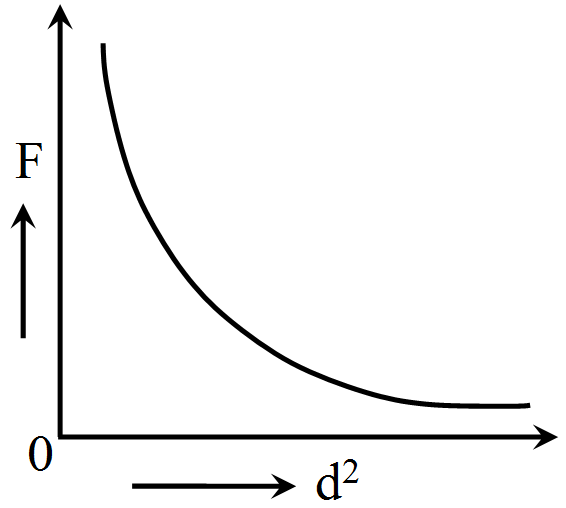
A graph was plotted taking gravitational force (F) along y-axis and the square of the distance (d2) along x-axis, what is the nature of graph?
Answer
The graph is a rectangular hyperbola.

View full question & answer
Question 501 Mark
Why are space rockets usually launched from west to east in the equatorial plane?
Answer
Space rockets are usually launched from west to east in the equatorial plane, so that linear velocity of Earth's rotation about its own axis is added with the launching velocity of rocket and linear velocity of Earth's rotation is maximum in the equatorial plane.
View full question & answer
1 Marks Question - Physics STD 11 Science Questions - Vidyadip