MCQ
$\begin{array}{*{20}{c}}
  {\,\,\,\,\,\,\,\,\,\,\,\,\,\,\,\,\,\,\,\,\,\,\,\,\,\,\,\,\,\,\,\,\,\,\,\,\,\,\,\,\,\,\,\begin{array}{*{20}{c}}
  {\,\,\,\,\,\,\,\,\,\,\,\,\,\,\,\,\,\,\,\,\,\,\,\,\,\,\,\,\,\,HOC{H_2}} \\ 
  \,\,\,\,\,\,\,\,\,\,\,\,\,\,\,\,| 
\end{array}} \\ 
  {{H_2}C = CH - C{H_2} - C{H_2} - C - OH} \\ 
  {\,\,\,\,\,\,\,\,\,\,\,\,\,\,\,\,\,\,\,\,\,\,\,\,\,\,\,\,\,\,\,\,\,\,\,\,\,\,\,\,\,\,\,\,\,\,\,\,\,\,\,\,\,\,\,\,\,|} \\ 
  {\,\,\,\,\,\,\,\,\,\,\,\,\,\,\,\,\,\,\,\,\,\,\,\,\,\,\,\,\,\,\,\,\,\,\,\,\,\,\,\,\,\,\,\,\,\,\,\,\,\,\,\,\,\,\,\,\,\,\,\,\,\,\,\,\,\,\,\,\,\,\,\,\,\,\,\,\,\,\,\,\,\,\,C{H_2} - C{H_3}} 
\end{array}$ $\xrightarrow[{TsOH}]{{\begin{array}{*{20}{c}}
  O \\ 
  {||} \\ 
  {C{H_3} - C - C{H_3}} 
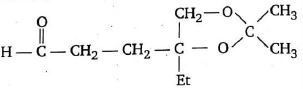
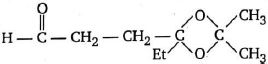
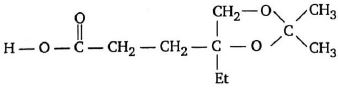
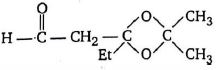
\end{array}}}(A)$ $\xrightarrow[{{{(C{H_3})}_2}S}]{{{O_3}}}(B) + HCHO$ Product $(B)$ is

  • B

  • C

  • D

Answer

Correct option: A.

a
$(a)$ Nucleophilic addition followed by reaction with $O_3$ .

Need a full question paper?

Generate a complete, print-ready paper with questions like this in minutes — across 16+ boards, with answer keys.

Start Generating Free

Similar questions

Two springs have spring constants ${K_A}$ and ${K_B}$ and ${K_A} > {K_B}$. The work required to stretch them by same extension will be
There are four concentric shells $A, B, C $ and $D $ of radii $ a, 2a, 3a$  and $4a$ respectively. Shells $B$ and $D$ are given charges $+q$ and $-q$ respectively. Shell $C$ is now earthed. The potential difference $V_A - V_C $ is : 
If a simple pendulum is taken to place where g decreases by $2\%$, then the time period
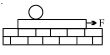
$A$ plank with a uniform sphere placed on it rests on a smooth horizontal plane. Plank is pulled to right by $a$ constant force $F$. If sphere does not slip over the plank. Which of the following is incorrect.
Two capillary tubes of same diameter are put vertically one each in two liquids whose relative densities are $0.8$ and $0.6$ and surface tensions are $60$ and $50$ dyne/cm respectively Ratio of heights of liquids in the two tubes $\frac{{{h_1}}}{{{h_2}}}$ is
Tesla is the unit of
In a sample of hydrogen like atoms all of which are in ground state, a photon beam containing photons of various energies is passed. In absorption spectrum, five dark lines, are observed. The number of bright lines in the emission spectrum will be (assume that all transitions takes place).
The difference of speed of light in the two media $A$ and $B\,\left(v_{A}-v_{B}\right)$ is $2.6 \times 10^{7}\,m / s$. If the refractive index of medium $B$ is $1.47$, then the ratio of refractive index of medium $B$ to medium $A$ is: (Given : speed of light in vacuum $\left.c =3 \times 10^{8}\, ms ^{-1}\right)$
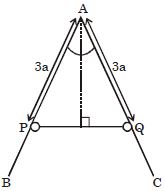
In the diagram, $BAC$ is a rigid fixed rough wire and angle $BAC$ is $60^o$. $P$ and $Q$ are two identical rings of mass $m$ connected by a light elastic string of natural length $2a$ and elastic constant $\frac{mg}{a}$. If $P$ and $Q$ are in equilibrium when $PA = AQ = 3a$ then the least coefficient of friction between the ring and the wire is $\mu$. Then value of $\mu + \sqrt 3 $ is :-
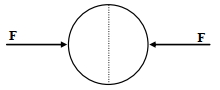
A uniformly charged thin spherical shell of radius $\mathrm{R}$ carries uniform surface charge density of $\sigma$ per unit area. It is made of two hemispherical shells, held together by pressing them with force $\mathrm{F}$ (see figure). $\mathrm{F}$ is proportional to