Two springs have spring constants ${K_A}$ and ${K_B}$ and ${K_A} > {K_B}$. The work required to stretch them by same extension will be
Easy


Download our appand get started for free
Experience the future of education. Simply download our apps or reach out to us for more information. Let's shape the future of learning together!No signup needed.*
Similar Questions
- 1In an experiment to determine the period of a simple pendulum of length $1\, m$, it is attached to different spherical bobs of radii $r_1$ and $r_2$ . The two spherical bobs have uniform mass distribution. If the relative difference in the periods, is found to be $5\times10^{-4}\, s$, the difference in radii, $\left| {{r_1} - {r_2}} \right|$ is best given by .... $cm$View Solution
- 2The function ${\sin ^2}(\omega t)$ representsView Solution
- 3View SolutionIf the metal bob of a simple pendulum is replaced by a wooden bob, then its time period will
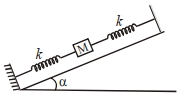
- 4In the given figure, a body of mass $M$ is held between two massless springs, on a smooth inclined plane. The free ends of the springs are attached to firm supports. If each spring has spring constant $k,$ the frequency of oscillation of given body is :View Solution
- 5Infinite springs with force constant $k$, $2k$, $4k$ and $8k$.... respectively are connected in series. The effective force constant of the spring will beView Solution
- 6Two particles execute $SHM$ of same amplitude of $20\, cm$ with same period along the same line about the same equilibrium position. The maximum distance between the two is $20\, cm.$ Their phase difference in radians isView Solution
- 7A simple pendulum has time period $T$. The bob is given negative charge and surface below it is given positive charge. The new time period will beView Solution
- 8Abody performs simple harmonic oscillations along the straight line $ABCDE$ with $C$ as the midpoint of $AE.$ Its kinetic energies at $B$ and $D$ are each one fourth of its maximum value. If $AE = 2R,$ the distance between $B$ and $D$ isView Solution

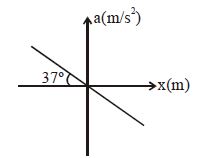
- 9The acceleration displacement graph of a particle executing $SHM$ is shown in figure. The time period of simple harmonic motion isView Solution
- 10A cylindrical block of wood (density $= 650\, kg\, m^{-3}$), of base area $30\,cm^2$ and height $54\, cm$, floats in a liquid of density $900\, kg\, m^{-3}$ . The block is depressed slightly and then released. The time period of the resulting oscillations of the block would be equal to that of a simple pendulum of length ..... $cm$ (nearly)View Solution