Question
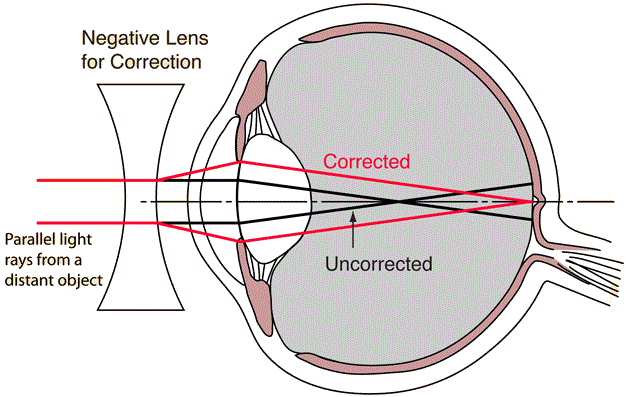
Draw a diagram to show why distant objects cannot be seen distinctly by a myopic eye. List two reasons due to which this defect of vision may be caused. A person with a myopic eye
cannot see objects clearly beyond a distance of 2 m. Name the type of corrective lens that would be needed to correct the defect of vision and draw a ray diagram to show how the defect
gets corrected.
Answer

In order to see objects by the eye the image of the object should form on the retina, exactly on the retina. When a person is suffering from Myopia or near sightedness, the near point
of distinct vision gets Increases and an object placed at a distance less than this new near point has its image formed in front of retina.
If a person can’t see the object clearly beyond 2m then he should use concave or diverging lens in order to correct his defect.

Need a full question paper?

Generate a complete, print-ready paper with questions like this in minutes — across 16+ boards, with answer keys.

Start Generating Free

Similar questions

With the help of a labelled diagram, explain the construction and working of a solar cooker.
Explain the various part of AC generator.
  1. What is dispersion of white light? What is the cause of such dispersion? Draw a diagram to show the dispersion of white light by a glass prism.
  2. A glass prism is able to produce a spectrum when white light passes through it but a glass slab does not produce any spectrum. Explain why it is so.
When a spherical mirror is held towards the sun and its sharp image is formed on a piece of a carbon paper for some time, a hole is burnt in the carbon paper.
  1. What is the nature of spherical mirror?
  2. Why is a hole burnt in the carbon paper?
  3. At which point of the spherical mirror the carbon paper is placed?
  4. What name is given to the distance between spherical mirror and carbon paper?
  5. What is the advantage of using a carbon paper rather than a white paper?
A nuclear reaction is represented by the equation:

$^{2}_{1}\text{H}+{^{2}_{1}\text{H}}\rightarrow{^{3}_{2}\text{He}}+\text{xc}+\text{E}$

  1. Name the process represented by this equation and describe what happens during this reaction.
  2. Identify the particle c and the number x of such particles produced in the reaction.
  3. What does E represent?
  4. State two conditions under which such a reaction takes place.
  5. What type of nuclear bomb is based on similar reactions?
Calculate the combined resistance in each case:
Draw a labelled diagram of an electric motor. Explain its principle and working. What is the function of a split ring in an electric motor?
i. A person suffering from myopia (near-sightedness) was advised to wear the corrective lens of power -2.5 D . A spherical lens of the same focal length was taken in the laboratory. At what distance should a student place an object from this lens so that it forms an image at a distance of 10 cm from the lens?
ii. Draw a ray diagram to show the position and nature of the image formed in the above case.
When a spherical mirror is held towards the sun and its sharp image is formed on a piece of a carbon paper for some time, a hole is burnt in the carbon paper.
  1. What is the nature of spherical mirror?
  2. Why is a hole burnt in the carbon paper?
  3. At which point of the spherical mirror the carbon paper is placed?
  4. What name is given to the distance between spherical mirror and carbon paper?
  5. What is the advantage of using a carbon paper rather than a white paper?
Explain the principle of working of a thermal power plant. Draw a labelled diagram to illustrate your answer.
