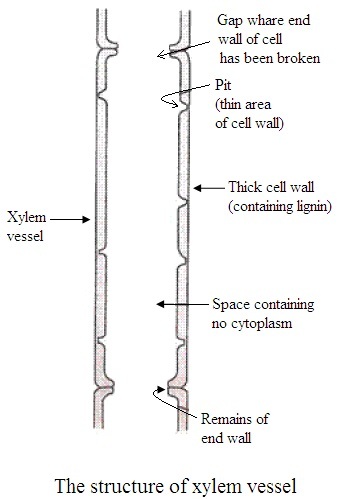
Draw a labelled diagram of:
- A xylem vessel.
- A sieve tube (or phloem).
Download our app for free and get started

Download our appand get started for free
Experience the future of education. Simply download our apps or reach out to us for more information. Let's shape the future of learning together!No signup needed.*
Similar Questions
- 1View SolutionX is a wild animal which eats only the flesh of other animals whereas Y is a domestic animal which feeds mainly on green grass.
- What are animals like X known as?
- What are animals Y known as?
- Which animal, X or Y, has a longer small intestine? Why?
- Name one animal which is like X.
- Name one animal which is like Y.
- 2View SolutionHow do carbohydrates, proteins and fats get digested in human beings?
- 3View SolutionDraw the diagram of alimentary canal of man and label the following parts.Mouth, Oesophagus, Stomach, Intestine.
- 4View SolutionExplain the process of breathing in man.
- 5View SolutionWrite the difference between nutrition in plants and animals.
- 6View SolutionHow does food prepared by leaves is utilized by roots? Explain.
- 7View SolutionWhen a person eats sugary food, then organisms A present in his mouth act on sugar to produce a substance B. The substance B first dissolves the calcium salts from the top part C of the tooth and then from its middle part D forming holes E. These holes ultimately reach the part F in the lower part of tooth which contains nerves and blood vessels. The substance B irritates the nerve endings inside the tooth causing toothache.
- What are (i) organisms A, and (ii) substance B?
- What are (i) part C, and (ii) part D, of tooth known as?
- By what name are the holes E in the tooth known?
- Name the part F of the tooth.
- What will happen if organisms A reach part F of the tooth known?
- 8View SolutionName the conducting structures present in plants.
- 9View SolutionWhat are the various components of blood? State their functions.
- 10View SolutionThe human body has an organ A which acts as a double pump. The oxygenated blood coming from the lungs through a blood vessel B enters the upper left chamber C of the double pump. When chamber C contracts, then blood goes into lower left chamber D. The contraction of chamber D forces the blood to go into a blood vessel E which supplies oxygenated blood to all the organs of the body (except the lungs). The deoxygenated blood coming out of the body organs is taken by a blood vessel F to the right upper chamber G of pumping organ. Contraction of chamber G forces the deoxygenated blood into right lower chamber H. And finally the contraction of chamber H sends the deoxygenated blood into lungs through a blood vessel I.
- What is organ A?
- Name the blood vessel (i) B (ii) E (iii) F, and (iv) I.
- What are chambers (i) C, and (ii) D?
- What are chambers (i) G and (ii) H?