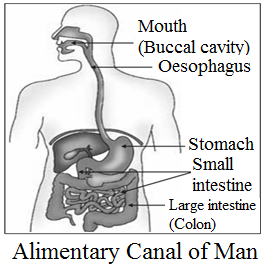
Draw the diagram of alimentary canal of man and label the following parts.Mouth, Oesophagus, Stomach, Intestine.
Download our app for free and get started
The diagram of alimentary canal of man and its parts are shown below:

Download our appand get started for free
Experience the future of education. Simply download our apps or reach out to us for more information. Let's shape the future of learning together!No signup needed.*
Similar Questions
- 1View SolutionName the raw materials required for photosynthesis. How do plants obtain these raw materials?
- 2View SolutionWhen a person puts food in his mouth, then teeth cut it into small pieces, chew and grind it. The glands A in the mouth secrete a substance B which is mixed with the food by tongue. The substance B contains an enzyme C which starts the digestion of food in the mouth. The slightly digested food from the mouth goes down a tube D. The special type of movements E in the walls of tube D push the food into stomach for further digestion. The stomach wall secretes gastric juice containing three substance F, G and H. One of the functions of F is to kill bacteria which may enter the stomach with food. The substance G protects the inside layer of stomach from the damaging effect of substance F whereas substance H is and enzyme for digestion. The partially digested food then enters into small intestine for further digestion.
- What is Gland A, Substance B and Enzyme C?
- Name the tube D.
- What is the movement E known as?
- What are F, G and H?
- 3View SolutionSecond stage of urine formation is called selective re-absorption. Why?
- 4View SolutionExplain the process of breathing in man.
- 5View SolutionExplain the mechanism of photosynthesis.
- 6View SolutionThe liquid connective tissue A circulates in our body continuously without stopping. This tissue contains a pigment B which imparts it a colour C. The tissue A consists of four components D, E, F and G. The component D fights infection and protects us from diseases. The component E helps in the clotting of tissue A if a person gets a cut. The component F is a liquid which consists mainly of water with many substances dissolved in it and component G carries oxygen from the lungs to all the parts of the body.
- What is (i) tissue A, (ii) pigment B and (iii) colour C?
- Name (i) D, (ii) E, (iii) F and (iv) G.
- Name one substance (other than oxygen) which is transported by tissue A in the human body.
- Which two components of tissue A are the cells without nucleus?
- Name any two organisms (animals) which do not have liquid like A in their body.
- 7View SolutionClassify the following into herbivores, carnivores and omnivores:
Lion, Man, Dog, Goat, Crow, Elephant, Snake, Hawk, Rabbit, Deer. - 8View SolutionExplain the significance of peristalsis.
- 9View SolutionExplain the three pathways of breakdown in living organisms.
- 10View Solution
- Draw a diagram depicting Human Alimentary Canal and label on it, Gall Bladder, Liver and Pancreas.
- State the roles of Liver and Pancreas.
- Name the organ which performs the following functions in humans:
- Absorption of digested food.
- Absorption of water.