Question
Draw a neuron and label all its parts.

Answer

Get the step-by-step solution for this question inside the Vidyadip app.

Get the answer in the app

Need a full question paper?

Generate a complete, print-ready paper with questions like this in minutes — across 16+ boards, with answer keys.
Start Generating Free

Similar questions

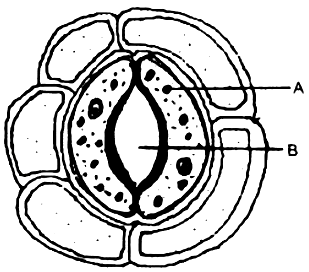
The diagram below represents a structure found in a leaf.

Study the same and answer the questions that follow:
(i) Name the pis labeled A and B.
(ii) What is the biological term for the above structure?
(iii) What is the function of the part labeled A?
(iv) Mention two structural features of A, which help in the function mentioned in (iii) above.
(v) Where is this structure likely to be found in a leaf?
(vi) The above structure helps in the process of transpiration. Explain the term transpiration.
(vii) How many other cells are found surrounding this structure as seen in the diagram?
Draw and label the structure of thyroid gland.
Explain the Term: Loop of Henle
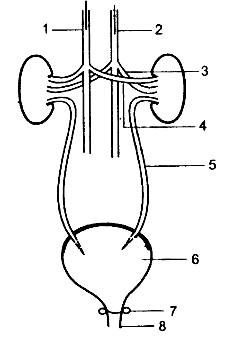
The diagram shows the Excretory System of a Human Being. Study the same and then answer the questions that follow:
(i) Name the parts labeled 1, 2,3, and 4.
(ii) Give the main function of the parts labeled 5,6, 7 and 8.
(iii) Name the endocrine gland which could be added in diagram and state its location/position
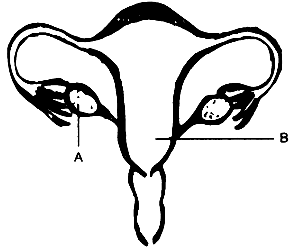
Study the diagram given below and then answer the questions that follow:

(i) Name the part labeled A. Name any two hormones produced by the part labeled A.
(ii) What happens to the part labeled B.
(1) if fertilization takes place?
(2) If fertilization does not take place?
(iii) Where does fertilization occur?
(iv) Draw a neat diagram of the human sperm as seen under high magnification and label the following parts.
(1) Acrosome
(2) Mitochondria
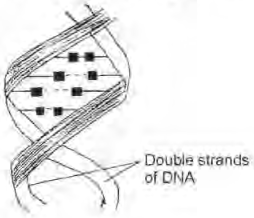
Given below is a diagram of a double helical structure of DNA :
Image
(i) Give the full form of DNA.
(ii) Name the unit of heredity.
(iii) Mention two points of differences between submetacentric and metacentric chromosomes.
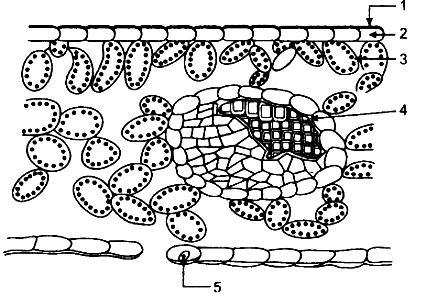
The figure below represents the vertical section of a leaf:

(i) Name the parts 1 to 5.
(ii) How many veins have been shown?
(iii) State the functions of parts 4 and 5.
List any three features of garden pea with their dominant and recessive traits.
Complete the following table:
 
Components Origin Function Approx. No. $(mm^3)$ Life span
RBCs        
WBCs        
Platelets        
When are the sounds ‘LUBB’ and ‘DUB’ produced during heartbeat ?