Question
Draw and label the structure of thyroid gland.

Answer

Get the step-by-step solution for this question inside the Vidyadip app.

Get the answer in the app

Need a full question paper?

Generate a complete, print-ready paper with questions like this in minutes — across 16+ boards, with answer keys.

Start Generating Free

Similar questions

A plant cell when kept in a hypertonic salt solution for about 30 minutes turns flaccid.
Which one or more of the expressions in column II are appropriate for the items listed in column I? write the correct matching pairs-
Column IColumn II
(i) The blind spot(a) colour of the eye
(ii) the yellow spot(b) shape of the lens
(iii) Ciliary muscle(c) protective covering of the brain
(iv) Iris(d) basic unit of brain
(v) Meninges(e) free of rod cells
(f) vitreous humour
(g) centre of the retina
(h) no sensory cells
Match the items in column A with those of column B.

Column A

Column B

(a) Auxin

(i) apical dominance

(b) Gibberellin

(ii) cell division

(c) Cytokinin

(iii) fruit ripening

(d) Ethylene

(iv) internodal elongation
Answer the following briefly:
Explain with the help of a chart what will be the colour of a child's hair if father has got dominant gene for black hair and mother has recessive gene for brown hair?
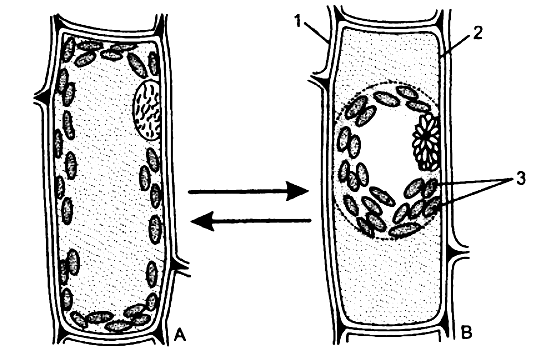
In the figure below ‘A’ shows a cell in the normal state and ‘B’ shows the same cell after leaving it in a certain solution for a few minutes.


(i) Describe the change which has occurred in the cell as seen in B.
(ii) Give the technical term for the condition of the cell as reached in B and as it was in A.
(iii) Define the process which led to this condition.
(iv) What was the solution-isotonic, hypotonic or hypertonic, in which the cell was kept?
(v) How can the cell in B, be brought back to its original condition?
(vi) Name the parts numbered 1 to 3.
State any five functions of the blood.
Differentiate between the following:
Eosinophil and Basophil
On a bright sunny day, water weeds growing in an aquarium were actively giving off bubbles of gas. Use this information to answer questions that follow:
  1. Name the process occurring in the water weed that has resulted in the evolution of these bubbles.
  2. Of what gas do these bubbles consist?
  3. Briefly describe the reactions occurring in the leaves of the water weeds leading to the evolution of these bubbles.
  4. Give an overall balanced chemical equation to represent the process named in (i) above.
Leaves of the sensitive plant wilt and droop down on a slight touch. What mechanism brings about this change?
State three ways in which roots are suited for absorbing water.