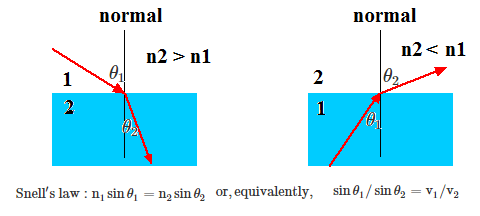
Draw a ray diagram showing the path of rays of light when it enters with oblique incidence:
- From air into water;
- From water into air.
Download our app for free and get started
- The light slows down when it passes from a rarer medium into a denser medium. Also, the light ray bends more towards the normal. (left image).
- From a denser medium to a rarer medium the light ray bends away from the normal (right image).

Download our appand get started for free
Experience the future of education. Simply download our apps or reach out to us for more information. Let's shape the future of learning together!No signup needed.*
Similar Questions
- 1View SolutionWhy does a ray falling normally on a plane mirror, retrace its path?
- 2View SolutionThe image of a candle flame placed at a distance of 45cm from a spherical lens is formed on a screen placed at a distance of 90cm from the lens. Identify the type of lens and calculate its focal length. If the height of the flame is 2cm, find the height of its image.
- 3View SolutionGive two uses of concave mirrors. Explain why you would choose concave mirrors for these uses.
- 4View SolutionAn object of size 7.0cm is placed at 27cm in front of a concave mirror of focal length 18cm. At what distance from the mirror should a screen be placed so that a sharp focussed image can be obtained? Find the size and nature of image.
[Hint. Find the value of image distance (v) first. The screen should be placed from the mirror at a distance equal to image distance.] - 5View SolutionThe diverging lens in part (a) is replaced by a converging lens also of focal length 100mm. The object remains in the same position and an image is formed by the converging lens. Compare two properties of this image with those of the image formed by the diverging lens in part (a).
- 6View SolutionSudha finds out that the sharp image of the window pane of her science laboratory is formed at a distance of 15cm from the lens. She now tries to focus the building visible to her outside the window instead of the window pane without disturbing the lens. In which direction will she move the screen to obtain a sharp image of the building? What is the approximate focal length of this lens?
- 7View SolutionAn object is placed at a distance of 100cm from each of the above lenses A and Calculate:
- Image distance, and
- Magnification, in each of the two cases.
- 8View SolutionDescribe with the help of a ray diagram the nature, size and position of the image formed when an object is placed at infinity (considerable distance) in front of a convex lens. State three characteristics of the image so formed.
- 9The refractive indices of water and glass are $\frac{3}{4}\text{ and }\frac{3}{2}$ respectively. Write the relation and find the value of refractive index of water with respect to glass and glass with respect to water.View Solution
- 10View SolutionA dentist’s mirror has a radius of curvature of 3cm. How far must it be placed from a small dental cavity to give a virtual image of the cavity that is magnified five times?