Question
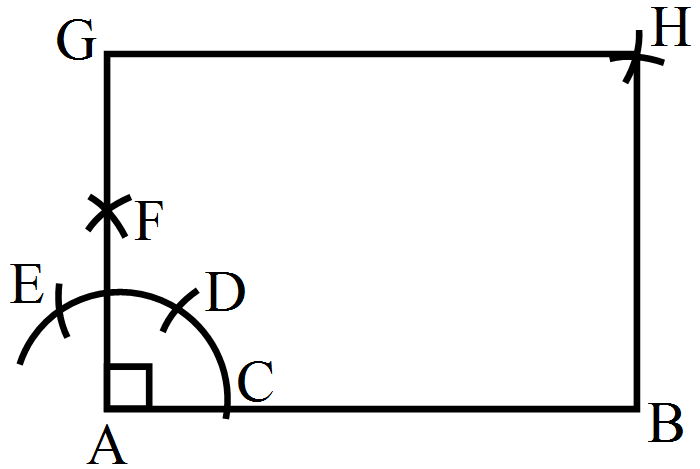
Draw a rectangle whose two adjacent sides are 5cm and 3.5cm. Make use of a pair of compasses and a ruler only.
Answer


Steps of Construction:
  1. Draw a line-segment AB = 5cm with the help of a rular.
  2. With Aas centre and suitable radius draw an arc cutting AB at C.
  3. With C as centre and same radius cut the previous arc at D and then with D as centre and same radius cut the arc at E.
  4. With D as centre and radius more than half DE draw an arc.
  5. With E as centre and same radius draw another arc to cut the previous arc at F.
  6. Join AF and produce it to G such that AG = 3.5cm. Then $\angle\text{BAG}=90^\circ.$
  7. With G as centre and radius equal to AB draw an arc. With B as centre and radius equal to AG draw another arc to cut the previous arc at H.
  8. Join GH and BH. Then, AB HG is the required rectangle.

Need a full question paper?

Generate a complete, print-ready paper with questions like this in minutes — across 16+ boards, with answer keys.

Start Generating Free

Similar questions

Find the greatest number that will divide 445, 572 and 699, leaving remainders 4, 5, 6 respectively.
Construct an angle bisector to obtain an angle of 30°.
Complete the following table:
NumberDivide the number by 4. Is it completely divisible?The number formed by the digits in the tens and units places.Is this number divisible by 4?
99292
7314
6448
8116
7773
3024
The following data gives the amount of loans (in crores of rupees) disbursed by a bank during some years:
Year
1992
1993
1994
1995
1996
Loan (in crores of rupees)
28
33
55
55
80
  1. Represent the above data with the help of a bar graph.
  2. With the help of the bar graph, indicate the year in which amount of loan is not increased over that of the preceding year.
Draw a line segment AB and bisect it. Bisect one of the equal parts to obtain a line segment of length $\frac{1}{2}(\text{AB}).$
Write the proper signs >, < or = in the boxes below:
  1. -4 __ 5
  2. 8 __ -10
  3. +9 __ +9
  4. -6 __ 0
  5. 7 __ 4
  6. 3 __ 0
  7. -7 __ 7
  8. -12 __ 5
  9. -2 __ -8
  10. -1 __ -2
  11. 6 __ -3
  12. -14 __ -14
Draw a line AB and take two points C and E on opposite sides of AB. Through C, draw $\text{CD}\perp\text{AB}$ and through E draw $\text{EF}\perp\text{AB}.$ ruler and set-squares.
Arrange the following numbers in descending order:
199988, 1704382, 200175, 1702497, 201200, 1712040
Match the following columns on whole numbers:
S.No.
Column A
S.No.
Column B
(a)
137 + 63 = 63 + 137
(i)
Associativity of multiplication
(b)
(16 × 25) is a number
(ii)
Commutativity of multiplication
(c)
365 × 18 = 18 × 365
(iii)
Distributive law of multiplication over addition.
(d)
(d) (86 × 14) × 25 = 86 × (14 × 25)
(iv)
Commutativity of addition
(e)
23 × (80 + 5) = (23 × 80) + (23 × 5)
(v)
Closure property for multiplication
Draw a line AB and take two points C and E on opposite sides of AB. Through C, draw $\text{CD}\perp\text{AB}$ and through E draw $\text{EF}\perp\text{AB}.$ Using ruler and compassed.