Question
Draw a right angle and construct its bisector.
Answer


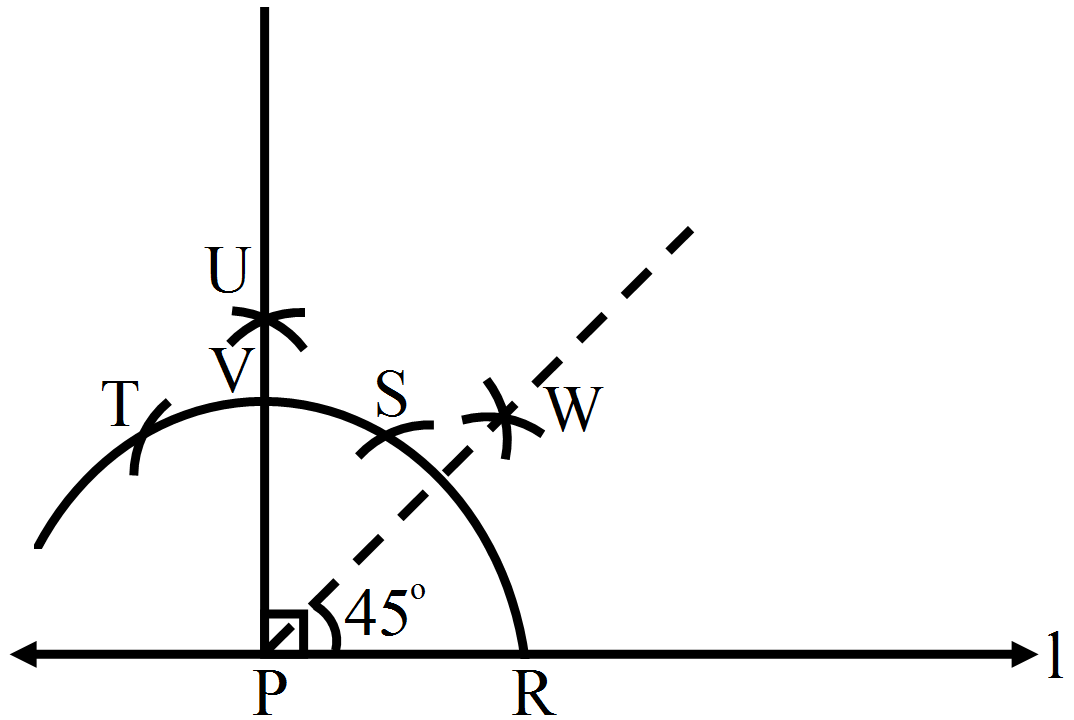
The below given steps will be followed to construct a right angle and its bisector.
$1.$Draw a line $l $ and mark a point $P$ on it. Draw an arc of convenient radius, while taking point $P$ as centre. Let it intersect line $l$ at $R.$
$2.$Taking $ R$ as centre and with the same radius as before, draw an arc intersecting the previously drawn arc at $S.$
$3.$Taking $S$ as centre and with the same radius as before, draw an arc intersecting the arc at $T ($see figure$).$
$4.$Taking $S$ and $T$ as centres, draw arcs of same radius to intersect each other at $U.$
$5.$Join $PU$. $PU$ is the required ray making $90^\circ $ with line $l.$ Let it intersect the major arc at point $V.$
$6.$Now, taking $R$ and $V$ as centres, draw arcs with radius more than $\frac{1}{2}RV$ to intersect each other at $W.$ Join $PW.$
$PW$ is the required bisector of this right angle.

Need a full question paper?

Generate a complete, print-ready paper with questions like this in minutes — across 16+ boards, with answer keys.
Start Generating Free

Similar questions

Reduce the fraction to simplest from: $\frac{12}{52}$
A rectangular courtyard is $18m, 72\ cm$ long and $13m, 20\ cm$ board. It is to be paved with square tiles of the same size. Find the least possibele number of such tiles.
A room is $8m$ long and $6m$ wide. Its floor is to be covered with rectangular tiles of size $25\ cm$ by $20\ cm$. How many tiles will be required? Find the cost of these tiles at $Rs. 25$ per tile.
Mark any four points on a paper so that no three of them are on one line. Label them $A, B, C, D$. Draw all possible lines going through pairs of these points. How many lines do you get? Name them. How many angles can you name using $A, B, C, D$ ? Write them all down, and mark each of them.
Write the fractions. Are all these fraction equivalent?
Draw a line segment of length $6\ cm.$ Construct its perpendicular bisector. Measure the two parts of theline segment.
Draw a circle with centre at point O and radius 5 cm. Draw its chord AB, draw the perpendicular bisector of line segment AB. Does it pass through the centre of the circle?
The pictograph shown different subject books which are kept in a library.

$i.\ $How many English books are there in the library?
$ii.\ $How many maths books are there?
$iii.\ $Which books are maxmimum in number?
$iv.\ $Which books are minimum in number?
Match the following columns on whole numbers:
S.No.
Column A
S.No.
Column B
$(a)$
$137 + 63 = 63 + 137$
$(i)$
Associativity of multiplication
$(b)$
$(16 \times 25)$ is a number
$(ii)$
Commutativity of multiplication
$(c)$
$365 \times 18 = 18 \times 365$
$(iii)$
Distributive law of multiplication over addition.
$(d)$
$(d) (86 \times 14) \times 25 = 86 \times (14 \times 25)$
$(iv)$
Commutativity of addition
$(e)$
$23 \times (80 + 5) = (23 \times 80) + (23 \times 5)$
$(v)$
Closure property for multiplication
Divide the park shown in Fig. of question $40$ into two rectangles. Find the total area of this park. If one packet of fertilizer is used for $300\ sq-m,$ how many packets of fertilizer are required for the whole park$?$