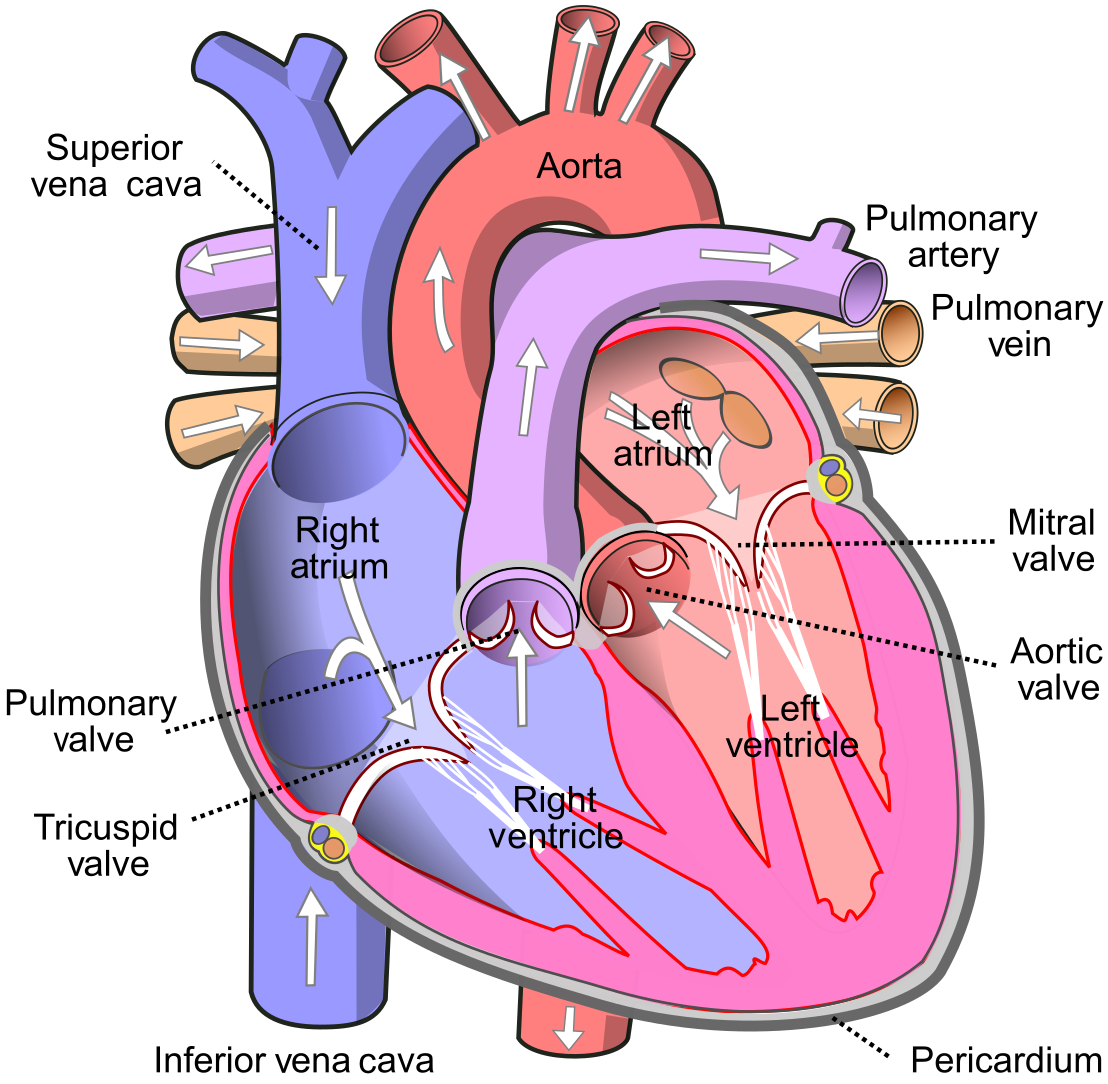
- Draw a sectional view of the human heart and label on it, Aorta, Right Ventricle and Pulmonary Veins.
- State the functions of the following components of transport system:
- Blood.
- Lymph.
CBSE DELHI - SET 1 2008
Download our app for free and get started
- Transport of nutrients, food, $O _2 CO _2$, Urea, waste materials and hormones.
- WBC present in blood kills germs.
- Bringing waste products to the kidneys and liver, which filter and clean the blood.
- Regulates body temperature.
- It Carries digested fats from intestine.
- Lymph contains lymphocyte cells which fight against infection.

Download our appand get started for free
Experience the future of education. Simply download our apps or reach out to us for more information. Let's shape the future of learning together!No signup needed.*
Similar Questions
- 1View Solution
- Draw a diagram of human alimentary canal and label - gall bladder, pancreas, liver and small intestine on it.
- Give two reasons to explain why absorption of digested food occurs mainly in the small intestine.
- 2View SolutionThe organs A of a person have been damaged completely due to which too much of a poisonous waste material B has started accumulating in his blood, making it dirty. In order to save this person's life, the blood from an artery in the person's arm is made to flow into long tubes made of substance E which are kept in coiled form in a tank containing solution F. This solution contains three materials G, H and I in similar proportions to those in normal blood. As the person's blood passes through long tubes of substance E, most of the wastes present in it go into solution. The clean blood is then put back into a vein in the arm of the person for circulation.
- What are organs A?
- Name the waste substance B.
- What are (i) E and (ii) F? Name G, H and I.
- What is the process described above known as?
- 3View Solution
- Why is there a difference in the rate of breathing between aquatic organisms and terrestrial organisms? Explain.
- Draw a diagram of human respiratory system and label-pharynx, trachea, lungs, diaphragm and alveolar sac on it.
- 4View SolutionA liquid X of colour Y circulates in the human body only in one direction: from body tissues to the heart. Among other things, liquid X contains germs from cells and dead cells. The liquid X is cleaned of germs and dead cells by a special type of white blood cells called Z. This cleaned liquid is then put into blood circulatory system in subclavian veins.
- What is (i) liquid X and (ii) colour Y?
- What are Z.
- The liquid X is somewhat similar to a component of blood. Name this component.
- Why is liquid X not red?
- 5View SolutionSecond stage of urine formation is called selective re-absorption. Why?
- 6View SolutionThe liquid connective tissue A circulates in our body continuously without stopping. This tissue contains a pigment B which imparts it a colour C. The tissue A consists of four components D, E, F and G. The component D fights infection and protects us from diseases. The component E helps in the clotting of tissue A if a person gets a cut. The component F is a liquid which consists mainly of water with many substances dissolved in it and component G carries oxygen from the lungs to all the parts of the body.
- What is (i) tissue A, (ii) pigment B and (iii) colour C?
- Name (i) D, (ii) E, (iii) F and (iv) G.
- Name one substance (other than oxygen) which is transported by tissue A in the human body.
- Which two components of tissue A are the cells without nucleus?
- Name any two organisms (animals) which do not have liquid like A in their body.
- 7View SolutionWhat is the difference between external and internal respiration.
- 8View SolutionDuring the respiration of an organism A, 1 molecule of glucose produces 2 ATP molecules whereas in the respiration of another organism B, 1 molecule of glucose produces 38 ATP molecules.
- Which organism is undergoing aerobic respiration?
- Which organism is undergoing anaerobic respiration?
- Which type of organism, A or B, can convert glucose into alcohol?
- Name one organism which behaves like A.
- Name two organisms which behave like B.
- 9View SolutionName the conducting structures present in plants.
- 10View SolutionThe transport system in plants consists of two kinds of tissues X and Y. The tissue X is made up of living cells and consists of two components A and B. The component A has tiny pores in its end walls and contains only cytoplasm but no nucleus. On the other hand, component B has cytoplasm as well as nucleus. The tissue Y is made up of dead cells and consists of two components C and D. The component C has open ends whereas component D does not have open ends. In flowering plants, either only C or both C and D transport water but D is the only water conducting tissue in non - flowering plants.
- What is (i) tissue X, (ii) component A and (iii) component B?
- What is (i) tissue Y, (ii) component C and (iii) component D?