Question
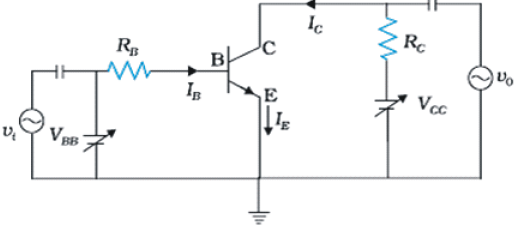
Draw a simple circuit of a CE transistor amplifier. Explain its working. Show that the voltage gain, $A_V$, of the amplifier is given by $\text{A}_{V} = - \frac{\beta_{ac}\text{R}_{L}}{\text{r}_{i}},\text{ where} \beta_{ac}$is the current gain, $R_L$ is the load resistance and $r_i $ is the input resistance of the transistor. What is the significance of the negative sign in the expression for the voltage gain?
Answer


When an ac input signal $v_i$ is superimposed on the bias $v_{BB}$, the output, which is measured between collector and ground, increases.
$\text{v}_{CC} = \text{v}_{CE} + \text{I}_{C}\text{R}_{L}$
$\text{v}_{BB} =\text{v}_{RE} + \text{I}_{B} \text{R}_{B}$
When $\text{v}_{i}$ is not zero, we have
$\text{v}_{BE} + \text{v}_{i} = \text{v}_{BE} + \text{I}_{B} \text{ R}_{B} +\Delta\text{I}_{B}(\text{R}_{B} + \text{R}_{i})$
$ = > \text{v}_{i} = \Delta\text{I}_{B}(\text{R}_{B} + \text{R}_{i})$
$\text{v}_{i} =\text{r}\Delta\text{I}_{B}$
Change in $\text{I}_{B}$ causes a change in $\text{I}_{C}$
Hence, $\beta_{ac} = \frac{\Delta\text{I}_{C}}{\Delta\text{I}_{B}} =\frac{\text{I}_{C}}{\text{I}_{B}}$
As $\Delta\text{V}_{CC} = \Delta\text{V}_{CE} + \text{R}_{L}\Delta\text{I}_{C} = 0 $
$ => \Delta\text{V}_{CE} = - \text{R}_{L}\Delta\text{I}_{C}$
$ = > \text{V}_{o} = -\text{R}_{L}\Delta\text{I}_{C}$
$\beta_{ac}\Delta\text{I}_{B}\text{R}_{L}$
$= > $ voltage gain of the amplifier
$\text{A}_{V} =\frac{\text{V}_{o}}{\text{V}_{i}} =\frac{\Delta\text{V}_{CE}}{\text{r}\Delta\text{I}_{B}} = \frac{-\beta_{ac}\Delta\text{I}_{B}\text{R}_{L}}{\text{r}\Delta\text{I}_{B}}$
Negative sign in the expression shows that output voltage and input voltage have phase difference of $\pi$.
Alternate Answer
(Also accept this derivation for voltage gain expression)
$\text{A}_{V}=\frac{\Delta\text{V}_{CE}}{\Delta\text{V}_{BE}} = \frac{-\Delta\text{I}_{C}\text{R}_{L}}{\Delta\text{I}_{B}\text{R}_{L}} $
But current gain
$\beta_{ac} = \frac{-\Delta\text{I}_{C}}{\Delta\text{I}_{B}}$
$ =\text{A}_{v} = - \beta_{ac}\times\frac{\text{R}_{L}}{\text{R}_{L}}\bigg].$

Need a full question paper?

Generate a complete, print-ready paper with questions like this in minutes — across 16+ boards, with answer keys.

Start Generating Free

Similar questions

  1. Using Biot-Savart’s law, derive an expression for the magnetic field at the centre of a circular coil of radius R, number of turns N, carrying current i.
  2. Two small identical circular coils marked 1, 2 carry equal currents and are placed with their geometric axes perpendicular to each other as shown in the figure. Derive an expression for the resultant magnetic field at O.
State Soddy-Fajan’s displacement laws for radioactive transformations.
The magnetic field B and the magnetic intensity H in material are found to be 1.6T and 1000A/m reepectively. Calculate the relative permeability $\mu_\text{r}$ and the susceptibility x of the material.
The friction coefficient between the board and the floor shown in figure is $\mu.$ Find the maximum force that the man can exert on the rope so that the board does not slip on the floor.
A body of mass 2kg is lying on a rough inclined plane of inclination 30°. Find the magnitude of the force parallel to the incline needed to make the block move:
  1. Up the incline
  2. Down the incline. Coefficient of static friction = 0.2.
A point source emitting alpha particles is placed at a distance of 1m from a counter which records any alpha particle falling on its $1cm^2$ window. If the source contains $6.0 \times 10^{16}$ active nuclei and the counter records a rate of 50000 counts/ second, find the decay constant. Assume that the source emits alpha particles uniformly in all directions and the alpha particles fall nearly normally on the window.
An LC circuit contains a 20mH inductor and a 50μF capacitor with an initial charge of 10mC. The resistance of the circuit is negligible.
Let the instant the circuit is closed be t = 0.
  1. What is the total energy stored initially? Is it conserved during LC oscillations?
  2. What is the natural frequency of the circuit?
  3. At what time is the energy stored
  1. completely electrical (i.e., stored in the capacitor)?
  2. completely magnetic (i.e., stored in the inductor)?
  1. At what times is the total energy shared equally between the inductor and the capacitor?
  2. If a resistor is inserted in the circuit, how much energy is eventually dissipated as heat?
What is interference of light? Write two essential conditions for sustained interference pattern to be produced on the screen. Draw a graph showing the variation of intensity versus the position on the screen in Young's experiment when (a) both the slits are opened and (b) one of the slit is closed. What is the effect on the interference pattern in Young's double-slit experiment when: 32. 33.
i. Screen is moved closer to the plane of slits?
ii. Separation between two slits is increased. Explain.
Draw a schematic diagram of a cyclotron. Explain its underlying principle and working, stating clearly the function of the electric and magnetic fields applied on a charged particle. Deduce an expression for the period of revolution and show that it does not depend on the speed of the charged particle.
In semiconductors, thermal collisions are responsible for taking a valence electron to the conduction band. Why does the number of conduction electrons not go on increasing with time as thermal collisions conμnuously take place?