Question
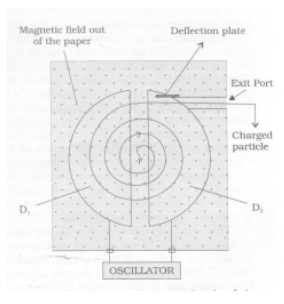
Draw a schematic diagram of a cyclotron. Explain its underlying principle and working, stating clearly the function of the electric and magnetic fields applied on a charged particle. Deduce an expression for the period of revolution and show that it does not depend on the speed of the charged particle.
Answer

  1.  
  1. Principle and working.
  2. The magnetic field make the charged particles go round in circular path inside the dees and electric field accelerates them every time the particles move from one dee to other.
$\frac{\text{mv}^{2}}{\text{r}} = \text{qvB}$
$\therefore \text{v} = \frac{\text{qBr}}{\text{m}}$
$\therefore$ Period of revolution, $\text{T} = \frac{2\pi\text{r}}{\text{v}}$
$=\frac{2\pi\text{rm}}{\text{qBr}} = \frac{2\pi\text{m}}{\text{qB}}$
$\therefore$ 'T' is independent of 'v'.

Need a full question paper?

Generate a complete, print-ready paper with questions like this in minutes — across 16+ boards, with answer keys.

Start Generating Free

Similar questions

Define resolving power of a compound microscope. How does the resolving power of a compound microscope change when:
  1. Refractive index of medium between the object and objective lens increases.
  2. Wavelength of radiation used is increased?
Quite often, connecting wires carrying currents in opposite directions are twisted together in using electrical appliances. Explain how it avoids unwanted magnetic fields.
Calculate the frequency of beats produced in air when two sources of sound are activated, one emitting a wavelength of 32cm and the other of 32.2cm. The speed of sound in air is 350m/s.
Explain quantitatively the order of magnitude difference between the diamagnetic susceptibility of $N_2 (~5 \times 10^{-9})$ (at STP) and Cu $(~10^{-5}).$
Is it possible that in a Coolidge tube characteristic $\text{L}_\alpha$ X-rays are emitted but not $\text{K}_\alpha$ X-rays?
A hemispherical portion of the surface of a solid glass sphere $(\mu=1.5)$ of radius r is silvered to make the inner side reflecting. An object is placed on the axis of the hemisphere at a distance 3r from the centre of the sphere. The light from the object is refracted at the unsilvered part, then reflected from the silvered part and again refracted at the unsilvered part. Locate the final image formed.
A conducting square loop having edges of length 2.0cm is rotated through 180° about a diagonal in 0.20s. A magnetic field B exists in the region which is perpendicular to the loop in its initial position. If the average induced emf during the rotation is 20mV, find the magnitude of the magnetic field.
Add vectors $\overrightarrow{\text{A}},\overrightarrow{\text{B}}$ and $\overrightarrow{\text{C}}$ each having magnitude of 100 unit and inclined to the X-axis at angles 45°, 135° and 315° respectively.
A convex lens has a focal length of 10cm. Find the location and nature of the image if a point object is placed on the principal axis at a distance of:
  1. 9.8cm
  2. 10.2cm from the lens.
State ampere's law. Obtain expression for magnetic field at a point located (i) externally (ii) internally due to a long cylindrical solid current carrying conductor.###Calculate the value of magnetic field at points $(r>a)$ and $(r