Question
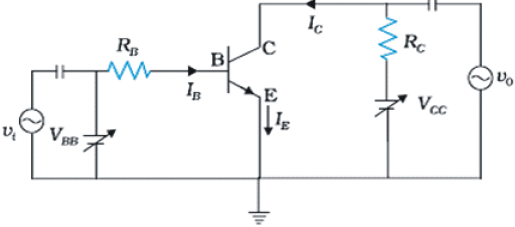
Draw a simple circuit of a $CE$ transistor amplifier. Explain its working. Show that the voltage gain $, A_V,$ of the amplifier is given by $\text{A}_{V} = - \frac{\beta_{ac}\text{R}_{L}}{\text{r}_{i}},$ where $ \beta_{ac}$ is the current gain $, R_L$ is the load resistance and $r_i$ is the input resistance of the transistor. What is the significance of the negative sign in the expression for the voltage gain?
Answer


When an ac input signal $v_i$ is superimposed on the bias $v_{BB},$ the output, which is measured between collector and ground, increases.
$\text{v}_{CC} = \text{v}_{CE} + \text{I}_{C}\text{R}_{L}$
$\text{v}_{BB} =\text{v}_{RE} + \text{I}_{B} \text{R}_{B}$
When $\text{v}_{i}$ is not zero, we have
$\text{v}_{BE} + \text{v}_{i} = \text{v}_{BE} + \text{I}_{B} \text{ R}_{B} +\Delta\text{I}_{B}(\text{R}_{B} + \text{R}_{i})$
$ \Rightarrow \text{v}_{i} = \Delta\text{I}_{B}(\text{R}_{B} + \text{R}_{i})$
$\text{v}_{i} =\text{r}\Delta\text{I}_{B}$
Change in $\text{I}_{B}$ causes a change in $\text{I}_{C}$
Hence, $\beta_{ac} = \frac{\Delta\text{I}_{C}}{\Delta\text{I}_{B}} =\frac{\text{I}_{C}}{\text{I}_{B}}$
As $\Delta\text{V}_{CC} = \Delta\text{V}_{CE} + \text{R}_{L}\Delta\text{I}_{C} = 0 $
$\Rightarrow \Delta\text{V}_{CE} = - \text{R}_{L}\Delta\text{I}_{C}$
$\Rightarrow \text{V}_{o} = -\text{R}_{L}\Delta\text{I}_{C}$
$\beta_{ac}\Delta\text{I}_{B}\text{R}_{L}$
$\Rightarrow $ voltage gain of the amplifier
$\text{A}_{V} =\frac{\text{V}_{o}}{\text{V}_{i}} =\frac{\Delta\text{V}_{CE}}{\text{r}\Delta\text{I}_{B}} = \frac{-\beta_{ac}\Delta\text{I}_{B}\text{R}_{L}}{\text{r}\Delta\text{I}_{B}}$
Negative sign in the expression shows that output voltage and input voltage have phase difference of $\pi$.
Alternate Answer
$($Also accept this derivation for voltage gain expression$)$
$\text{A}_{V}=\frac{\Delta\text{V}_{CE}}{\Delta\text{V}_{BE}} = \frac{-\Delta\text{I}_{C}\text{R}_{L}}{\Delta\text{I}_{B}\text{R}_{L}} $
But current gain
$\beta_{ac} = \frac{-\Delta\text{I}_{C}}{\Delta\text{I}_{B}}$
$ [=\text{A}_{v} = - \beta_{ac}\times\frac{\text{R}_{L}}{\text{R}_{L}}\bigg].$

Need a full question paper?

Generate a complete, print-ready paper with questions like this in minutes — across 16+ boards, with answer keys.

Start Generating Free

Similar questions

How many wavelengths are emitted by atomic hydrogen in visible range $(380\ nm-780\ nm)?$ In the range $50] nm$ to $100\ nm?$
Discuss the diffraction of monochromatic light at single thin slit. Establish the formula for angular width of central maxima and secondary maxima.
Three immiscible liquids of densities $d_1 > d_2 > d_3$ and refractive indices $\mu _1 > \mu _2 > \mu _3$ are put in a beaker. The height of each liquid column is $\frac{\text{h}}{3}$. A dot is made at the bottom of the beaker. For near normal vision, find the apparent depth of the dot.
Find the current in the sliding rod AB (resistance = R) for the arrangement shown in Fig. B is constant and is out of the paper. Parallel wires have no resistance. v is constant. Switch S is closed at time t = 0.
Monochromatic light of wavelength $589 \ nm$ is incident from air on a water surface. What are the wavelength, frequency and speed of $(a)$ reflected, and $(b)$ refracted light? Refractive index of water is $1.33.$
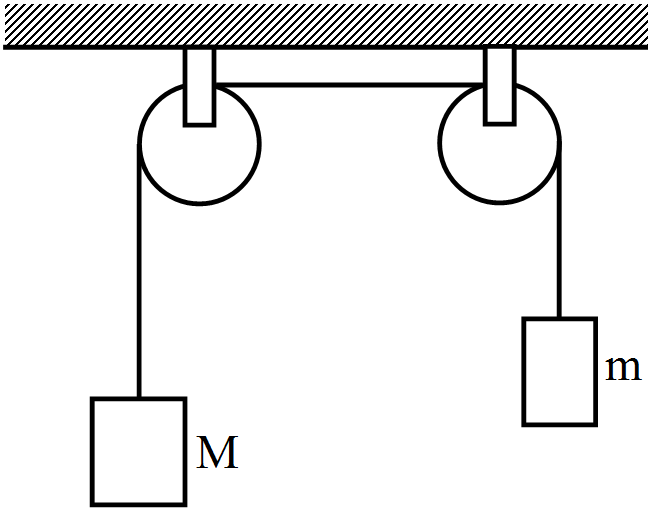
The pulleys in figure are identical, each having a radius $R$ and moment of inertia $I.$ Find the acceleration of the block $M.$
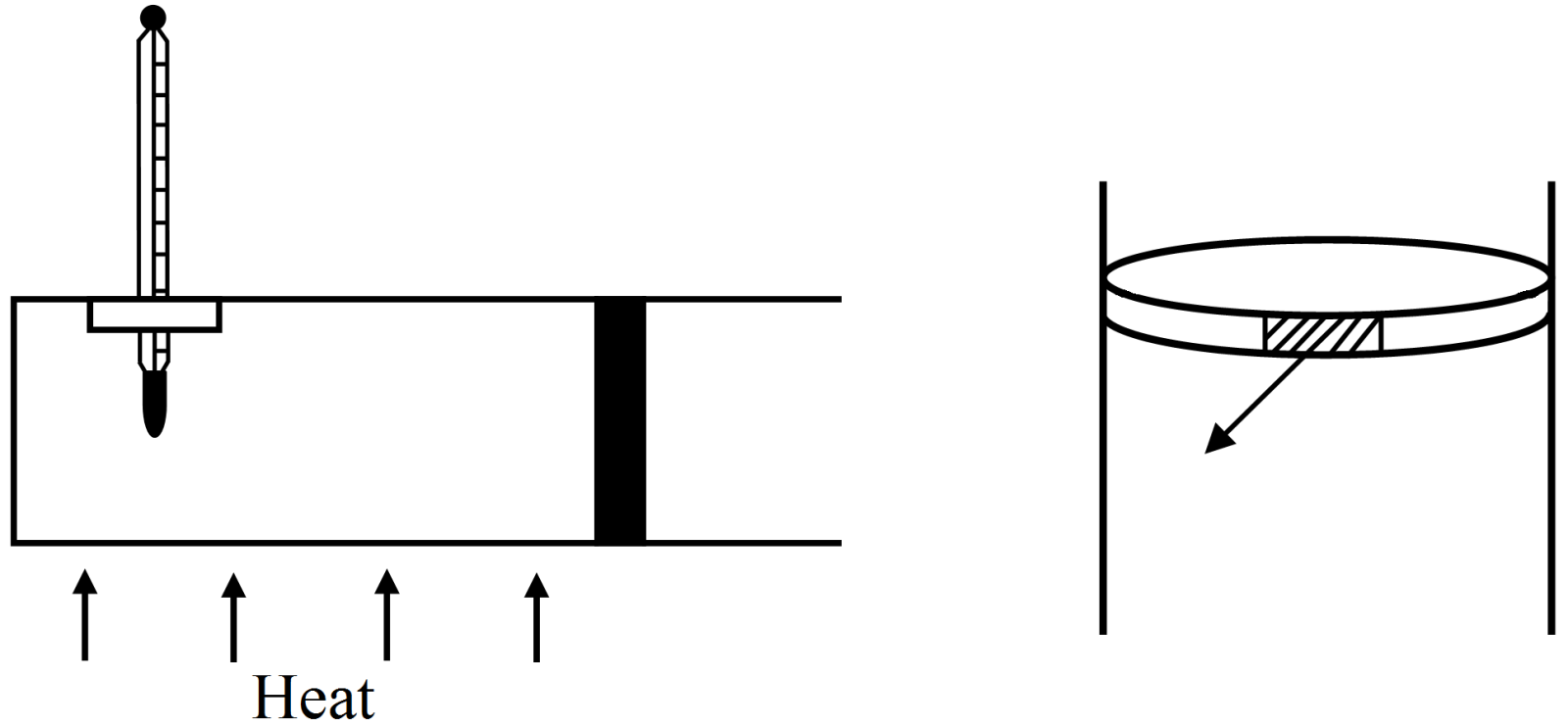
Figure. shows a cylindrical tube of radius 5cm and length 20cm. It is closed by a tight-fitting cork. The friction coefficient between the cork and the tube is 0.20. The tube contains an ideal gas at a pressure of 1 atm and a temperature of 300K. The tube is slowly heated and it is found that the cork pops out when the temperature reaches 600K Let dN denote the magnitude of the normal contact force exerted by a small length dl of the cork along the periphery (see the figure). Assuming that the temperature of the gas is uniform at any instant, calculate $\frac{\text{dN}}{\text{dl}}.$
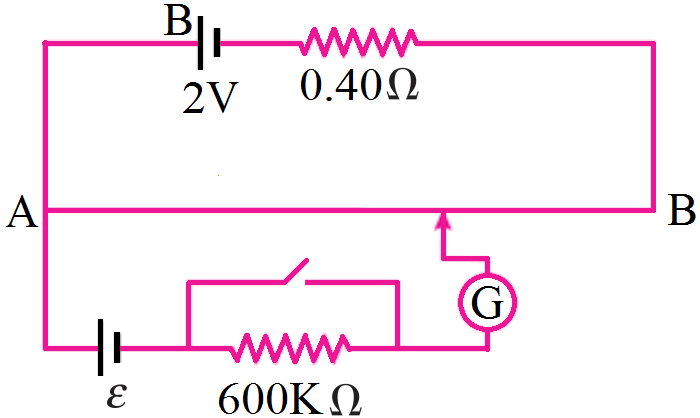
Figure shows a potentiometer with a cell of $2.0V$ and internal resistance of $0.40\Omega$ maintaining a potential drop across the resistor wire $AB.$ A standard cell which maintains a constant emf of $1.02V ($for very moderate currents upto a few $mA)$ gives a balance point at $67.3\ cm$ length of the wire. To ensure very low currents drawn from the standard cell, a very high resistance of $600\ \text{k}\Omega$ is put in series with it, which is shorted close to the balance point. The standard cell is then replaced by a cell of unknown $emf$ and the balance point found similarly, turns out to be at $82.3\ cm$ length of the wire.
  1. What is the value of $\varepsilon?$
  2. What purpose does the high resistance of $600\ \text{k}\Omega$ have?
  3. Is the balance point affected by this high resistance?
  4. Is the balance point affected by the internal resistance of the driver cell?
  5. Would the method work in the above situation if the driver cell of the potentiometer had an $emf$ of $1.0V$ instead of $2.0V$?
  6. Would the circuit work well for determining extremely small $emf,$ say of the order of few $mV ($such as the typical $emf$ of a thermo couple$)$? If not, how would you modify the circuit?
The energy of a silver atom with a vacancy in $K$ shell is $25.31\ keV,$ in $L$ shell is $3.56\ keV$ and in $M$ shell is $0.530\ keV$ higher than the energy of the atom with no vacancy. Find the frequency of $\text{K}_\alpha\text{K}_\beta$ and $\text{L}_\alpha\ X-$rays of silver.
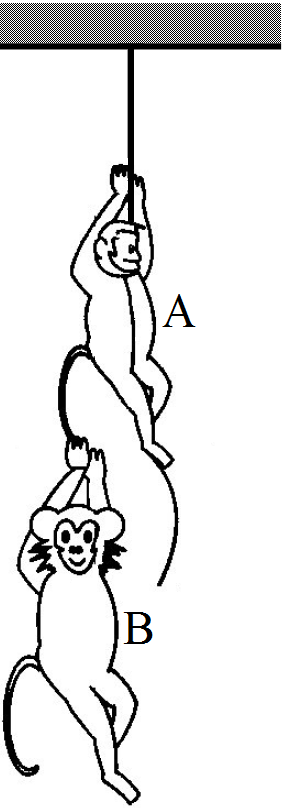
The monkey $B$ shown in figure is holding on to the tail of the monkey A which is climbing up a rope. The masses of the monkeys $A$ and $B$ are $5\ kg$ and $2\ kg$ respectively. If $A$ can tolerate a tension of $30N$ in its tail, what force should it apply on the rope in order to carry the monkey $B$ with it? Take $ g = 10m/s^2$​​​​​​​