Question
Draw an angle of $80^\circ$ using a protractor and divide it into four equal parts, using ruler and compasses. Check your construction by measurement.
Answer

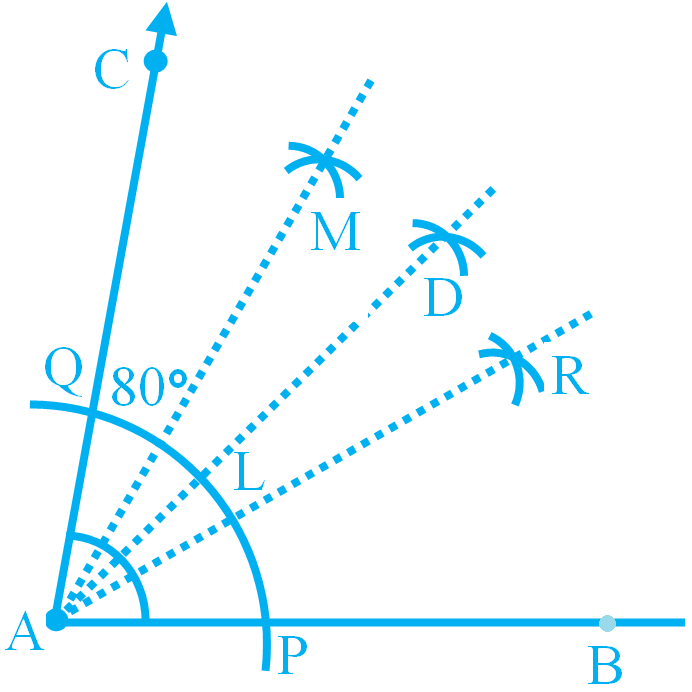
Here, to divide an angle of measure $80^\circ $ into four equal parts, we use the following steps of construction:
Step I: Draw a line segment $AB$ of any length. Place the centre of the protractor at A and the zero edge along $AB.$
Step II: Start with zero near $B$ and mark $C$ at $80^\circ .$​​​​​​​
Step III: Join $AC,$ then $\angle\text{BAC}$ is an angle of measure $80^\circ .$​​​​​​​
Step IV: With $A$ as centre and using compass, draw an arc that cuts both the rays of $\angle\text{A}$ at $P$ and $Q.$​​​​​​​
Step V: With $P$ as centre, draw $($in the interior of $\angle\text{A})$ an arc, whose radius is more than half the length of $PQ.$​​​​​​​

Step VI: With $Q$ as centre and the same radius, draw another arc in the interior of $A.$ Let the two arcs intersect at $D.$ Join $AD,$ cutting arc $PQ$ at $L.$ Then, $AD$ divides the $\angle\text{BCA}$ into two equal parts.
Step VII: Now, taking $P$ and $L$ as centre, having radius more than half of length $PL,$ draw two arcs respectively, which cut each other at $R.$​​​​​​​
Step VIII: Join $AR,$ which divides $\angle\text{BAD}$ into two equal parts.
Step IX: Now, taking $Q$ and $L$ as centre, having radius more than half of length $QL,$ draw two arcs respectively, which cut each other at $M.$​​​​​​​
Step X: Join $AM,$ which divide $\angle\text{CAD}$ into two equal parts. Thus, $AM, AD$ and $AR$ divide $\angle\text{BAC}$ into four equal parts.

Need a full question paper?

Generate a complete, print-ready paper with questions like this in minutes — across 16+ boards, with answer keys.
Start Generating Free

Similar questions

Draw the perpendicular bisector of a given line segment $AB$ of length 6cm.
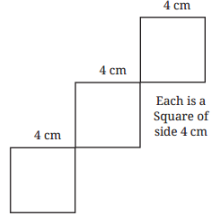
Construct the ‘Falling Squares” figure shown below:
Image
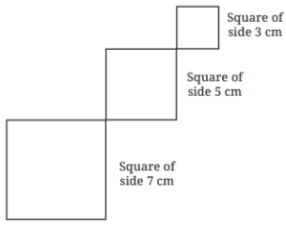
Make sure that the squares are aligned the way they are shown. Now, try this.
Image
Draw any line segment $\overline {AB} $. Mark any point $M$ on it. Through $M$ draw a perpendicular to $\overline {AB} . ($Use ruler and compasses$)$
Draw an angle of $45^\circ ,$ using a pair of compasses.
Draw an angle of measure $135^\circ $ and bisect it.
Using the number line, write the integer which is $5$ less than $3.$
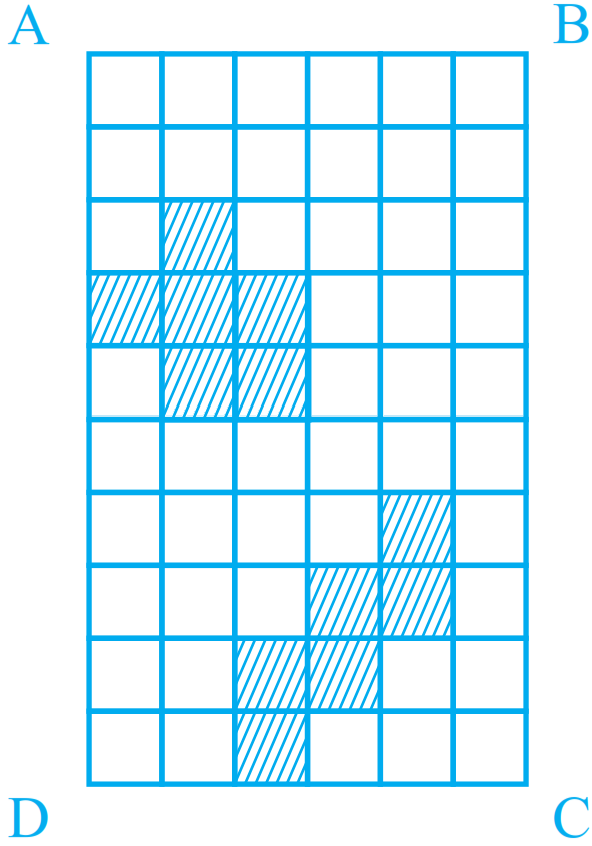
In Fig. each square is of unit length

$a.\ $What is the perimeter of the rectangle $ABCD?$
$b.\ $What is the area of the rectangle $ABCD?$
$c.\ $Divide this rectangle into ten parts of equal area by shading squares. $($Two parts of equal area are shown here$)$
$d.\ $Find the perimeter of each part which you have divided. Are they all equal?
The following fractions represent just three different numbers. Separate them into three groups of equivalent fractions, by changing each one to its simplest form.
$(a.)\frac{2}{12}$ $(b.)\frac{3}{15}$ $(c.)\frac{8}{50}$ $(d.)\frac{16}{100}$ $(e.)\frac{10}{60}$ $(f.)\frac{15}{75}$ $(g.)\frac{12}{60}$ $(h.)\frac{16}{96}$ $(i.)\frac{12}{75}$ $(j.)\frac{12}{72}$ $(k.)\frac{3}{18}$ $(l.)\frac{4}{25}$
Draw a circle and any two of its diameters. If you join the ends of these diameters, what is the figure obtained? What figure is obtained if the diameters are perpendicular to each other? How do you check your answer?
Give the correct matching of the statements of Column $A$ and Column $B.$
No.
Column A
 
Column B
$i$
Points are collinear.
$a.$
May be parallel or intersecting.
$ii$
Line is completely known.
 
$b.$
Are undefined terms in geometry.
$iii$
Two lines in a plane.
$c.$
If they lie on the same line.
$iv$
Relations between points and lines.
$d.$
Can pall through a point.
$v$
Three non-collinear points.
$e.$
Determine a plane.
$vi$
A plane extends.
$f.$
Are called incidence porperties.
$vii$
Indefinite number of lines.
$g.$
It two points are givne.
$viii$
Point, line and plane are.
$h.$
Indefinitely in all directions.