Question
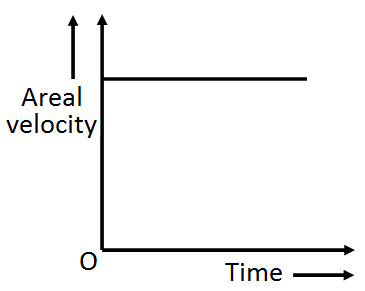
Draw areal velocity versus time graph for mars.

Answer

Areal velocity of Mars revolving around the Sun does not change with time according to Kepler’s law, i.e. it is constant with time. Then graph of a real velocity versus time is a straight line parallel to time axis.

Need a full question paper?

Generate a complete, print-ready paper with questions like this in minutes — across 16+ boards, with answer keys.
Start Generating Free

Similar questions

An engine is attached to a wagon through a shock absorber of length 1.5 m . The system with a total mass of $50,000 \mathrm{~kg}$ is moving with a speed of $36 \mathrm{~km} \mathrm{~h}^{-1}$ when the brakes are applied to bring it to rest. In the process of the system being brought to rest, the spring of the shock absorber gets compressed by 1.0 m . If $90 \%$ of energy of the wagon is lost due to friction, calculate the spring constant.
A certain material has refractive indices $1.56, 1.60$ and $1.68$ for red, yellow and violet light respectively.
  1. Calculate the dispersive power.
  2. Find the angular dispersion produced by a thin prism of angle $6^\circ$ made of this material.
A certain gas at atmospheric pressure is compressed adiabatically so that its volume becomes half of its original volume. Calculate the resulting pressure in $Nm^{-2}$. Take $\gamma=1.4$ for air.
A beam of light having wavelengths distributed uniformly between 450nm to 550nm passes through a sample of hydrogen gas. Which wavelength will have the least intensity in the transmitted beam?
Show that there are two values of time for a projectile when it is at same height. Also show that the sum of these two times is equal to the time of flight.OR
Prove the following relations by calculus method:
  1. $\text{s}=\text{ut}+\frac{1}{2}\text{at}^2$
  2. $\text{v}^2-\text{u}^2=2\text{as}$
“Politics is the art of the possible”. Similarly, “Science is the art of the soluble”. Explain this beautiful aphorism on the nature and practice of science.
A particle executes the motion described by $\text{x}(\text{t})=\text{x}_0(1-\text{e}^{-\gamma\text{t}});\text{t}\ge0,\text{x}_0>0.$
Where does the particle start and with what velocity?
Equal torqueses are applied on a cylinder and a sphere. Both have same mass and radius. The cylinder rotates about its axis and the sphere rotates about one of its diameters. Which will acquire greater speed? Explain why.
A raindrop of mass $1.00g$ falling from a height of $1km$ hits the ground with a speed of $50m s^{-1}$. Calculate:
  1. The loss of $P.E.$ of the drop.
  2. The gain in $K.E$. of the drop.
  3. Is the gain in $K.E$. equal to loss of $P.E$.? If not why.
Take $g = 10m s^{-2}$
  1. Describe a Carnot's cycle.
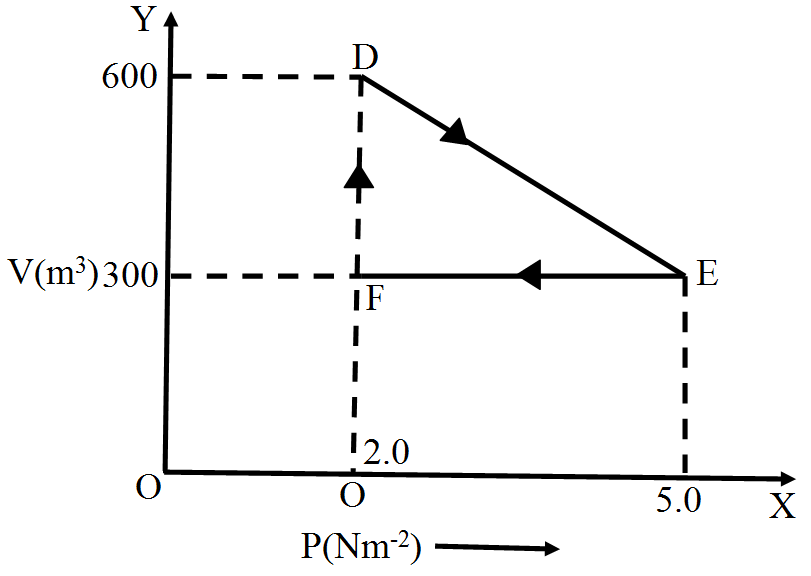
  2. A thermodynamic system is taken from an original state to an intermediate state by the linear process shown in below figure. Its volume is then reduced to the original value from $E$ to $F$ by an isobaric process. Calculate the work done by the gas from $D$ to $E$ to $F$.