Question
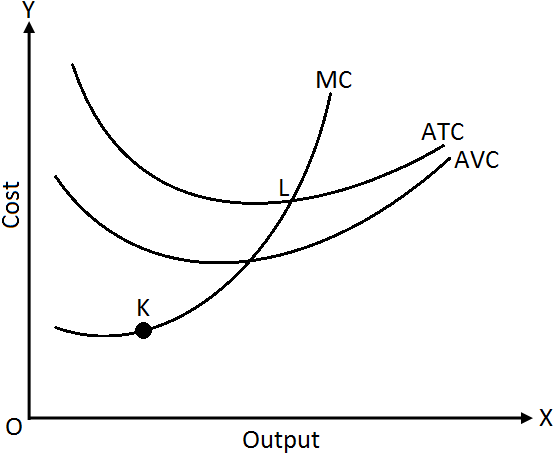
Draw Average Variable Cost (AVC), Average Total Cost (ATC) and Marginal Cost (MC) curves in a single diagram. State the relation between MC curve and AVC & ATC curves.
Answer


Relationship among MC, AVC & AC:
When,
MC < ATC or AVC, ATC or AVC falls
MC = ATC or AVC, ATC or AVC constant
MC > ATC or AVC, ATC or AVC rises.

Need a full question paper?

Generate a complete, print-ready paper with questions like this in minutes — across 16+ boards, with answer keys.

Start Generating Free

Similar questions

Market for a good is in equilibrium. There is simultaneous "increase". both in demand and supply of the good. Explain its effect on market price.
Define equilibrium price of a commodity. How is it determined? Explain with the help of a schedule.
What would be an effect on equilibrium price and equilibrium quantity when demand and supply both shift leftward?
OR
There is simultaneously decrease in demand and supply of a commodity, when it will result in:
  1. No change in equilibrium price (Case I).
  2. A fall in equilibrium price. (Case III).
OR
Market for a good is in equilibrium. There is simultaneous "decrease" in both demand and supply of the goods. Explain its effect on market price.
For a consumer to be in equilibrium why must marginal rate of substitution be equal to the ratio of prices of the two goods?
OR
Using indifference curve approach, explain the conditions of consumer's equilibrium.
OR
Why is the consumer in equilibrium when he buys only that combination of the two goods that is shown at the point of tangency of the budget line with an indifference curve? Explain.
OR
What are the conditions of consumer's equilibrium under the indifference curve approach? What changes will take place if the conditions are not fulfilled to reach equilibrium?
OR
State and explain the conditions of consumer's equilibrium in indifference curve analysis.
OR
Explain consumer equilibrium using the concept of budget line and indifference map or Interior Optimum Consumer Equilibrium.
OR
A consumer consumes only two of goods. For the consumer to be in equilibrium why must Marginal Rate of Substitution between the two goods must be equal to the ratio of prices of these two goods? Is it enough to ensure equilibrium?
OR
A consumer consumes only two goods. Explain the conditions that need to be satisfied for the consumer to be in equilibrium under indifference curve analysis.
OR
Show diagrammatically the conditions for consumer's equilibrium, in Hicksian analysis of demand.
OR
Explain the conditions of consumer's equilibrium under indifference curve approach.
Explain the law of returns to a factor with the help of total product and marginal product schedule.
Complete the following table.
Price (₹) 1 2 3 4 5 6 7
Units Sold 100 90 80 70 60 50 40
What is a production possibility frontier?
What is meant by producer's equilibrium? Explain the conditions of producer's equilibrium through the 'total revenue and total cost' approach. Use diagram.
Consider the following demand and supply functions for a good:
Quantity demanded = 160 - 2p
Quantity supplied = -40 + 2p
  1. Calculate the equilibrium price and quantity.
  2. Find out a price at which there is excess demand.
  3. Find out a price at which there is excess supply.
Explain the chain of effect of excess demand of a good on its equilibrium price.