Questions · Page 1 of 2

6 Marks Question

🎯

Test yourself on this topic

50 questions · timed · auto-graded

Question 16 Marks
Complete the following table:
Output (units) Average Fixed Cost ₹ Average Variable Cost ₹ Marginal Cost ₹ Total Cost ₹
1 120 40 .... ....
2 60 56 .... 232
3 .... 54 .... ....
4 30 .... 54 ....
5 .... .... .... ....
Answer
Output (units) Average Fixed Cost ₹ Average Variable Cost ₹ Marginal Cost ₹ Total Cost ₹
1 120 40 40 160
2 60 56 72 232
3 40 54 50 282
4 30 54 54 336
5        
View full question & answer
Question 26 Marks
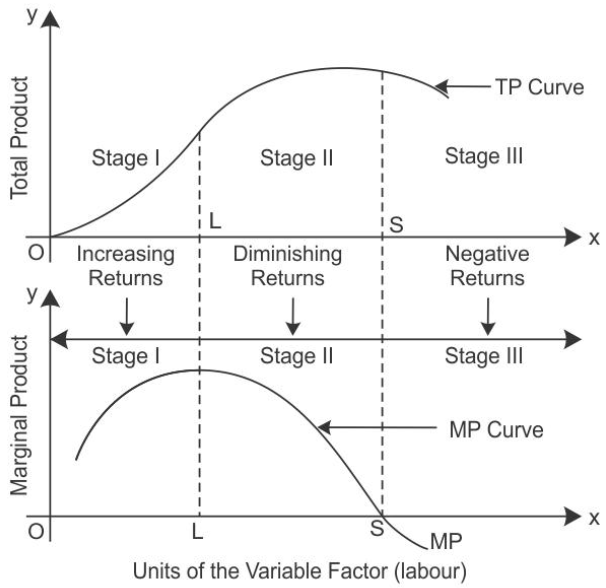
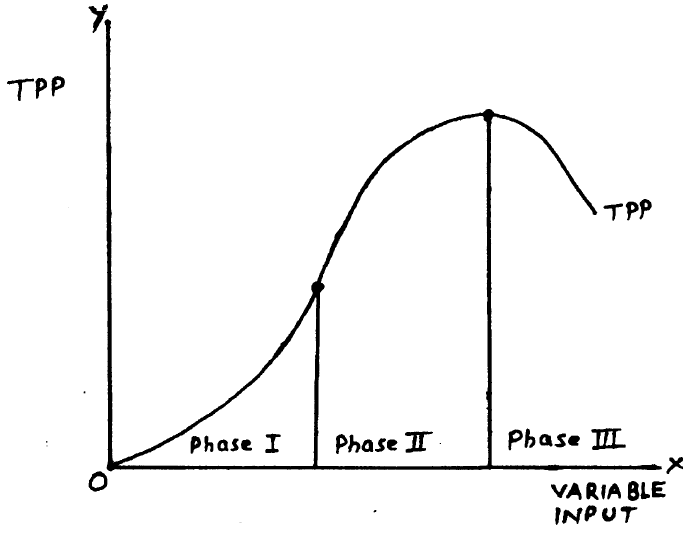
What are the different phases in the Law of Variable Proportions in terms of marginal product? Give reason behind each phase. Use diagram.
Answer
The Phases are:Phase: I MP rises up to A
Phase: II MP falls but is positive i.e. between A and B.
Phase: III MP falls and is negative i.e. after B
Reasons:
Phase I: Initially variable input is too small as compared to the fixed input, As production is increased there is specialisation of variable inputs and efficient use of the fixed input leading to rise in productivity of the variable input. As a result, MP raises.
Phase II: After a level of output a pressure on fixed input leads to fall in productivity of the variable input. MP starts falling but remains positive.
Phase III: The amount of variable input becomes too large in comparison to the fixed input causing decline in total product. MP becomes negative.
View full question & answer
Question 36 Marks
Complete the following table:
Output (units) Total Cost ₹ Average Variable Cost ₹ Marginal Cost ₹ Average Fixed Cost ₹
0 30      
1 .... .... 25 30
2 78 .... .... ....
3 .... 23 .... 10
4 .... .... 23 ....
5 150 .... .... 6
Answer
Output Total cost AVC MC AFC
0 30 - - -
1 55 25 25 30
2 78 24 23 15
3 99 23 21 10
4 122 23 23 7.5
5 150 24 28 6
View full question & answer
Question 46 Marks
Complete the following table:
Output (units) Average Fixed Cost ₹ Marginal Cost ₹ Average Variable Cost ₹ Average Cost ₹
1 60 20 .... ....
2 .... .... 19 ....
3 20 .... 18 ....
4 .... 18 .... ....
5 12 .... .... 31
Answer
Output (units) Average Fixed Cost ₹ Marginal Cost ₹ Average Variable Cost ₹ Average Cost ₹
1 60 20 20 80
2 30 18 19 49
3 20 16 18 38
4 15 18 18 33
5 12 23 19 31
View full question & answer
Question 56 Marks
Giving reasons, state whether the following statements are true or false:
  1. Average product will increase only when marginal product increases.
  2. With increase in level of output, average fixed cost goes on falling till it reaches zero.
  3. Under diminishing returns to a factor, total product continues to increase till marginal product reaches zero.
Answer
  1. False: Average product will increase only when marginal product is greater than average product whether MP is rising or falling.
  2. False: $AFC=\frac{TFC}{output}.$ TFC is constant and positive. So with an increase in output AFC will fall but can never be zero.
  3. True: Under diminishing returns, MP falls. TP increases till MR is positive.
View full question & answer
Question 66 Marks
State whether the following statements are true or false. Give reasons for your answer:
  1. When marginal revenue is constant and not equal to zero, then total revenue will also be constant.
  2. As soon as marginal cost starts rising, average variable cost also starts rising.
  3. Total product always increases whether there is increasing returns or diminishing returns to a factor.
Answer
  1. False: When MR is constant and not equal to zero, it may be positive or negative TR increases when MR is positive and decreases when it is negative.
  2. False: AVC will rise only when MC>AVC whether MC is rising or falling.
  3. False: TP increases under Increasing Returns. It also increases under Diminishing returns till MP is positive. TP falls under Diminishing returns when MP is negative.
View full question & answer
Question 76 Marks
Explain the law of returns to a factor with the help of total product and marginal product schedule.
Answer
Units of variable

factor
TP

(Units)
MP

(Units)
1 2 2
2 6 4
3 9 3
4 9 0
5 6 -3
When more and more units of a variable factor are employed with fixed factors, MP and TP change in the following manner:
  1. MP increases and TP increases at an increasing rate. (upto 2 units of variable factor)
  2. MP falls and is positive and TP increases at a decreasing rate. (from 3rd to 4th unit of variable factor)
  3. MP falls and is negative, TP falls. (after 4 units of variable factor)
View full question & answer
Question 86 Marks
Giving reasons, state whether the following statements are true or false:
  1. Average cost falls only when marginal cost falls.
  2. The difference between average total cost and average variable cost is constant.
  3. When total revenue is maximum, marginal revenue is also maximum.
Answer
  1. It is false. Average cost falls only when marginal cost is less then average cost. Even when MC is rising but is less than AC AC will fall.
  2. It is false. The difference between ATC and AVC is AFC and AFC is never constant.
  3. It is false. Total revenue is maximum when marginal revenue is zero.
View full question & answer
Question 96 Marks
Explain, with the help of numerical examples, the effect on total output of a good when all the inputs used in production of that good are increased simultaneously and in the same proportion.
Answer
Units of Capital Units of Labour Total Output % Change in Inputs % Change in Output Returns to Scale
20 150 3000 - - -
40 300 7500 100 150 Increasing.
60 450 12000 50 60 Increasing.
80 600 16000 33 33 Constant.
100 750 18000 25 13 Decreasing.
View full question & answer
Question 106 Marks
Identify the three phases of the Law of Variable Proportions from the following and also give reason behind each phase:
Units of Variable Input
(Units)
Total Physical Product
1 10
2 22
3 30
4 35
5 30
Answer
Units of Variable
(input)
TPP
(units)
MPP
(units)
Phase  
1 10 10 TPP rises at increasing rate. Phase I
2 22 12 MPP rises.
3 30 8 TPP rises at decreasing rate. Phase II
4 35 5 MPP falls but is Positive.
5 30 - 5 TPP falls but is Positive. Phase III
View full question & answer
Question 116 Marks
Calculate total cost and average variable cost of a firm at each given level of output from its cost schedule given below.
Output
(units)
Average fixed cost
(Rs.)
Marginal cost
(Rs.)
1 60 32
2 30 30
3 20 28
4 15 30
5 12 35
6 10 43
Answer
Output

(Units)
AFC

(Rs.)
TFC

(Rs.)
MC

(Rs.)
TVC

(Rs.)
AVC

(Rs.)
TC

(Rs.)
1 60 60 32 32 32 92
2 30 60 30 62 31 122
3 20 60 28 90 30 150
4 15 60 30 120 30 180
5 12 60 35 155 31 215
6 10 60 43 198 33 258
View full question & answer
Question 126 Marks
Explain the law of variable proportions with the help of total product curve. Use diagram.
Answer
Law of variable proportion: Law of variable proportion states that as more of the variable factor input is combined with the fixed factor input, a point will eventually be reached where the marginal product of the variable factor input starts declining.
Stage I: As more units of factor input are used, MP tends to rise till $3$ units of factor input are used. Here, the total product increases at an increasing rate which is called increasing returns to the factor input.
Stage II: However, when the $4^{th}$ unit of factor input is used, the diminishing returns sets in where MP starts decreasing and TP increases at a decreasing rate. Diminishing MP reduces to zero. The total output is the maximum when the marginal output is zero.
Stage III: When MP is negative, TP starts declining from $34$ to $10$ when the $9^{th}$​​​​​​​ unit is employed.
View full question & answer
Question 136 Marks
Complete the following table:
Output Units Marginal Cost ₹ Average Variable Cost ₹ Total Cost ₹ Average Fixed Cost ₹
1 60 .......... 120 ..........
2 .......... .......... 174 ..........
3 .......... 54 .......... ..........
4 54 .......... .......... 15
5 .......... 57 345 ..........
Answer
Output Units Marginal Cost Average Variable Cost Total Cost Average Fixed Cost
1 60 60 120 60
2 54 57 174 30
3 48 54 222 20
4 54 54 276 15
5 69 57 345 12
View full question & answer
Question 146 Marks
Explain the concepts of Opportunity Cost and Marginal Rate of Transformation using a production possibility schedule based on the assumption that no resource is equally efficient in production of all goods.
Answer
Suppose the only two goods produced are X and Y.
Combinations X (Units) Y (Units) $\text{MRT}\left(=\Delta{\text{Y}}{:}\Delta{\text{X}}\right)$
A 0 20 -
B 1 18 2Y:1X
C 2 14 4Y:1X
D 3 8 6Y:1X
E 4 0 8Y:1X
Opportunity Cost refers to the quantity of one good foregone to obtain more quantity of the other good. For example, when we move from combination A to B the economy foregoes 2 units of Y to obtain one more units of X. So opportunity cost of obtaining 1X is 2Y.
MRT means quantity of one good sacrificed to produce an additional unit of the other good. For example, When we move from combination B to C the MRT is 4Y:1X. MRT increases as to produce more of good X. We need to transfer less and less efficient resources from good Y.
View full question & answer
Question 156 Marks
Complete the following table:
Output units
Total cost Rs.
Average variable cost Rs.
Marginal cost Rs.
Average fixed costRs.
0
30


1
---
---
20
---
2
68
---
---
---
3
84
18
---
---
4
---
---
18
---
5
125
19
---
6
Answer
Output units
Total cost Rs.
Average variable cost Rs.
Marginal cost Rs.
Average fixed costRs.
0
30


1
50
20
20
30
2
68
19
18
15
3
84
18
16
10
4
102
18
18
7.5
5
125
19
23
6
View full question & answer
Question 166 Marks
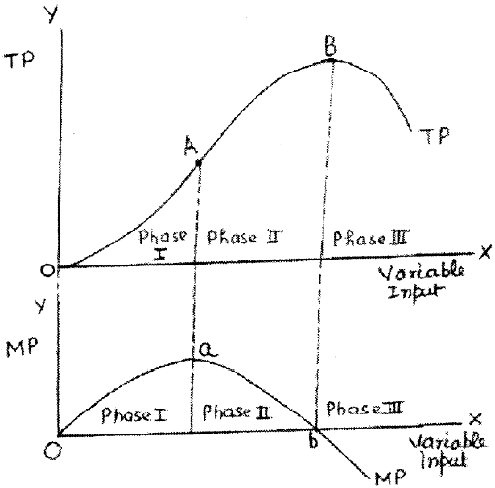
State the different phases of changes in Total Product and Marginal Product in the Law of Variable Proportions. Also show the same in a single diagram.
Answer
The Phases are:Phase: I TP rises at increasing rate i.e. up to A in diagram.
MP rises i.e. up to 'a'.Phase: II TP rises at decreasing rate i.e. between A and B. MP falls and remains positive between 'a' and 'b'.
Phase: III TP falls i.e. after B. MP falls and is negative i.e. after 'b'.
View full question & answer
Question 176 Marks
Complete the following table:
Output units
Total cost Rs.
Average variable cost Rs.
Marginal cost Rs.
Average fixed cost Rs.
0
30


1
---
---
20
---
2
68
---
---
---
3
84
18
---
---
4
---
---
18
---
5
125
19
---
6
Answer
Output units
Total cost Rs.
Average variable cost Rs.
Marginal cost Rs.
Average fixed costRs.
0
30


1
50
20
20
30
2
68
19
18
15
3
84
18
16
10
4
102
18
18
7.5
5
125
19
23
6
View full question & answer
Question 186 Marks
Assuming that no resource is equally efficient in production of all goods, name the curve which shows production potential of the economy. Explain, giving reasons, its properties.
Answer
The curves is called production possibilities frontier or curve. Properties:
  1. PPF slope downwards from left to right:
It is because to produce more quantity of one good, some quantity of other good has to be sacrificed because resources are limited.
  1. PPF is Concave:
This implies that slope of the curve (i.e. marginal rate of transformation) increases as we move along the curve from left to right. MRT increases because no resource is equally efficient in production of all goods so that to obtain more quantity of one good, the quantity of the other good is sacrificed at an increasing rate.
View full question & answer
Question 196 Marks
Complete the following table:
Output units
Total cost Rs.
Average variable cost Rs.
Marginal cost Rs.
Average fixed costRs.
0
30


1
---
---
20
---
2
68
---
---
---
3
84
18
---
---
4
---
---
18
---
5
125
19
---
6
Answer
Output units
Total cost Rs.
Average variable cost Rs.
Marginal cost Rs.
Average fixed costRs.
0
30


1
50
20
20
30
2
68
19
18
15
3
84
18
16
10
4
102
18
18
7.5
5
125
19
23
6
View full question & answer
Question 206 Marks
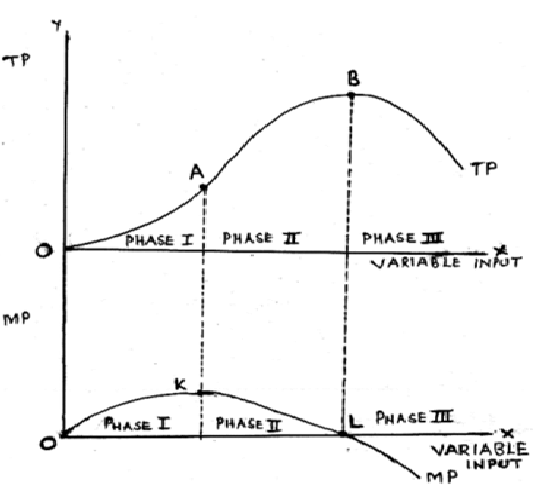
Explain the Law of variable Proportion with the help of total product and marginal product curves.
Answer

According to the Law of Variable Proportions, when only one input is increased while others are held unchanged, MP and TP change in the following manner:
Phase-I: MP increases and TP increases at increasing rate i.e. up to A on TP curve (upto K on MP curve) because there is under utilization of the fixed input.
Phase-II: MP decreases but is positive and TP increases at decreasing rate i.e. up to B on TP curve (upto L on MP curve) because there is pressure on fixed input.
Phase III: MP decrease and is negative and TP falls i.e. after B on TP curve (after L on MP curve) because there is too much of variable input in relation to fixed input.
View full question & answer
Question 216 Marks
Explain producer’s equilibrium with the help of a marginal cost and marginal revenue schedule.
Answer
Price per unit OUTPUT TR TC MR MC
(Rs.) (Units) (Rs.) (Rs.) (Rs.) (Rs.)
8 1 8 6 8 6
7 2 14 11 6 5
6 3 18 15 4 4
5 4 20 18 2 3
There are two conditions of producer’s equilibrium:
  1. MC = MR
  2. MC is greater than MR after equilibrium level of output.
The conditions are fulfilled at 3 units of output.
View full question & answer
Question 226 Marks
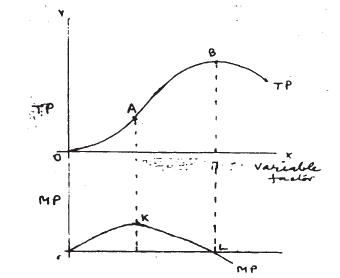
Explain the law of variable proportions with the help of total product and marginal product curves.
Answer

According to the Law of Variable Proportions when only one input is increased while others are held unchanged, MP and TP change in the following manner:
Phase-I: MP increases and TP increases at increasing rate i.e. up to A on TP curve. (upto K on MP curve)
Phase-II: MP decreases but is positive and TP increases at decreasing rate i.e. up to Bon TP curve. (upto L on MP curve)
Phase-III: MP decrease and is negative and TP falls i.e. after B on TP curve. (after L on MP curve)
View full question & answer
Question 236 Marks
State whether the following statements are true or false. Give reasons for your answer.
  1. When total revenue is constant average revenue will also be constant.
  2. Average variable cost can fall even when marginal cost is rising.
  3. When marginal product falls, average product will also fall.
Answer
  1. False because when TR is constant. AR will fall as output increases.
  2. True, provided MC
  3. False, because AP falls only when MP
View full question & answer
Question 246 Marks
Giving reasons, state whether the following statements are true or false:
  1. When there are diminishing returns to a factor, total product always decreases.
  2. Total product will increase only when marginal product increases.
  3. When marginal revenue is zero, average revenue will be constant.
Answer
  1. False because diminishing returns means diminishing MP, and so long as MP is positive, TP increases even though MP is falling.
  2. False because when MP decreases, TP will increase so long as MP is positive.
  3. False because MR = 0 is possible when TR is constant and as TR is constant AR will fall as output is increased.
View full question & answer
Question 256 Marks
Explain “Returns to Scale” using numerical examples. Give reasons.
Answer
Three diffrent Situations of return to scale with numerical examples Reason behind increasing and diminishing returns to scale.
View full question & answer
Question 266 Marks
Explain the Law of Variable Proportions through the behaviour of both Total Product and Marginal Product. Give reasons.
Answer
Statement of law through TP.Statement of law through MP.
Reasons behind the law.
View full question & answer
Question 276 Marks
State the phases of the law of variable proportions in terms of total physical product. Use diagram.
Answer

Statement of three phases of law of variable proportion in terms of total physical product using the diagram.
View full question & answer
Question 286 Marks
The total fixed cost of a firm is Rs. 12. Given below is its marginal cost schedule. Calculate total cost and average variable cost for each given level of output.
Output (units) 1 2 3 4 5 6
Marginal cost (Rs.) 9 7 2 4 8 12
Answer
Output
(Units)
F.C.
(Rs.)
M.C.
(Rs.)
TVC
(Rs.)
AVC
(Rs.)
TC
(Rs.)
1 12 9 9 9 21
2 12 7 16 8 28
3 12 2 18 6 30
4 12 4 22 5.5 34
5 12 8 30 6 42
6 12 12 42 7 54
View full question & answer
Question 296 Marks
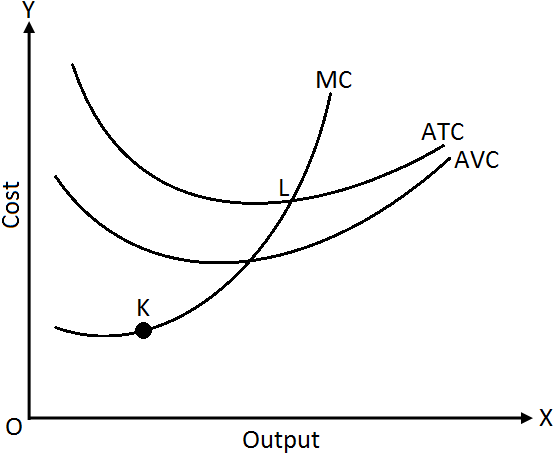
Draw Average Variable Cost (AVC), Average Total Cost (ATC) and Marginal Cost (MC) curves in a single diagram. State the relation between MC curve and AVC & ATC curves.
Answer

Relationship among MC, AVC & AC:
When,
MC < ATC or AVC, ATC or AVC falls
MC = ATC or AVC, ATC or AVC constant
MC > ATC or AVC, ATC or AVC rises.
View full question & answer
Question 306 Marks
Explain the conditions of producer's equilibrium in terms of Marginal Revenue and Marginal Cost.
Answer
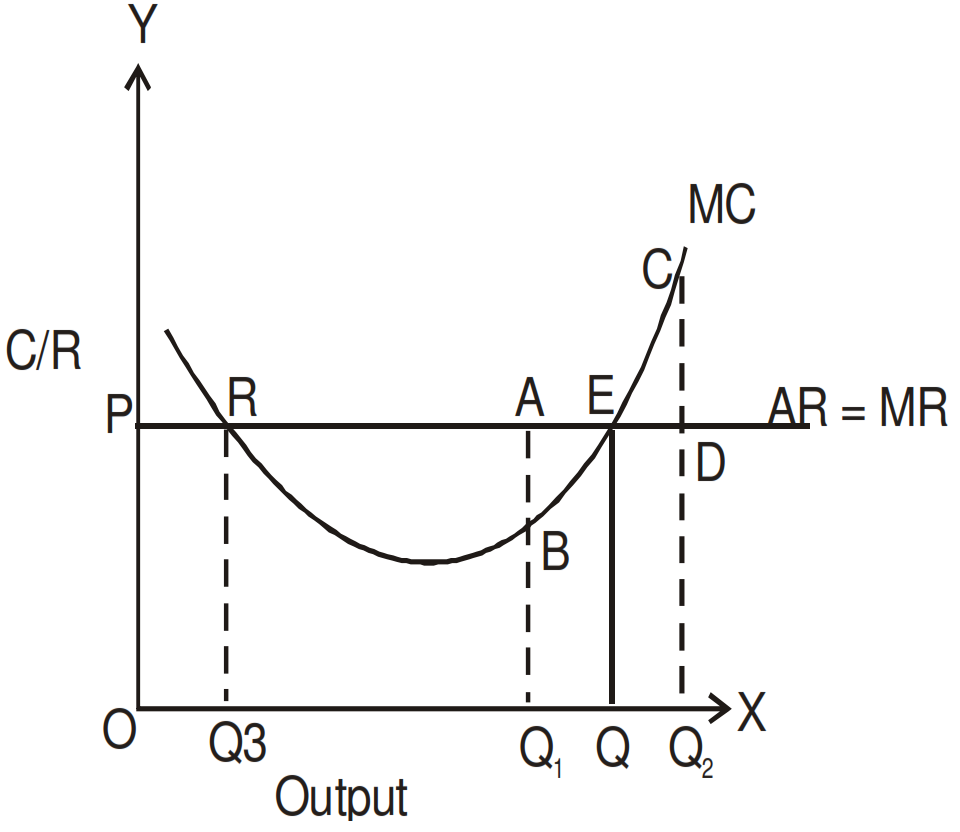
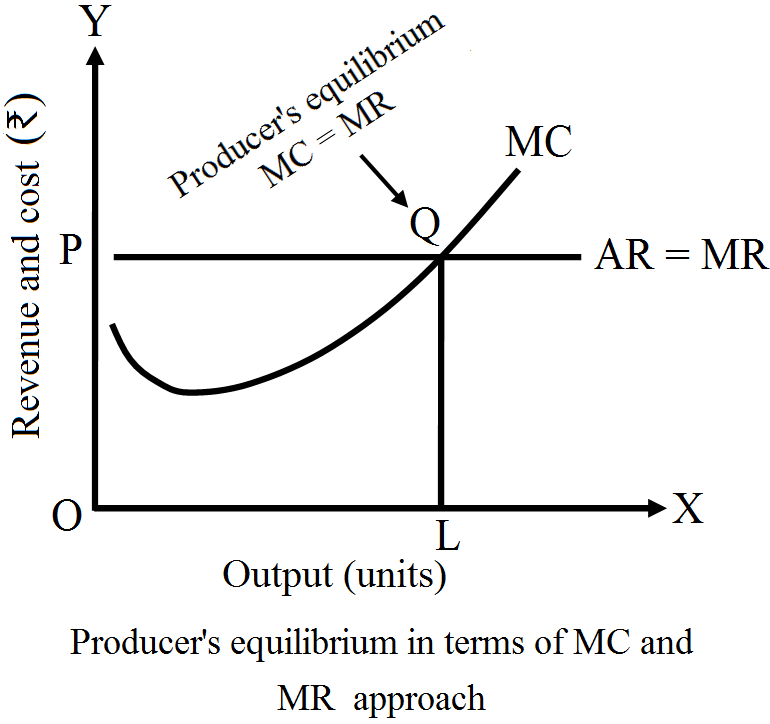
"The producer's equilibrium refers to the situation in which producer maximizes his profits (or minimizes his loss) and the producer has no intention to make any changes in his existing production or to make any changes in his existing expenditure on means of production". Profit of the firm operating in perfect competition market, is maximised where the price line (AR = MR) intersects the MC curve and MC should be rising.
ASSUMPTIONS:
  1. Rational behaviour of producer.
  2. The goal of producer is profit maximisation.
  3. Price of means of production remains constant.
  4. There is perfect competition exist in market.
  5. Technique of production and management remains constant.
CONDITIONS FOR PRODUCERíS EQUILIBRIUM:
  1. MR = MC.
  2. MC should be rising at that level of output.
If the producer is producing $OQ_1$ units of commodity (output less than OQ), MR is equal to $AQ_1$ and MC is equal to $BQ_1$ which means MC < MR. Which means that the cost incurred on producing additional unit is lesser than the revenue received from the sale of that unit, which indicates that the producer is receiving profit on that unit. So in order to maximise total profit producer will further increase the level of output until MC becomes equals to MR.
But if the producer is producing $OQ_2$ units of commodity (output more than OQ), MR is equal to $DQ_2$ and MC is equal to $CQ_2$ which means MC > MR. Which means that the cost incurred on producing additional unit is more than the revenue received from the sale of that unit, which indicates that the producer is receiving loss on that unit. So in order to minimise the loss or to maximise the profit producer will decrease the level of output until MC becomes equals to MR. But if the producer is producing at $OQ_3$ units of the commodity then MR is equal to MC but MC is falling means first condition for equilibrium is satisfied but not the second condition. At this particular unit firm will receive only loses because on all unit before this output level MC > MR means firm recovered only loss on all those units but if firm further increases production beyond this level then they will receive super normal profit on all units. So the firm will increses the level of output till again MR and MC both becomes equal. At OQ units of commodity then MR and MC both are equal to EQ which means MC = MR and MC is rising. Which means both the conditions for producerís equilibrium are satisfied at this level means firm is receiving maximum total profit at this output level. So producer will maintain this level of output for maximum profit.
View full question & answer
Question 316 Marks
What is meant by “diminishing returns to a factor”? Discuss any two reasons for the operation of diminishing returns to a factor.
Answer
Diminishing returns to a variable input referred to a stage in production when with the employment of more and more units of variable factor with the given fixed factor, marginal product (MP) decreases and total product (TP) increases at diminishing rate.
Reasons for the decreasing returns to a variable factor are:
  1. Over-utilisation of the fixed factor: As we keep on increasing the variable factor along with the fixed factor eventually a position comes when the fixed factor has its limits and starts yielding diminishing returns.
  2. Improper coordination between Fixed and Variable factors: After a certain level of employment, the production process becomes too crowded with the variable input and factor proportion tends to become less and less suitable for the production.
View full question & answer
Question 326 Marks
Complete the following table:
Output (Units)
Average Cost (₹)
Marginal Cost (₹)
1
12
-
2
10
-
3
-
10
4
10.5
-
5
11
-
6
-
17
Answer
Output (Units)
Average Cost (₹)
Total Cost (₹)
Marginal Cost (₹)
1
12
12
-
2
10
20
$8\Big[\frac{\Delta\text{TC}}{\Delta\text{Q}}\Big]$
3
$10\Big[\frac{\text{TC}}{\text{Q}}\Big]$
$30(\sum\text{MC})$
10
4
10.5
42 [AC × Q]
$12\Big[\frac{\Delta\text{TC}}{\Delta\text{Q}}\Big]$
5
11
55
$13\Big[\frac{\Delta\text{TC}}{\Delta\text{Q}}\Big]$
6
$12\Big[\frac{\text{TC}}{\text{Q}}\Big]$
72
17
View full question & answer
Question 336 Marks
A producer starts a business by investing his own savings and hiring the labour. Identify implicit and explicit costs from this information. Explain.
Answer
  1. For producing a commodity, a firm requires factor inputs (like services of land, labour, capital etc.) and non-factor inputs (like raw material, electricity, fuel etc.).
  2. Actual money spent by a firm on Pats buying and hiring of factor and non factor inputs is called explicit cost. As per question, a producer is hiring the labour, than the wages and salary paid to labour is a explicit cost.
  3. Implicit cost is the imputed or estimated value of inputs supplied by the owner of the firm himself. As, per question, if a producers start a business by investing his own savings, than the imputed interest on self-supplied capital he earned is a implicit cost.
View full question & answer
Question 346 Marks
Complete the following table:
Output (Units)
AFC (₹)
AC (₹)
AVC (₹)
MC (₹)
1
-
140
-
50
2
-
-
45
-
3
-
-
-
45
4
22.5
-
48
-
5
18
-
52
-
Answer
Output AFC AC AVC MC TVC TFC
1 $90\Big[\frac{\text{TFC}}{\text{Q}}\Big]$ 140 $50\Big[\frac{\text{TFC}}{\text{Q}}\Big]$ 50 50 [=MC of unit 1] 90 [4 × 22.5]
2 $45\Big[\frac{\text{TFC}}{\text{Q}}\Big]$ 90 [AVC + AFC] 45 $40\Big[\frac{\Delta\text{TVC}}{\Delta\text{Q}}\Big]$ 90 [AVC × Q] 90
3 $30\Big[\frac{\text{TFC}}{\text{Q}}\Big]$ 75 [AVC + AFC] $45\Big[\frac{\text{TFC}}{\text{Q}}\Big]$ 45 135 [90 + 45] 90
4 22.5 70.5 [AVC + AFC] 48 $57\Big[\frac{\Delta\text{TVC}}{\Delta\text{Q}}\Big]$ 192 [AVC × Q] 90
5 18 70 [AVC + AFC] 52 $68\Big[\frac{\Delta\text{TVC}}{\Delta\text{Q}}\Big]$ 260 [AVC × Q] 90
View full question & answer
Question 356 Marks
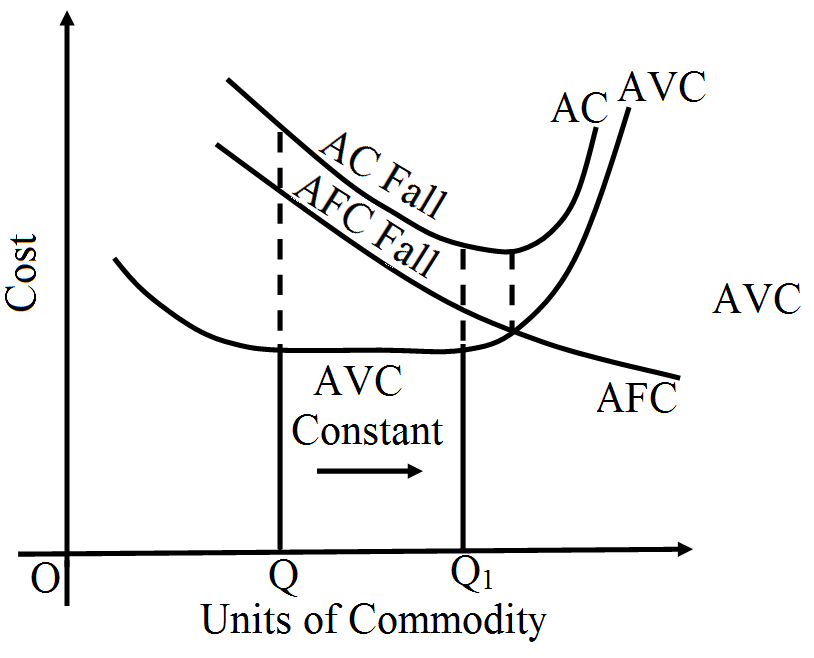
Show the behaviour of AC when AVC per unit of output is constant.
Answer
Average cost will fall when AVC per unit of output remains constant. It is so because AC includes AFC also and AFC always fall with increase in production. It can be explain with the help of given diagram.
In the given diagram AVC is constant from the range of output OQ to OQ,. As we know, AC is sum of AVC and AFC. It can be seen from the above diagram that when AVC is constant AFC is falling which makes the Average Cost to fall. So, when AVC remains constant, AC falls.
View full question & answer
Question 366 Marks
Complete the following table:
Output (Units)
Total Cost (₹)
Average Variable Cost (₹)
MC (₹)
1
90
-
30
2
-
27
-
3
-
-
27
4
180
30
-
Answer
Output TC AVC MC TVC TFC AFC AC
1 90 $30\big[\frac{\text{TVC}}{\text{Q}}\big]$ 30 30 [MC of 1 unit] 60 [TC - TVC] 60 $90\big[\frac{\text{TC}}{\text{Q}}\big]$
2 114 [AC × Q] 27 $24\big[\frac{\Delta\text{TVC}}{\Delta\text{Q}}\Big]$ 54 [AVC × Q] 60 30 578 [AVC + AFC]
3 141 [AC × Q] $$$27\Big[\frac {\text{TVC}}{\text{Q}}\Big]$ 27 81 [54 + 27] 60 20 47 [AVC + AFC]
4 180 30 $39\Big[\frac{\Delta\text{TVC}}{\Delta\text{Q}}\Big]$ 120 [TC - TFC] 60 15 45
View full question & answer
Question 376 Marks
A farmer takes a farm on rent and carries on farming with the help of his family members. Identify explicit and implicit costs from this information. Explain.
Answer
  1. For producing a commodity, a firm requires factor inputs (like services of land, labour, capital etc.) and non-factor inputs (like raw material, electricity, fuel etc.).
  2. Actual money spent by a firm on buying and hiring of factor and nonfactor inputs is called explicit cost. As per question, a farmer takes a farm on rent. So, the rent he pays to landlord is the explicit cost.
  3. Implicit cost is the imputed or estimated value of inputs supplied by the owner of the firm himself. As per question, if a farmer carries on farming with the help of family members, even then the imputed wages will be an implicit cost.
View full question & answer
Question 386 Marks
What are the average fixed cost, average variable cost and average cost of a firm? How are they related?
Answer
  1. Average Fixed Cost: It is the per unit fixed cost of producing a commodity. It is calculated by dividing the total fixed cost by the number of units of commodity produced. For example, if total fixed cost of manufacturing 100 fans is Rs 7,500, then:
$\text{AFC}=\frac{\text{Tatal Fixed Cost}}{\text{No. of units produced}}$

$\text{AFC}=\frac{7500}{100}=\text{Rs}\ 75$

Beware that fixed cost (i.e., total fixed cost) remains fixed or same at different levels of production. As a result when units of production increase, AFC falls as depicted in Fig.

3.7. Thus AFC decreases as level of output is increased.
  1. Average Variable Cost: It is per unit variable cost of producing a commodity. It is worked out by dividing the total variable cost by the number of units produced. For instance if total variable cost of manufacturing 100 fans is Rs 12,500, then:
$\text{AVC}=\frac{\text{Total Variable Cost}}{\text{No. of units produced}}$

$\text{AVC}=\frac{12,500}{100}=\text{Rs}\ 125$

It should be kept in mind that in the beginning AVC decreases but after reaching the stage of minimum cost, it starts increasing as shown in Fig. 3.7. AVC curve is a dish shaped (U-shaped) curve.
  1. Average total cost: It is per unit cost of production of a commodity. It is worked out by dividing the total cost (fixed cost + variable cost) by the number of units produced. Continuing the above example if total cost of manufacturing 100 fans is र 20,000 (fixed cost 7,500 + variable cost 12,500), then:
$\text{ATC}=\frac{\text{Total Cast}}{\text{No. of units produced}}$

$\text{ATC}=\frac{20,000}{100}=\text{Rs}\ 200$

Like total cost which is the sum of total fixed cost and total variable cost, ATC is also the sum of AFC and AVC. Symbolically:

ATC = AFC + AVC.
View full question & answer
Question 396 Marks
The total fixed cost of a firm is ₹ 12. Given below is its marginal cost schedule. Calculate total cost and average variable cost for each given level of output.
Output
1
2
3
4
5
6
Marginal Cost ()
9
7
2
4
8
12
Answer
Output (Units)
MC (Given)
$\text{TVC}=\sum\text{MC}$
TFC
TC = TFC + TVC
$\text{AVC}=\frac{\text{TVC}}{\text{Output}}$
1
9
9
12
21
9
2
7
16
12
28
8
3
2
18
12
30
6
4
4
22
12
34
5.5
5
8
30
12
42
 
6
12
42
12
54
 
View full question & answer
Question 406 Marks
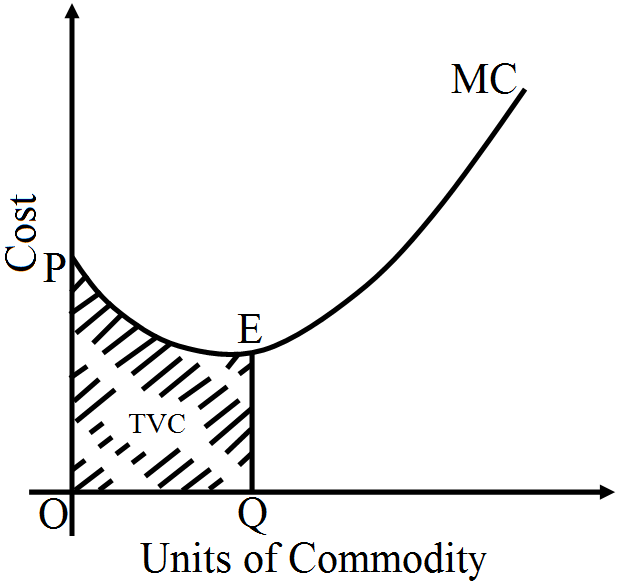
Explain that area under marginal bar cost (MC) is total variable cost (TVC).
Answer
As we know that MC is addition to the total variable cost when an additional unit is produced. This means that total variable cost (TVC) is the sum of marginal cost, since total fixed cost remains the same. This is proved with the help of given figure. Assuming output at OQ, an imaginary marginal cost (MC) is drawn in diagram. Thus, under assumption of marginal cost curve, total variable cost (TVC) is equal to the area under marginal cost curve. For example, at OQ units of output, TVC is equal to the shaded area OPEQ. It can be explained with the help of the following table.
Units of Commodity
MC
$\text{TVC}=\sum\text{MC}$
0
0
0
1
30
30
2
10
40
3
15
55
4
30
85
5
35
120
View full question & answer
Question 416 Marks
Find out (a) explicit cost and (b) implicit cost from the following data:
S No
 
 
1.
Investment in fixed assets
(Rs Thousand)
2.
Borrowings at 12% interest per annum.
2000
3.
Wages paid during the year
1500
4.
Annual rental value of the owner's factory building
120
5.
Annual depreciation
100
6.
Estimated annual value of the management services of the owner
100
Answer
Case I-When Calculating Accounting Cost Depreciation is a Explicit Cost:
  1. Explicit cost = Interest on borrowings = 180 1500 thousand @12%) + Wages paid = 120 + Depreciation = 100 = Total 400 (Rs in Thousand).
  2. Implicit cost: Imputed interest on Own investment of 500 (2000-1500) Thousand.
@ 12% = 60 + Rental value = 100 + Imputed value of the owner's services = 240 = Total 400 R in Thousand).
Case II--When Calculating Economic Cost Depreciation is a Implicit Cost:
  1. Explicit cost = Interest on borrowings = 180 R1500 thousand @12%) + Wages paid = 120 = Total 300 ( in Thousand).
  2. Implicit cost: Imputed interest on Own investment of 500(2000-1500) Thousand.
@ 12% = 60 + Rental value = 100 + Imputed value of the owner's services = 240 + Depreciation = 100 = Total 500€ in Thousand).
View full question & answer
Question 426 Marks
What is the relationship between marginal product and marginal cost?
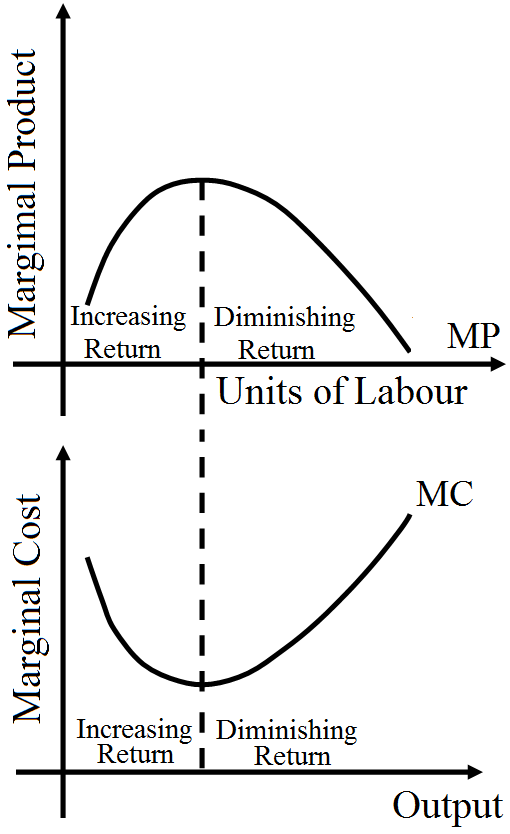
Answer
  1. Diminishing returns determines the shape of both of these curves.
  2. When marginal product is rising, marginal cost is falling.
  3. When diminishing returns occur, marginal product begins falling and marginal cost begins rising.
​​​​​​​
View full question & answer
Question 436 Marks
What are the total fixed cost, total variable cost and total cost of a firm? How are they related?
Answer
Total Fixed Cost: This refers to the costs incurred by a firm in order to acquire the fixed factors for production like cost of machinery, buildings, depreciation, etc. In short run, fixed factors cannot vary and accordingly the fixed cost remains the same through all output levels. These are also called overhead costs.
Total Variable Cost: This refers to the costs incurred by a firm on variable inputs for production. As we increase quantities of variable inputs, accordingly the variable cost also goes up. It is also called 'Prime cost' or 'Direct cost' and includes expenses like - wages of labour, fuel expenses, etc.
Total Cost (TC): The sum of total fixed cost and total variable cost is called the total cost.
Total cost = Total fixed cost + Total variable cost
TC = TFC + TVC
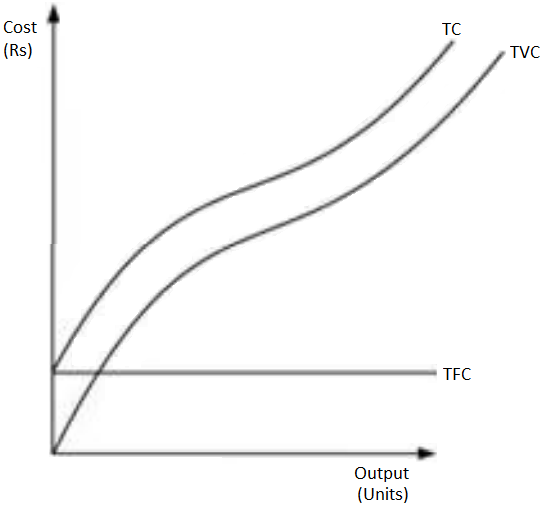
Relationship between TC, TFC, and TVC:
  1. TFC curve remains constant throughout all the levels of output as fixed factor is constant in short run.
  2. TVC rises as the output is increased by employing more and more of labour units. Till point Z, TVC rises at a decreasing rate, and so the TC curve also follows the same pattern.
  3. The difference between TC and TVC is equivalent to TFC.
  4. After point Z, TVC rises at an increasing rate and therefore TC also rises at an increasing rate.
  5. Both TVC and TFC is derived from TC i.e. TC = TVC + TFC.
View full question & answer
Question 446 Marks
Complete the following table:
Output (Units)
ATC (₹)
AVC (₹)
MC (₹)
1
54
30
30
2
-
24
-
3
-
-
24
4
33
-
-
Answer
Output ATC AVC MC AFC TFC TVC
1 54 30 30 24 [ATC - AVC] 24 30
2 36 [AVC + AFC] 24 $18\big[\frac{\Delta\text{TVC}}{\Delta\text{Q}}\big]$ $12\big[\frac{\text{TFC}}{\text{Q}}\big]$ 24 48 [AVC × Q]
3 32 [AVC + AFC] $24\big[\frac{\text{TVC}}{\text{Q}}\big]$ 24 $8\big[\frac{\text{TFC}}{\text{Q}}\big]$ 24 72 [48 + 24]
4 33 27 [ATC - AFC $36\big[\frac{\Delta\text{TVC}}{\Delta\text{Q}}\big]$ $6\big[\frac{\text{TFC}}{\text{Q}}\big]$ 24 108 [AVC × Q]
View full question & answer
Question 456 Marks
Explain the conditions of producer's equilibrium. under perfect competition.
Answer
Producer's equilibrium refers to a situation, where a producer is producing that level of output, at which its profits are maximum. In other words, it is a situation of profit maximisation or cost minimisation (under MR and MC approach).
Following schedule explain the producer's equilibrium Conditions of producer's equilibrium:
Units of output (Q) MR (₹) MC (₹)
1 12 15
2 12 12 MR = MC
3 12 10 MR > MC
4 12 9
5 12 8
6 12 7
7 12 8
8 12 9
9 12 10
10 12 12 Producer's equilibrium MR = MC
Following are the two conditions of producer's equilibrium:
  1. MR = MC (Marginal Revenue = Marginal Cost)
  2. MC must be rising at the point of equilibrium or MC curve must cut MR curve from below.
In the given schedule MR = MC, both at 2 units and 10 units of output, but the second condition of rising MC is fulfilled only at 10th unit of output. So, the producer is in equilibrium when he is producing 10 units.
View full question & answer
Question 466 Marks
Explain producer's equilibrium with the help of a diagram.
Answer
Producer's equilibrium refers to a situation of profit maximisation or cost minimisation. To study producer's equilibrium, two approaches are used
  1. Total Revenue and Total Cost approach: Under this approach, a producer is deemed to be in equilibrium, on the fulfillment of the following two conditions
  1. The difference between TR and TC is the maximum.
  2. Total profits are falling after this level of output.
  1. Marginal Revenue and Marginal Cost approach Under this approach, a producer attains equilibrium on the fulfillment of the following two conditions:
  1. MR = MC
  2. MC is rising after the point of equilibrium.
View full question & answer
Question 476 Marks
Explain the break-even point.
Answer
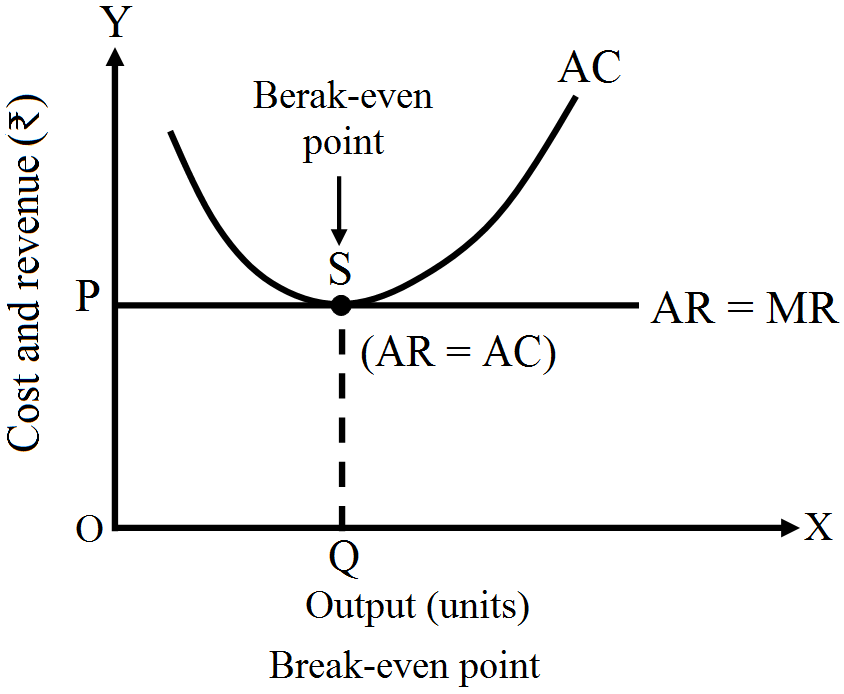
Break-even for a firm occurs when it is able to cover all its costs of production. Accordingly, break-even point is defined as a situation when AR = AC or TR = TC. This is a condition of ‘no profit-no loss' for the firm. But, still the firms are able to earn normal profits, as normal profits are an element of cost.

Break-even occurs at points S.
Here, AR = AC.
View full question & answer
Question 486 Marks
Calculate Total Variable Cost, Total Fixed Cost, Total Cost, Average Fixed Cost, Average Variable Cost, Average Total Cost.
S No.
 
 
1.
Rent
10,000
2.
Number of workers employed
50
3.
Salary paid to each worker
200
4.
Interest on capital
5,000
5.
Raw material purchased
6,000
6
Total quantity produced
100
7.
Insurance premium paid
1,500
Answer
TVC = Raw material purchased + salary (no. of workers * salary paid to each worker)
= 6000 + (200 ~ 50) = 6000 + 10000 = 16,000 \
TFC = Rent + Interest on capital + Insurance premium paid
= 10000 + 5000 + 1500 = 16500
TC = TVC + TFC = 16,000 + 16500 = 32,500
AFC = 165 AVC = 160 ATC = 325
View full question & answer
Question 496 Marks
Find out the marginal cost in:
Total Output
(Units)
Total Cost (Rs)
0
120
1
180
2
200
3
210
4
230
5
270
6
360
Answer
Marginal cost is the addition to the total cost or total variable cost as a result of producing an additional unit of a commodity. It can be calculated as follows:
Total Output (Units) 0 1 2 3 4 5 6
Total Cost 120 180 200 210 230 270 360
TVC 0 60 80 90 110 150 240
$\text{MC}=\frac{\Delta\text{TC}}{\Delta\text{Output}}$
$\text{Or}=\frac{\Delta\text{TVC}}{\Delta\text{Output}}$
- 60 20 10 20 40 90
View full question & answer
Question 506 Marks
Suppose that a firm's TFC is * 100 and MC schedule of the firm is the following:
Output (Units)
1
2
3
4
5
6
7
MC (₹)
10
20
30
40
50
60
70
  1. Is the MC curve U-shaped?
  2. Derive AVC schedule. Will the AVC curve be U-shaped? Discuss why or why not?
Answer
  1. MC curve is not U-shaped.
  2.  
Output (Units) 1 2 3 4 5 6 7
TFC (Given) 100 100 100 100 100 100 100
MC (given) 10 20 30 40 50 60 70
$\text{TVC}=\sum\text{MC}$ 10 30 60 100 150 210 280
$\text{AVC}=\frac{\text{TVC}}{\text{Output}}$ 10 15 20 256 30 35 40
AVC curve will not be U-shaped because AVC data does not show operation of law of variable proportion.
View full question & answer