Question
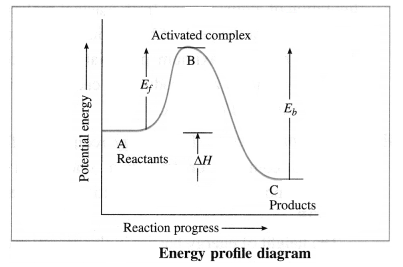
Draw energy profile diagram and show
(i) Activated complex
(ii) Energy of activation for forward reaction
(iii) Energy of activation for backward reaction
(iv) Heat of reaction.
Answer

Image
(i) $B \rightarrow$ Activated complex
(ii) $E _{ f } \rightarrow$ Energy of activation for forward reaction
(iii) $E _{ b } \rightarrow$ Energy of activation for backward reaction
(iv) $\Delta H \rightarrow$ Heat of reaction.

Need a full question paper?

Generate a complete, print-ready paper with questions like this in minutes — across 16+ boards, with answer keys.

Start Generating Free

Similar questions

Classify the following into monosaccharides, oligosaccharides and polysaccharides.
(1) Starch
(2) Glucose
(3) Stachyose
(4) Maltose
(5) Raffinose
(6) Cellulose
(7) Sucrose
(8) Lactose.
Explain the position of lanthanoids in the periodic table.
How is the position of lanthanoids justified?
Give the structures of the following compounds:
(1) 2-Methylpropanal
(2) Pentan-3-one
(3) Methanal
Compound ' $X$ ' with a molecular formula $C _4 H _{11} N$ did not react with Hinsberg's reagent, but reacted with one mole of $CH _3$ l to form a salt. What is the structure of ' $X$ '?
Answer the following
Explain the role of green chemistry.
Classify the following complexes as homoleptic and heteroleptic
$[Cu(NH_3)_4]SO_4, [Cu(en)_2(H_2O)Cl]^{3⊕}, [Fe(H_2O)_5(NCS)]^{2⊕}$^, tetraammine zinc (II) nitrate.
In a cubic crystalline structure of zinc blende $( Z n S),$ sulphide ions are at corners and face centres while zinc ions occupy half of tetrahedral voids.
Find in the unit cell :
$(i)$ Number of $Zn ^{2+}$ ions
$(ii)$ Number of $S^{2-}$ ions
$(iii)$ Number of $ZnS$ molecules
$(iv)$ Molecular formula of zinc blende.
Ozone acts as an oxidising agent and a reducing agent. Explain with examples.
Sucrose decomposes in acid solution to give glucose and fructose according to the first order rate law.
The half life of the reaction is $3$ hours. Calculate fraction of sucrose which will remain after $8$ hours.
For the reaction $2A + B \rightarrow C$, rate of disappearance of A $0.076\ mol\ s ^{–1}.$​​​​​​​
  1. What is the rate of formation of C?
  2. What is the rate of consumption of B?
  3. What is the rate of the overall reaction?