Question 13 Marks
What is the rate determining step?
AnswerMany chemical reactions take place in a series of elementary steps. Among many steps of the reaction, one of the steps is the slowest step compared to other steps.
Rate determining step : The slowest step in the reaction mechanism which involves many steps is called the rate-determining step.
View full question & answer→Question 23 Marks
For the reaction,
$CH _3 Br ( aq )+ OH -( aq ) \rightarrow CH _3 OH ^{\ominus}( aq )+ Br ^{\ominus}( aq )$, rate law is rate $= k \left[ CH _3 Br \right]\left[ OH ^{\ominus}\right]$
a. How does reaction rate changes if $\left[ OH ^{\ominus}\right]$ is decreased by a factor of $5$ ?
b. What is change in rate if concentrations of both reactants are doubled?
AnswerGiven :
(a) Rate $= R = k \left[ CH _3 Br \right] \times\left[ OH ^{-}\right]$
If $R_1$ and $R_2$ are initial and final rates of reaction then,
$R_1=k\left[CH_3 Br\right] \times\left[OH^{-}\right]_1$
$R_2=k\left[CH_3 Br\right] \times\left[OH^{-}\right]_2$
$=k\left[CH H_3 Br\right] \times \frac{1}{5} \times\left[OH^{-}\right]_1$
$\therefore \frac{R_2}{R_1}=\frac{k\left[CH_3 Br\right] \times \frac{1}{5} \times\left[OH^{-}\right]_1}{k\left[CH_3 Br\right] \times\left[OH^{-}\right]_1}=\frac{1}{5}$
$\therefore R_2=\frac{1}{5} \times R_1$
(b)
$R_1=k \times\left[CH_3 Br\right] \times\left[OH^{-}\right]$
$R_2=k \times 2 \times\left[CH_3 Br\right] \times 2 \times\left[OH^{-}\right]$
$\therefore \frac{R_2}{R_1}=\frac{k \times 2 \times\left[CH_3 Br\right] \times 2 \times\left[OH^{-}\right]}{k \times\left[CH_3 Br\right] \times\left[OH^{-}\right]}=4$
$\therefore R_2=4 R_1$
Rate will be increased $4$ time.
View full question & answer→Question 33 Marks
The half-life of a first-order reaction is $0.5$ min. Calculate (a) time needed for the reactant to reduce to $20\%$ and (b) the amount decomposed in $55$ s.
Answer(a) $ t_{1 / 2} =0.5 min =30 s ;[ A ]_0=100 ;[ A ]_t=20 ;$
$t_{1 / 2} =\frac{0.693}{k}$
$\therefore k =\frac{0.693}{30}=0.0231 s$
$k =\frac{2.303}{t} \log _{10} \frac{[ A ]_0}{[ A ]_t}$
$\therefore t =\frac{2.303}{k} \log _{10} \frac{[ A ]_0}{[ A ]_t}$
$ =\frac{2.303}{0.0231} \log _{10} \frac{100}{20}$
$ =\frac{2.303 \times 0.6990}{0.0231}$
$ =69.69 s $
(b) $\log \frac{[ A ]_0}{[ A ]_t}=\frac{t \times k}{2.303}=\frac{55 \times 0.0231}{2.303}=0.5517$
$\therefore \frac{[ A ]_0}{[ A ]_t}=\text { Antilog } 0.5517=3.562$
$\text { If }[ A ]_0=100 \text { then }$
${[ A ]_t=\frac{[ A ]_0}{3.562}}$
$\quad=\frac{100}{3.562}=28.07$
$\therefore \text { Amount remained }=28.07 \%$
$\therefore \text { Amount decomposed }=100-28.07=71.93 \%$
View full question & answer→Question 43 Marks
The rate of the reaction $2 A+B \rightarrow 2 C+D$ is $6 \times 10^{-4} mol dm ^{-3} s^{-1}$ when $[A]=[B]=0.3 mol dm ^{-3}$ If the reaction is of first order in $A$ and zeroth order in $B$ , what is the rate constant?
AnswerFor the reaction,
$ 2 A + B \rightarrow 2 C + D \text {, }$
$\text { Rate }=6 \times 10^{-4} mol dm ^{-3} s ^{-1}$
${[ A ]=[ B ]=0.3 mol dm ^{-3}}$
$n_{ A }=1 \text { and } n_{ B }=0$
$\text { Rate }=R=k[ A ]^{n_{\star}} \times[ B ]^{n_n}$
$=k[ A ]^1 \times[ B ]^0$
$\therefore k =\frac{R}{[ A ]} $
$ =\frac{6 \times 10^{-4} mol dm ^{-3} s ^{-1}}{0.3 mol dm ^{-3}} $
$ =2 \times 10^{-3} s ^{-1}$
Rate constant $=k=2 \times 10^{-3} s ^{-1}$
View full question & answer→Question 53 Marks
What fraction of molecules in a gas at $300\ K$ collide with an energy equal to activation energy of $50\ kJ/mol? (2 × 10^{-9})$
AnswerGiven: $T=300 K ; E_a=50 kJ mol ^{-1}$
$=50 \times 10^3 mol ^{-1}$
The fraction of molecules undergoing fruitful collisions is
$ f= e ^{-} E_{ a } / R T$
$= e ^{-} 50 \times 10^3 / 8.314 \times 300$
$= e ^{-} 20.0465 \text { }$
$\therefore \log _{10} f=\frac{-20.0465}{2.303}$
$=-8.7045$
$\therefore f=\text { Antilog }-8.7045$
$=\text { Antilog } \overline{9} .2955$
$=1.974 \times 10^{-9}$
$\cong 2 \times 10^{-9}$
Answer:
Fraction of molecules undergoing collision $=2 \times 10^{-9}$
View full question & answer→Question 63 Marks
The rate constant for the first order reaction is given by $\log _{10} k =14.34-1.25 \times 10^4 T$. Calculate activation energy of the reaction. ( $239.3 kJ / mol$ )
AnswerGiven: $\log _{10} k =14.34-\frac{1.25 \times 10^4}{T}$
From Arrhenius equation we can write,
$\log _{10} k=\log _{10} A-\frac{E_{ a }}{2.303 R \times T}$
By comparing equations (1) and (2),
$ \frac{E_{ a }}{2.303 \times R}=1.25 \times 10^4$
$\therefore E a=1.25 \times 10^4 \times 2.303 \times R$
$=1.25 \times 10^4 \times 2.303 \times 8.314$
$=23.93 \times 10^4=239.3 kJ mol ^{-1} $
[Note : Frequency factor A may also be calculated as follows : $\log _{10} A=14.34$
$\therefore A=\text { Antilog } 14.34=2.188 \times 10^4$
Answer:
Energy of activation $=E_a=239.3 k mol ^{-1}$.
View full question & answer→Question 73 Marks
A first order reaction takes 40 minutes for 30% decomposition. Calculate its half life. (77.66 min)
AnswerGiven : $t=40 min ;[ A ]_0=100$;
$
\begin{aligned}
{[ A ]_t } & =100-30=70 ; t_{1 / 2}=? \\
k & =\frac{2.303}{t} \log _{10} \frac{[ A ]_0}{[ A ]_t} \\
& =\frac{2.303}{40} \log _{10} \frac{100}{70} \\
& =\frac{2.303}{40} \log _{10} 1.4286 \\
& =\frac{2.303 \times 0.1549}{40} \\
& =8.918 \times 10^{-3} min ^{-1} \\
t_{1 / 2} & =\frac{0.693}{k} \text { } \\
& =\frac{0.693}{8.918 \times 10^{-3}} \\
& =77.70 min
\end{aligned}
$
Answer:
Half life period $=77.70$ min.
View full question & answer→Question 83 Marks
Show that time required for $99.9\%$ completion of a first order reaction is three times the time required for $90\%$ completion.
AnswerGiven : For $99.9 \%$ completion, if $[A]_0 = 100,$
$[ A ]_t=100-99.9=0.1$
For $90 \%$ completion, if $[ A ]_0=100$,
$\begin{array}{l}
{[ A ]_t=100-90=10} \\
k=\frac{2.303}{t} \log _{10} \frac{[ A ]_0}{[ A ]_t} \text {} \\
\therefore t=\frac{2.303}{k} \log _{10} \frac{[ A ]_0}{[ A ]_t}
\end{array}$
If $t_1$ and $t_2$ are the times required for $99.9 \%$ and $90 \%$ completion of reaction respectively, then
$
\begin{array}{l}
\frac{t_1}{t_2}=\frac{\frac{2.303}{k} \log _{10} \frac{100}{0.1}}{\frac{2.303}{k} \log _{10} \frac{100}{10}} \\
=\frac{\log 1000}{\log 10} \\
=\log 10^3 \\
=3 \log 10=3 \\
\therefore t_1=3 t_2
\end{array}
$
Answer:
Time required for $99.9 \%$ completion of a first order reaction is three time the time required for $90 \%$ completion of the reaction.
View full question & answer→Question 93 Marks
The rate constant of a reaction at $5000\ C$ is $1.6 \times 10^3 M ^{-1} s^{-1}$. What is the frequency factor of the reaction if its activation energy is $56 kJ / mol .\left(9.72 \times 106 M ^{-1} s^{-1}\right)$
AnswerGiven : $k=1.6 \times 10^3 M ^{-1} s ^{-1}$;
$T=273+500=773 K$
Energy of activation $=E_{ a }=56 kJ mol ^{-1}$
$=56000 J mol ^{-1}$
Frequency factor $= A = ?$
By Arrhenius equation,
$ k=A \times e ^{-E_{ n } / R T}$
$\therefore \ln k=\ln A-\frac{E_{ a }}{R T} $
$2.303 \log _{10} k=2.303 \log _{10} A-\frac{E_{ a }}{R T}$
$\therefore \log _{10} k=\log _{10} A-\frac{E_{ a }}{2.303 R T}$
$\therefore \log _{10} A=\log _{10} k+\frac{E_{ a }}{2.303 R T}$
$=\log _{10} 1.6 \times 10^3+\frac{56000}{2.303 \times 8.314 \times 773}$
$ =3.204+3.784$
$=6.988 $
$\therefore A= AL 6.988=9.727 \times 10^6 M ^{-1} s ^{-1}$
Answer:
Frequency factor $= A =9.727 \times 10^6 M ^{-1} s ^{-1}$
View full question & answer→Question 103 Marks
What is the energy of activation of a reaction whose rate constant doubles when the temperature changes from 303 K to 313 K? (54.66 kJ/mol)
AnswerGiven: $k _2=2 k _{ t }, T _1=303 K ; T _2=313 K ; E _{ a }=?$
$
\begin{aligned}
\log _{10} & \frac{k_2}{k_1}=\frac{E_{ a } \times\left(T_2-T_1\right)}{2.303 \times R \times T_1 \times T_2} \\
\therefore E_{ a } & =\frac{2.303 \times R \times T_1 \times T_2}{\left(T_2-T_1\right)} \times \log _{10} \frac{k_2}{k_1} \\
& =\frac{2.303 \times 8.314 \times 303 \times 313}{(313-303)} \log _{10} \frac{2 k_1}{k_1} \\
& =\frac{2.303 \times 8.314 \times 303 \times 313 \times 0.3010}{10} \\
& =54660 J \quad \text { } \\
& =54.66 kJ \quad
\end{aligned}
$
Answer:
Energy of activation $= E _{ a }=54.66 kJ$
View full question & answer→Question 113 Marks
The energy of activation for a first order reaction is $104 kJ / mol$. The rate constant at 250 C is $3.7 \times 10^{-5} s^{-1}$. What is the rate constant at $30^{\circ} C$ ? $( R =8.314 J / K mol )\left(7.4 \times 10^{-5}\right)$.
AnswerGiven: $E_a=104 kJmol ^{-1}=104 \times 10^3 Jmol ^{-1}$
$k_1=3.7 \times 10^{-5} s^{-1} ; T_1=273+25=298 K$
$T_2=273+30=303 K ; k_2=\text { ? }$
$\log _{10} \frac{k_2}{k_1}=\frac{E_a \times\left(T_2-T_1\right)}{2.303 \times R \times T_1 \times T_2}$
$\therefore \log _{10} k_2-\log _{10} k_1=\frac{E_a \times\left(T_2-T_1\right)}{2.303 \times R \times T_1 \times T_2}$
$\therefore \log _{10} k_2 \quad \text { MaharashtraBoardsolutions.in }$
$=\log _{10} k_1+\frac{E_a \times\left(T_2-T_1\right)}{2.303 \times R \times T_1 \times T_2}$
$=\log _{10} 3.7 \times 10^{-5}+\frac{104 \times 10^3 \times(303-298)}{2.303 \times 8.314 \times 298 \times 303}$
$=\overline{5} .5682+0.3$
$=-4.4318+0.3=-4.1318$
$k_2=\text { Antilog - } 4.1318$
$=\text { Antilog } \overline{5} .8682$
$=7.382 \times 10^{-5} s^{-1}$
Answer:
$k_2=7.382 \times 10^{-5} s^{-1}$
View full question & answer→Question 123 Marks
The half life of a first order reaction is $1.7$ hours. How long will it take for $20\%$ of the reactant to react? ($32.9$ min)
Answer$\text { Given: } t_{1 / 2}=1.7 hr ;\left[ A _0]=100\right. \text {; }$
${[A]_t=100-20=80 ; t=?}$
$t_{1 / 2}=\frac{0.693}{k}$
$\therefore k=\frac{0.693}{t_{1 / 2}}$
$=\frac{0.693}{1.7}$
$=0.4076 hr ^{-1}$
$\because k=\frac{2.303}{t} \log _{10} \frac{[ A ]_0}{[ A ]_t}$
$\therefore t=\frac{2.303}{k} \log _{10} \frac{100}{80}$
$=\frac{2.303}{0.4076} \log _{10} 1.25$
$=\frac{2.303 \times 0.09691}{0.4076}$
$=0.5476 hr \text { }$
$=0.5476 \times 60 min$
$=32.86 min \text {. }$
Time required $= t = 32.86\ min$
View full question & answer→Question 133 Marks
In a first order reaction, the concentration of reactant decreases from $20 mmol dm ^{-3}$ to $8 mmol dm ^{-3}$ in 38 minutes. What is the half life of reaction? ( 28.7 min )
AnswerGiven: $[A]_0=20 mmol dm ^{-3}$;
$[ A ]_{ t }=8 mmol dm ^{-3} ; t =38 mm$;
$t_{1 / 2} =?$
$=\frac{2.303}{t} \log _{10} \frac{[A]_0}{[A]_t}$
$=\frac{2.303}{38} \log _{10} \frac{20}{8}$
$=\frac{2.303}{38} \times 0.3979$
$=0.02411 min^{-1}$
$t_{1 / 2} =\frac{0.693}{k}$
$=\frac{0.693}{0.02411}=28.74 min$
Half life period $=28.74 min$
View full question & answer→Question 143 Marks
For the reaction 2A + 2B → 2C + D, if concentration of A is doubled at constant [B] the rate increases by a factor of 4. If the concentration of B is doubled with [A] being constant the rate is doubled. Write the rate law of the reaction.
AnswerRate $=R_1=k[A]^{ x }[ B ]^{ y }$
When concentration of $A=[2 A]$ and
$[ B ]=$ constant,
$R_2=4 R_1=k[2 A ]^x[ B ]^y$
When $[A]=$ constant and concentration of $B =[2 B ]$
$R_3=2 R_1=k[ A ]^x[2 B ]^\gamma$
$\frac{R_2}{R_1}=\frac{k[2 A ]^x[ B ]^y}{k[ A ]^x[ B \}^y}=4$
$\therefore 2^x=4$
$\therefore x=2 \quad$
$\frac{R_3}{R_1}=\frac{k[ A ]^x[2 B ]^y}{k[ A ]^x[ B ]^y}=2$
$\therefore 2^y=2$
$\therefore y=1$
Hence order with respect to $A$ is 2 and with respect to $B$ is 1 . By rate law, Rate $=A:[A]^2[B]$
View full question & answer→Question 153 Marks
A complex reaction takes place in two steps:
(i) $NO _{( g )}+ O _{3(g)} \rightarrow NO _{3(g)}+ O _{( g )}$
(ii) $NO _{3(g)}+ O _{( g )} \rightarrow NO _{2(g)}+ O _{2(g)}$
The predicted rate law is rate $= k [ NO ]\left[ O _3\right]$. Identify the rate-determining step. Write the overall reaction. Which is the reaction inter-mediate? Why?
Answer(i) $NO _{( g )}+ O _{3(g)} \rightarrow NO _{3(g)}+ O _{( g )}$
(ii) $NO _{3(g)}+ O _{( g )} \rightarrow NO _{2(g)}+ O _{2(g)}$
(a) The first step is slow and rate determining step since the rate depends on concentrations of $NO _{( g )}$ and $O _{3(g)}$.
(Given : Rate $= k [ NO ] \times[ O ]$ )
(b) The overall reaction is the combination of two steps.
$NO_{(g)}+O_{3(g)} \rightarrow NO_{2(g)}+O_{2(g)}$
(c) $NO _{3(g)}$ and $O _{( g )}$ are reaction intermediates. They are formed in first step (i) and removed in the second step (ii).
View full question & answer→Question 163 Marks
A reaction occurs in the following steps:
(i) $NO _{2(g)}+ F _{2(g)} \rightarrow NO _2 F_{( g )}+ F _{( g )}$ (slow)
(ii) $F _{( g )}+ NO _{2(g)} \rightarrow NO _2 F_{( g )}$ (fast)
(a) Write the equation of overall reaction.
(b) Write down rate law.
(c) Identify the reaction intermediate.
Answer(a) The addition of two steps gives the overall reaction as
$2 NO_{2(g)}+F_{2(g)} \rightarrow 2 NO_2 F_{(g)}$
(b) Step (i) is slow. The rate law of the reaction is predicted from its stoichiometry. Thus, rate $= k \left[ NO _2\right]\left[ F _2\right]$
(c) F is produced in step (i) and consumed in step (ii) hence F is the reaction intermediate.
View full question & answer→Question 173 Marks
For the reaction,
$
3 I _{(a q)}^{-}+ S _2 O _{8(a q)}^{2-} \longrightarrow I _{3( aq )}^{-}+2 S O _{4( aq )}^{2-}
$
Calculate (a) the rate of formation of $I _3^{-}$,
(b) the rates of consumption of 1 and $S _2 O$ and (c) the overall rate of reaction if the rate of formation of $SO _4^{2-}$ is 0.022 moles $dm ^{-3} sec ^{-1}$.
Answer$\therefore$ (a) Rate of formation of $I _3^{-}=0.011 mol dm ^{-3} s ^{-1}$
(b) Rate of consumption of $I ^{-}=0.033 mol dm ^{-3} s ^{-1}$
(c) Rate of consumption of $S _2 O _8^{2-}=0.011 mol dm ^{-3} s ^{-1}$
(d) Overall rate of reaction $=$ Rate of consumption of reactant $=$ Rate of formation of product
View full question & answer→Question 183 Marks
Write the expressions for rates of reaction for :
$2N_2O_{5(g)} \rightarrow 4NO_{2(g)} + O_{2(g)}?$
AnswerFor the given reaction, Rate of reaction $=$
$ =R=-\frac{1}{2} \frac{d\left[ N _2 O _5\right]}{d t}$
$=+\frac{1}{4} \frac{d\left[ NO _2\right]}{d t}$
$=+\frac{d\left[ O _2\right]}{d t} $
View full question & answer→Question 193 Marks
For the reaction $2A + B \rightarrow $ products, find the rate law from the following data.
| $[A]/M$ |
$[A]/M$ |
$rate/M s^{-1}$ |
| $0.3$ |
$0.05$ |
$0.15$ |
| $0.6$ |
$0.05$ |
$0.30$ |
| $0.6$ |
$0.2$ |
$1.20$ |
AnswerGiven: $2 A+B \rightarrow$ Products
Rates: $R _1=0.15 Ms ^{-1} R _2=0.3 Ms ^{-1}$
${[A]_1=0.3 M[A]_2=0.6 M}$
${[B]_1=0.05 M[B]_2=0.05 M}$
(i) If order of the reaction in A is x and in B is y then, by rate law,Rate $=R_1=k[A]_1^x[B]_1^y$ and
$R_2=k[A]_2^x[B]_2^y$
$\therefore \frac{R_2}{R_1}=\frac{k[A]_2^z[B]_2^y}{k[A]_1^z[B]_1^y}$
$=\left(\frac{\mid A]_2}{[A]_1}\right)^x \times\left(\frac{\mid B]_2}{[B]_1}\right)^y$
$\frac{0.3}{0.15}=\left(\frac{0.6}{0.3}\right)^x \times\left(\frac{0.05}{0.05}\right)^y$
$2=2^x$
$\therefore x=1$. Hence, the reaction has order one in $A$
(ii) Rates : $R_1=0.3 M s^{-1} \quad R_2=1.2 M s^{-1}$
${[A]_1=0.6 M \quad[A]_2=0.6 M}$
${[B]_1=0.05 M \quad[B]_2=0.2 M}$
$\frac{R_2}{R_1}=\frac{k[A]_2^x[B]_2^y}{k[A]_1^x[B]}$
$=\left(\frac{\mid A]_2}{[A]_1}\right)^x \times\left(\frac{[B]_2}{[B]_1}\right)^y$
$\frac{1.2}{0.3}=\left(\frac{0.6}{0.6}\right)^x \times\left(\frac{0.2}{0.05}\right)^y$
$4=(4)^y$
$\therefore y=1$. Hence the reaction has order one in $B$.
The order of overall reaction $=n=n_A+n_B=1+1=2$
$\text { Rate }=R=k[A] \times[B]$
$\therefore k=\frac{R}{[A][B]}$
$=\frac{R_1}{[A]_1[B]_1}$
$=\frac{0.15}{0.3 \times 0.05}$
$=10 M^{-1} s^{-1}$
(i) Rate law: Rate $= fc [ A ] \times[ B ]$
Rate constant $=k=10 M ^{-1} s^{-1}$
Order of the reaction $=2$
View full question & answer→Question 203 Marks
Explain graphically the effect of catalyst on the rate of reaction.
Answer(i) The phenomenon of catalysed reaction is called catalysis and depends on nature of the catalyst. In heterogeneous catalysis, the reactant molecules are adsorbed on the solid catalyst surface while in case of homogeneous catalysis, the catalyst reacts with one of the reactants, forms intermediate and decomposes reforming original catalyst and the products.
(ii) The catalyst provides alternative and lower energy path or mechanism for the reaction.
(iii) In the presence of the catalyst, the activation energy of the reaction is lowered. The height of activation energy barrier is less than that in the uncatalysed reaction.
View full question & answer→Question 213 Marks
Explain graphically the effect of temperature on the rate of reaction.
Answer(i) It has been observed that the rates of chemical reactions increase with the increase in temperature.
(ii) The kinetic energy of the molecules increases with the increase in temperature. The fraction of molecules possessing minimum energy barrier,
i. e. activation energy $E_a$ increases with increase in temperature.
(iii) Hence the fraction of colliding molecules that possess kinetic energy $(E_a)$ also increases, hence the rate of the reaction increases with increase in temperature.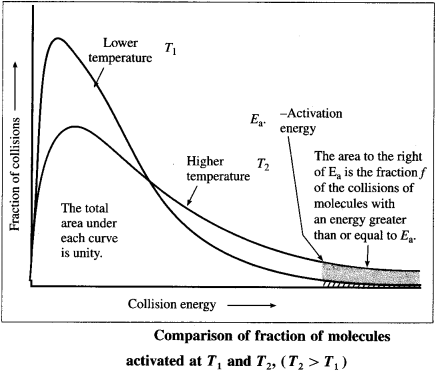
(iv) The above figure shows that the area that represents the fraction of molecules with kinetic energy exceeding $E_a$ is greater at higher temperature $T_2$ than at lower temperature $T_1$. This explains that the rate of the reaction increases at higher temperature.
(v) The shaded area to the right of activation energy $E_a$ represents fraction of collisions of activated molecules having energy $E_a$ or greater. View full question & answer→Question 223 Marks
How will you determine activation energy: (a) graphically using Arrhenius equation (b) from rate constants at two different temperatures?
Answer(a) By Arrhenius equation,
Rate constant $== A \times e ^{- E _2 / R T}$ where A is a fre-quency factor.
$\therefore \ln k=\ln A-\frac{E_{ a }}{R T}$
$\therefore 2.303 \log _{10} k=2.303 \log _{10} A-\frac{E_{ a }}{R T}$
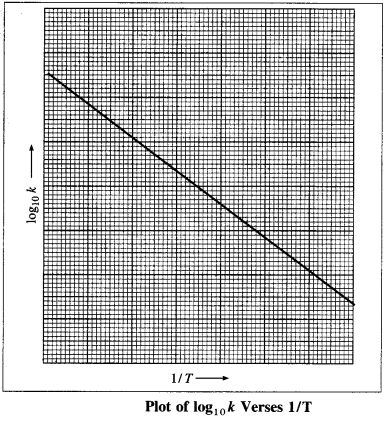
$\therefore \log _{10} k=\log _{10} A-\frac{E_{ a }}{2.303 R T}$
$\therefore \log _{10} k=-\left(\frac{E_{ a }}{2.303 R}\right) \times \frac{1}{T}+\log _{10} A$
$\quad(y=-m x+ C )$
When $log_{10}k$ is plotted against 1/T a straight line with negative slope is obtained. From the slope of the graph, energy of activation $E_a$, is obtained as follows :
$ \text { Slope }=\frac{E_{ a }}{2.303 R}$
$\therefore \text { Ea }=2303 R \times \text { sloPe } $
(b) For the given reaction, rate constants $k _1$ and $k _2$ are measured at two different temperatures $T_1$ and $T_2$ respectively. Then $\log _{10} \frac{k_2}{k_1}=\frac{E_a\left(T_2-T_1\right)}{2.303 R \times T_1 \times T_2}$ where $E_a$ is the energy of activation.
Hence by substituting appropriate values, energy of activation $E_a$ for the reaction is determined. View full question & answer→Question 233 Marks
What is zeroth-order reaction? Derive its integrated rate law. What are the units of rate constant?
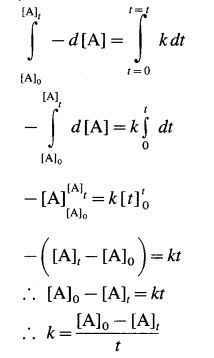
AnswerDefinition : Zero order reaction : A reaction in which the rate of the reaction does not depend on the concentration of any reactant taking part in the reaction is called zero order reaction.Consider a zero order reaction, A $\rightarrow $ Products
The rate of the reaction is, Rate = $\frac{-d[ A ]}{d t}$
By rate law,
Rate $= k x [A]^0 = k$
$\therefore – d[A] = k x dt$
If $[A]_0$ is the initial concentration of the reactant $A$ at $t = 0$ and $[A]_t$ is the concentration of $A$ present after time t, then by integrating above equation,
$\int_{[ A ]_0}^{[ A ]_t}-d[ A ]=\int_{t=0}^{t=[ A ]_t} k d t$
$-\int_{[ A ]_0}^t d[ A ]=k \int_0^t d t$
$-[ A ]_{[ A ]_0}^{[ A ]_t}=k[t]_0^t$
$-\left([ A ]_t-[ A ]_0\right)=k t$
$\therefore[ A ]_0-[ A ]_t=k t$
$\therefore k=\frac{[ A ]_0-[ A ]_t}{t}$
This is the integrated rate law expression for rate constant for zero order reaction.
$\therefore k x t = [A]_0 – [A]_t$
$\therefore [A]_t = – kt + A_0$
For a zero order reaction :
The rate of reaction is $R = k [A]^0 = k$
Hence, the velocity constant k has the unit of the rate of the reaction, i.e., $mol\ dm^{-3} s^{-1}.$
View full question & answer→Question 243 Marks
Derive the integrated rate law for the first order reaction, $A ( g ) \rightarrow B ( g )+ C ( g )$ in terms of pressure.
AnswerConsider following gas phase reaction, $\quad A_{(g)} \longrightarrow B_{(g)}+C_{(g)}$
$\begin{array}{llll}\text { At start } & P_0 & 0 & 0$
At time $t P_0-x \quad x \quad x$
Let initial pressure of A be $P _0$ at $t=0$. If after time $t$ the pressure of a A decreases by jc then the partial pressures of the substances will be, $P _{ A }= P _{ Q }- x ; P _{ B }= x$ and $P _{ C }= x$
Total pressure will be,
$P_T+P_0-x+x+x=P_0+x$
$\therefore x=P_T-P_n$
The partial pressures at time $t$ will be,
${[A]_t } =P_0-x=P_0-\left(P_T-P_0\right)=2 P_0-P_T$
${[A]_0 } =P_0$
$\because k & =\frac{2.303}{t} \log _{10} \frac{[A]_0}{[A]_t}$
$=\frac{2.303}{t} \log _{10}\left(\frac{P_0}{2 P_0-P_T}\right)$
View full question & answer→Question 253 Marks
Derive the integrated rate law for first order reaction.
AnswerConsider following gas phase reaction,$ \ \ \ \ \ \ \ \ \ \ \ \ \ \ \ \ \ \ \ \ A _{( g )} \longrightarrow B _{( g )}+ C _{( g )}$
$\begin{array}{llll}\text { At start } \ \ \ \ \ \ P_0 & & &0& & 0\end{array}$
At time $t\ \ \ \ \ P_0-x \ \ \ \quad x \ \ \ \ \quad x$
Let initial pressure of $A$ be $P_0$_ at $t = 0$. If after time t the pressure of a A decreases by jc then the partial pressures of the substances will be,
$P_A = P_Q – x; P_B= x$ and $P_c = x$
Total pressure will be,
$P_T + P_0 – x + x + x = Po + x$
$\therefore x = P_T – P_n$
The partial pressures at time t will be,
$\begin{aligned} {[ A ]_t } & =P_0-x=P_0-\left(P_{ T }-P_0\right)=2 P_0-P_{ T } \\ {[ A ]_0 } & =P_0 \\ \because k & =\frac{2.303}{t} \log _{10} \frac{[ A ]_0}{[ A ]_t} \\ & =\frac{2.303}{t} \log _{10}\left(\frac{P_0}{2 P_0-P_{ T }}\right)\end{aligned}$
View full question & answer→Question 263 Marks
Explain with the help of the Arrhenius equation, how does the rate of reaction changes with (a) temperature and (b) activation energy.
Answer(a) By Arrhenius equation, $k = Ax e^{-E_a/RT}$ where k is rate constant, A is a frequency factor and Ed is energy of activation at temperature T. As $E_a$ increases, the rate constant and rate of the reaction decreases.(b) As temperature increases $E_a/RT$ decreases but due to negative sign, k and rate increase with the increase in temperature.
View full question & answer→Question 273 Marks
What are pseudo-fist order reactions? Give one example and explain why it is pseudo-fist order.
AnswerPseudo-first-order reaction :
A reaction which has higher-order true rate law but is experimentally found to behave as first order is called pseudo first order reaction.
Explanation : Consider an acid hydrolysis reaction of an ester like methyl acetate.
$CH _3 COOCH _{3( aq )}+ H _2 O _{(1)} \stackrel{ H _{( aq )}^{+}}{\longrightarrow} CH _3 COOH _{( aq )}+ CH _3 OH _{( aq )}$
Since the reaction involves two substances, ester and water, it is a bimolecular reaction and the true rate law should be, Rate $=k^{\prime}\left[ CH _3 COOCH _3\right] \times\left[ H _2 O \right]$
Hence the reaction is expected to follow second order kinetics.
However experimentally it is found that the reaction follows first order kinetics.
This is because solvent water being in a large excess, its concentration remains constant.
Hence, $[H_2O]$ = constant = $k”$
Rate $= k [CH_3COOCH_3] x [H_2O]$
$= k [CH_3COOCH_3] x k”$
$= k’ x k” x [CH_3COOCH_3]$
$If k’ x k” = k,$ then Rate $= k [CH_3COOCH_3],$
This indicates that second-order true rate law is forced into first order rate law.
Therefore this bimolecular reaction which appears of second order is called pseudo first order reaction.
View full question & answer→Question 283 Marks
A reaction takes place in two steps,
1. $NO(g) + Cl_2(g) NOCl_2(g)$
2. $NOCl_2(g) + NO(g) → 2NOCl(g)$
a. Write the overall reaction.
b. Identify reaction intermediate.
c. What is the molecularity of each step?
AnswerGiven :
(1) $NO_{(g)} + Cl_{2(g)} \rightarrow NOCl_{2(g)}$
(2) $NOCl_{2(g)} + NO_{(g)} \rightarrow2NOCl_{(g)}$
(a) Overall reaction is obtained by adding both the reactions
$2NO_{(g)} + Cl_{2(g)} \rightarrow 2NOCl_{2(g)}$
(b) The reaction intermediate is $NOCl_2$, since it is formed in first step and consumed in the second step.
(c) Since the first step is a slow and rate determining step, the molecularity is two.
Since the second step is a fast step its molecularity is not considered.
View full question & answer→Question 293 Marks
Distinguish between order and molecularity of a reaction.
Answer| Order | Molecularity |
| 1. It is the sum of the exponents to which the concentration terms in rate law expression are raised. | 1. ¡t is the number of molecules (or atoms or ions) of the reaCtants taking part in the elementary reaction. |
| 2. It is experimentally determined and indicates the dependence of the reaction rate on the concentration of particular reactants. | 2. It is the oretical property and indicátes the number of molecules of reactant in each step of the reaction. |
| 3. It may have values that are integer, fractional, or zero. | 3. It is always an integer. |
| 4. Its value depends upon experimental conditions. | 4. Its value does not depend upon experimental conditions. |
| 5. It is the property of elementary and complex reactions. | 5. It is the property of elementary reactions only. |
| 6. Rate law expression describes the order of the reaction. | 6. Rate law does not describe molecularity. |
View full question & answer→Question 303 Marks
The frequency factor for a second-order reaction is $4.83 \times 10^{12} M ^{-1} s ^{-1}$ at $27^{\circ} C$. If the rate constant of the reaction is $1.37 \times 10^{-3} M ^{-1} s ^{-1}$, find the energy of activation.
View full question & answer→Question 313 Marks
In the Arrhenius equation for a first order reaction, the values of ' $A$ ' and ' $E_a^{\prime}$ are $4 \times 10^{13} \sec ^{-1}$ and $98.6 kJ mol ^{-1}$ respectively. At what temperature will its half-life period be 10 minutes? $[R=$ $\left.8.314 JK ^{-1} mol ^{-2}\right]$
View full question & answer→Question 323 Marks
A first order gas-phase reaction has an energy of activation of $240 kj mol ^{-1}$. If the frequency factor of the reaction is $1.6 \times 10^{13} s ^{-1}$, calculate its rate constant at $600 K$.
View full question & answer→Question 333 Marks
The rate of a gaseous reaction is $6.08 \times 10^{-2} Ms ^{-1}$ at $50^{\circ} C$. What will be its rate at $60^{\circ} C$ ? Energy of activation of the reaction is $18.26\ kj\ mol ^{-1} .\left(R=8.314 k ^{-1} mol ^{-1}\right)$
AnswerInitial rate $= R _1=6.08 \times 10^{\prime \prime} 2\ Ms ^{-1}$
Energy of activation $=E_a=18.26\ kJ\ mol ^{-1}=18260\ mol ^{-1}$
Initial temperature $= T _1=273+50=323 K$
Final temperature $=T_2=273+60=333 K$
Final rate of the reaction $=R_2= ?$
$\log _{10} \frac{k_2}{k_1} =\frac{E_{ a }\left(T_2-T_1\right)}{2.303 R \times T_1 \times T_2}$
$ =\frac{18260(333-323)}{2.303 \times 8.314 \times 323 \times 333}$
$ =\frac{18260 \times 10}{2.303 \times 8.314 \times 323 \times 333}$
$ =0.08866$
$\therefore \frac{k_2}{k_1}$
$=\text { AL } 0.08866=1.227$
If $R_1$ and $R_2$ are initial and final rates of the reaction, then$R_1=k_1[A]$ and $R_2=k_2[A]$
$\therefore \frac{R_2}{R_1}=\frac{k_2[A]}{k_1[A]}=\frac{k_2}{k_1}=1.227$
$\therefore R_2=1.227 R_1$
$=1.227 \times 6.08 \times 10^{-2}$
$=7.46 \times 10^{-2} M s ^{-1}$
Rate of reaction at $37^{\circ} C =7.46 \times 10^{-2} Ms ^{-1}$
View full question & answer→Question 343 Marks
The half-life of a first order reaction is $900 min$ at $820 K$. Estimate its half-life at $720 K$ if the energy of activation of the reaction is $250 kJ mol ^{-1}\left(1.464 \times 10^5 mm \right)$.
View full question & answer→Question 353 Marks
The rate constant of a first order reaction are $0.58 s ^{-1}$ at $313 K$ and $0.045 s ^{-1}$ at $293 K$. What is the energy of activation for the reaction?
AnswerGiven : $k_1=0.58 s ^{-1} ; k_2=0.045 s ^{-1}$
$T_1=313 K ; T_2=293 K$
$E_{ a }=?$
$ \log _{10} \frac{k_2}{k_1}=\frac{E_{ a }\left(T_2-T_1\right)}{2.303 R \times T_1 \times T_2}$
$\therefore E_{ a }=\frac{2.303 R \times T_1 \times T_2}{\left(T_2-T_1\right)} \log _{10} \frac{k_2}{k_1}$
$=\frac{2.303 \times 8.314 \times 313 \times 293}{293-313} \log _{10} \frac{0.045}{0.58}$
$=\frac{2.303 \times 8.314 \times 313 \times 293}{20} \log _{10} \frac{0.58}{0.045}$
$=\frac{2.303 \times 8.314 \times 313 \times 293 \times 1.1102}{20}$
$=97460 \ J \ mol ^{-1}$
$=97.46 \ kJ \ mol ^{-1} $
Energy of activation $= Ea =97.46\ kJ\ mol ^{-1}$
View full question & answer→Question 363 Marks
What is a frequency factor or pre-exponential factor?
AnswerIn Arrhenius equation, $k=A \times e^{-E_3 / R T}$ the factor $A$ is called frequency factor and since it is a coefficient of exponential expression, $e \sim Ea / RT$ it is also called a pre-exponential factor.
In the above equation $k$ is a rate constant at temperature $T, E_a$ is the energy of activation and $R$ is a gas constant.
A is related to frequency of collisions $(Z)$ or rate of collisions. It is represented as, $A=P \times Z$ where $P$ is the probability of collisions with proper orientations and $Z$ is the frequency of collisions of reacting molecules.
The units of $A$ are same as that of $k$.
View full question & answer→Question 373 Marks
Obtain Arrhenius equation, $k = A \times e ^{- E _3 / R T}$
Answer$(i)$ From experimental observations of variation in rate constants with temperature, Arrhenius developed a mathematical equation between reaction rate constant $( k )$, activation energy $\left( E _{ a }\right)$ and temperature $T$.
$(ii)$
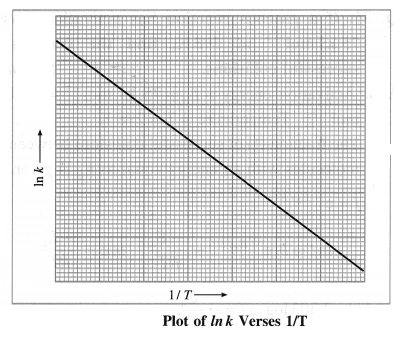
When a graph of Ink is plotted against reciprocal of temperature $(1 / T )$ a straight line with a negative slope is obtained. This is described by a mathematical equation as,
$\ln k=\ln A-\frac{E_{ a }}{R T}$
$=\ln A-\frac{E_{ a }}{R T} \ln e$
$\because \ln e=\log _{ e } e=1$
$=\ln A+\left(\frac{-E_{ a }}{R T}\right) \ln e_{}$
$=\ln A+\ln e ^{-E_{ a } / R T}$
$\therefore \log _{ e } k=\log _{ e } A+\log _{ e } e ^{-E_{ a } / R T}$
$\quad=\log _{ e } A \times e ^{-E_{ a } / R T}$
$\therefore 2.303 \log _{10} k=2.303 \log _{10} A \times e ^{-E_{ a } / R T}$
$\therefore \log _{10} k=\log _{10} A \times e ^{-E_{ a } / R T}$
By taking antilogarithm,
$k=A \times e ^{-E_{ a } / R T}$ View full question & answer→Question 383 Marks
Draw energy profile diagram and show
(i) Activated complex
(ii) Energy of activation for forward reaction
(iii) Energy of activation for backward reaction
(iv) Heat of reaction.
Answer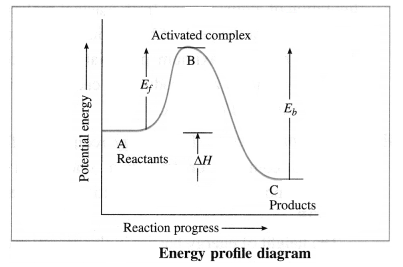
(i) $B \rightarrow$ Activated complex
(ii) $E _{ f } \rightarrow$ Energy of activation for forward reaction
(iii) $E _{ b } \rightarrow$ Energy of activation for backward reaction
(iv) $\Delta H \rightarrow$ Heat of reaction. View full question & answer→Question 393 Marks
The rate constant of a certain first-order reaction is $3.12 \times 10^{-3} min ^{-1}$,
(a) How many minutes does it take for the reactant concentration to drop to $0.02 M$ if the initial concentration of the reactant is $0.045 M$ ?
(b) What is the molarity of the reactant after $1.5 hr$ ?
AnswerGiven : Rate constant $= k =3.12 \times 10^{-3} min ^{-1}$
(a) At $t=0,[ A ]_0=0.045 M ;[ A ]_t=0.02 M ; t=$ ?
$\begin{aligned}
k= & \frac{2.303}{t} \log _{10} \frac{[ A ]_0}{[ A ]_t} \\
\therefore t & =\frac{2.303}{k} \log _{10} \frac{[ A ]_0}{[ A ]_t} \\
& =\frac{2.303}{3.12 \times 10^{-3}} \log _{10} \frac{0.045}{0.02} \\
& =\frac{2.303}{3.12 \times 10^{-3}} \log _{10} 2.25 \\
& =\frac{2.303 \times 0.3522}{3.12 \times 10^{-3}}=260 min
\end{aligned}$
(b) $t=1.5 hr =1.5 \times 160=90 min$
$[ A ]_t=$ ?
$k=\frac{2.303}{t} \log _{10} \frac{[ A ]_0}{[ A ]_t}$
$\therefore \log _{10} \frac{[ A ]_0}{[ A ]_t}=\frac{k \times t}{2.303}=\frac{3.12 \times 10^{-3} \times 90}{2.303}$
$=0.122$
$\begin{aligned}
& \therefore \frac{[ A ]_0}{[ A ]_t}= AL 0.122=1.324 \\
& \therefore[ A ]_t=\frac{[ A ]_0}{1.324}=\frac{0.045}{1.324}=0.034 M
\end{aligned}$
(i) Time required to drop the concentration to $0.02 M =260 min$
(ii) Molarity after $1.5 hr =0.034 M$
View full question & answer→Question 403 Marks
The rate constant of a first order reaction is $6.8 \times 10^{-4} s ^{-1}$. If the initial concentration of the reactant is $0.04\ M$, what is its molarity after $20$ minutes? How long will it take for $25 \%$ of the reactant to react?
AnswerRate constant $= k =6.8 \times 10^{-4} s ^{-1}$
$[ A ]_0=0.04 M$
$(i)$ After $t=20\ min =20 \times 60 s =1200 s$
${[ A ]_t=? }$
$ k=\frac{2.303}{t} \log _{10} \frac{[ A ]_0}{[ A ]_t}$
$ \therefore \log _{10} \frac{[ A ]_0}{[ A ]_t}$$=\frac{k \times t }{2.303}$
$=\frac{6.8 \times 10^{-4} \times 1200}{2.303}$
$=0.3543$
$ \therefore \frac{[ A ]_0}{[ A ]_t}= AL 0.3543=2.26$
$ \therefore[ A ]_t=\frac{[ A ]_0}{2.26}=\frac{0.04}{2.26}=0.0177 M$
$(ii)$ For $25 \%$ reactant to react, $t= ?$
Reactant reacted $=25$ of $0.04 M$
$ =\frac{25}{100} \times 0.04$
$ =0.01 M$
Reactant left $=[ A ]_t=0.04-0.01$
$ =0.03 M$
$ t=\frac{2.303}{k} \log _{10} \frac{[ A ]_0}{[ A ]_t}$
$ =\frac{2.303}{6.8 \times 10^{-4}} \log _{10} \frac{0.04}{0.03}$
$=\frac{2.303 \times 0.125}{6.8 \times 10^{-4}}$
$=423 s$
$=\frac{423}{60}\ min$
$=7.05\ min$
$(i)$ Molarity of reactant after $20\ min =0.0177 M$
$(ii)$ Time for $25 \%$ of the reaction $=7.05\ min$
View full question & answer→Question 413 Marks
Sucrose decomposes in acid solution to give glucose and fructose according to the first-order rate law. The half-life of the rection is 3 hours. Calculate the fraction of sucrose which will remain after 8 hours.
Question 423 Marks
The gaseous reaction $A_2 \rightarrow 2 A$ is first order in $A_2$. After 12.3 minutes, $65 \%$ of $A_2$ remains undecomposed. How long will it take to decompose $90 \%$ of $A _2$ ? What is the half-life of the reaction?
Answer$\begin{aligned}
& \text { Given: } A _2 \rightarrow 2 A \\
& t _1=12.3 min \\
& \begin{aligned}
& {[ A ]_0=100,[ A ], } 65 \\
& t _2=? \text { for } 90 \% \text { decomposition Half-life period }= t _{1 / 2}=\text { ? } \\
& \text { Rate constant, } k=\frac{2.303}{t} \log _{10} \frac{[ A ]_0}{[ A ]_t} \\
&=\frac{2.303}{12.3} \log _{10} \frac{100}{65} \\
&=\frac{2.303 \times 0.1871}{12.3} \\
&=0.035 min ^{-1}
\end{aligned}
\end{aligned}$
Rate constant, $k=\frac{2.303}{t} \log _{10} \frac{[ A ]_0}{[ A ]_t}$
$\begin{aligned}
& =\frac{2.303}{12.3} \log _{10} \frac{100}{65} \\
& =\frac{2.303 \times 0.1871}{12.3} \\
& =0.035 min ^{-1}
\end{aligned}$
Now, if $[ A ]_0=100,[ A ]_t=100-90=10$
$\begin{aligned}
t_2 & =\frac{2.303}{k} \log _{10} \frac{[ A ]_0}{[ A ]_t} \\
& =\frac{2.303}{0.035} \log _{10} \frac{100}{10} \\
& =\frac{2.303 \times 1}{0.035} \\
& =65.8 min \\
t_{1 / 2} & =\frac{0.693}{k} \quad \\
& =\frac{0.693}{0.035} \\
& =19.8 min
\end{aligned}$
(i) Time required for $90 \%$ reaction $=65.8 min$
(ii) Half-life periods $=t_{1 / 2}=19.8 min$
View full question & answer→Question 433 Marks
The half$-$life of a first order reaction is $1.7$ hours. How long will it take for $20 \%$ of the reactant to disappear?
AnswerHalf$-$life period $= t _{1 / 2}=1.7 hrs \text {. }$
If $[ A ]_0=100,$
$[A]_t=100-20=80$
Time $=t=\text { ? }$
$t_{1 / 2}=\frac{0.693}{k}$
$\therefore k=\frac{0.693}{t_{1 / 2}}$
$=\frac{0.693}{1.7}$
$=0.4076 hr ^{-1}$
$k=\frac{2.303}{t} \log _{10} \frac{[ A ]_0}{[A]_t}$
$\therefore t=\frac{2.303}{k} \log _{10} \frac{[ A ]_0}{[A]_t}$
$=\frac{2.303}{0.4076} \log _{10} \frac{100}{80}$
$=\frac{2.303}{0.4076} \times 0.09691$
$=0.5476\ hr$
$=0.5476 \times 60\ min$
$=32.86\ min$
Time required for $20 \%$ reaction $=32.86\ min$
View full question & answer→Question 443 Marks
In acidic solution, sucrose is converted to a mixture of glucose and fructose in pseudo first order reaction. It has been found that the con-centration of sucrose decreased from $20 mmol _{ L ^{-}}$ 1 to $8 mmol L ^{-1}$ in 38 minutes. What is the half-life of the reaction?
View full question & answer→Question 453 Marks
View full question & answer→Question 463 Marks
Gaseous $A _2$ dissociates as, $A _{2( g )} \rightarrow 2 A _{( g )}$. Initial pressure of $A _2$ is $0.8 atm$. After 20 minutes the pressure is $1.1 atm$. Calculate rate constant and half-life period for the reaction.
View full question & answer→Question 473 Marks
Inversion of cane sugar (sucrose) is a pseudo-first-order reaction. Explain.
###
The reaction,
$\begin{aligned} & C _{12} H _{22} O _{11( aq )}+\underset{\text { (excess) }}{ H _2 O _{( D )}} \longrightarrow \underset{\text { glucose }}{ C _6 H _{12} O _{6( aq )}} \\ \quad+\underset{\text { fructose }}{ C _6 H _{12} O _{6( aq )}} \\ & \end{aligned}$
Can it be of pseudo-first-order type?
View full question & answer→Question 483 Marks
Give the examples of zero order reactions.
AnswerZero order reactions are not common. They take place under special conditions. They are heterogeneous catalysed reactions generally involving metals as catalysts.
(1) Decomposition $NH _3$ on $Pt$ surface :
$2 NH _{3( g )} \xrightarrow[\text { Pt }]{1130 K } N _{2( g )}+3 H _{2( g )}$
(2) Decomposition of $N _2 O$ to $N _2$ and $O _2$ on $Pt$ :
$2 N _2 O _{( g )} \xrightarrow{ Pt } 2 N _{2( g )}+ O _{2( g )}$
(3) Decomposition of $PH _3$ on hot tungsten catalyst at high pressure.
View full question & answer→Question 493 Marks
Obtain an expression for half-life period of zero order reaction.
AnswerThe rate law expression for zero order reaction is, $[ A ]_t=- kt +[ A ]_0$ where $[ A ]_0$ and $[ A ]_t$ are the concentrations of the reactant at time, $t =0$ and after time $t$ respectively, Half-life period, $t_{1 / 2}$ is the time when the concentration reduces from $[A]_0$ to $[A]_0 / 2$. i.e., at $t=t_{1 / 2},[A]_t=[A]_0 / 2$.
$\begin{aligned}
& \therefore \frac{[ A ]_0}{2}=-k t_{1 / 2}+[ A ]_0 \\
& \therefore k t_{1 / 2}=[ A ]_0-\frac{[ A ]_0}{2}=\frac{[ A ]_0}{2}
\end{aligned}$
$\therefore t_{1 / 2}=\frac{[ A ]_0}{2 k}$
Hence for a zero-order reaction, the half-life period is directly proportional to the initial concentration of the reactant.
View full question & answer→Question 503 Marks
Derive the expression for integrated rate law for zero-order reaction $A \rightarrow$ Products.
View full question & answer→Question 513 Marks
Write a note on a zero order reaction.###What is a zero order reaction? Explain.
Question 523 Marks
Define and explain the term elementary reaction.
AnswerMany reactions take place in a series of steps. Such reactions are called complex reactions. Each step taking place in a complex reaction is called an elementary reaction. This shows that a complex reaction is broken down in a series of elementary chemical reactions.
By adding all the elementary steps of a complex reaction we get the overall reaction.
The mechanism of a reaction is decided from the sequence of the elementary steps that are added to give overall reaction.
Elementary reaction : It is defined as the reaction which takes place in a single step and cannot be divided further into simpler chemical reactions.
The order and molecularity of the elementary reaction are same.
Some reactions take place in one step and cannot be broken down into simpler reactions. For example,
$\begin{aligned} & C _2 H _5 I _{( g )} \rightarrow C _2 H _{4( g )}+ HI _{( g )} \\ & O _{3( g )} \rightarrow O _{2( g )}+ O _{( g )}\end{aligned}$
View full question & answer→Question 533 Marks
What are the features (or key points) of order of a reaction?
AnswerThe features of order of reaction are as follows :- It represents the number of atoms, ions or molecules whose concentrations influence the rate of the reaction.
- It is not related to the stoichiometric equation of the reaction, hence it cannot be predicted from stoichiometric balanced equation.
- It is experimentally determined quantity.
- It is defined only in terms of the concentrations of the reactants and not of products.
- It may have values which are integers, fractional or zero.
- Higher values are rare. Reactions of first and second order are in large number. Third order reactions are very few like,
$2 NO _{( g )}+ Cl _{2( g )} \rightarrow 2 NOCl _{( g )}$.
View full question & answer→Question 543 Marks
Define and explain the term order of a chemical reaction.
AnswerOrder of a chemical reaction: The order of a chemical reaction is defined as the number of molecules (or atoms) whose concentrations influence the rate of the chemical reaction.
OR
The order of a chemical reaction is defined as the sum of the powers (or exponents) to which the concentration terms of the reactants are raised in the rate law expression for the given reaction.
Explanation:
Consider a reaction,
$n_1 A + n _2 B \rightarrow$ Products
where $n_1$ moles of $A$ react with $n_2$ moles of $B$.
The rate of this reaction can be expressed by the rate law equation as,
$R=k[A]^{n_1}[B]^{n_2}$
where $k$ is the rate constant of the reaction, hence, the order of the reaction is $n-n_1+n_2$, (observed, experimentally).
If $n =1$, the reaction is called the first order reaction, if $n =2$, it is called the second order reaction, etc.
If $n =0$, it is called the zero order reaction, e.g., photochemical reaction of $H _{2( g )}$ and $Cl _{2( g )}$. View full question & answer→Question 553 Marks
Ammonia and oxygen react at high temperature as :
$4 NH _{3( g )}+5 O _{2( g )} \rightarrow 4 NO _{( g )}+6 H _2 O _{( g )}$
In an experiment, rate of formation of $NO _{( g )}$ is $3.6 \times 10^{-3} mol L ^{-1} s ^{-1}$. Calculate-
(a) Rate of disappearance of ammonia
(b) Rate of formation of water.
View full question & answer→Question 563 Marks
Consider the reaction $2 A + B \rightarrow 2 C$. Suppose that at a particular moment during the reaction, rate of disappearance of $A$ is $0.076 M / s$,
(a) What is the rate of formation of $C$ ?
(b) What is the rate of consumption of B?
(c) What is the rate of the reaction?
View full question & answer→Question 573 Marks
In the reaction, $2 N _3 O _{5( g )} \rightarrow 4 NO _{2( g )}+ O _{2( g )}$, at a certain time, the rate of formation of $NO _2$ is 0 . $04 Ms ^{-1}$. Find the rate of consumption of $N _2 O _5$, rate of formation of $O _2$ and the rate of the reaction.
View full question & answer→Question 583 Marks
In the reaction, $PCl _{5( g )} \rightarrow PCl _{3( g )}+ Cl _{2( g )}$, at a particular moment, the rate of disappearance of $PCl _5$ is $0.015 Ms ^{-1}$. What are the rates of formation of $PCl _3$ and $Cl _2$ ?
View full question & answer→Question 593 Marks
What are the characteristics of rate constant?
AnswerThe characteristics of rate constant are as follows :
- The rate constant depends upon the nature of the reaction.
- Higher the value of the rate constant, faster is the reaction.
- Lower the value of the rate constant, slower is the reaction.
- By increasing the temperature, the magnitude of the rate constant increases.
- For the given reaction, the rate constant has higher value in the presence of a catalyst than in the absence of the catalyst.
- The reactions having lower activation energy have higher values for rate constants.
View full question & answer→Question 603 Marks
Define the rate constant. What are the factors which influence the rate constant of a chemical reaction?
Question 613 Marks
Give examples of rate law with illustrations.
AnswerConsider following examples:
$\begin{aligned}
& \text {(i) } H _{2( g )}+ I _{2( g )} \rightarrow 2 HI _{( g )} \\
& R = k \left[ H _2\right]\left[ I _2\right]
\end{aligned}$
(ii) $2 H _2 O _{2( g )} \rightarrow 2 H _2 O _{( l )}+ O _{2( g )}$
Experimentally it is observed that the rate of the reaction is proportional to
the concentration of $H _2 O _2$
$\therefore R = k \left[ H _2 O _2\right]$
(iii) $NO _{2( g )}+ CO _{( g )} \rightarrow NO _{( g )}+ CO _{2( g )}$
Experimentally it is observed that rate of the reaction does not depend on
the concentration of CO but it is proportional to $\left[ NO _2\right]^2$.
$\therefore R = k \left[ NO _2\right]^2$
View full question & answer→Question 623 Marks
Explain the following :
(A) Rate of the reaction in terms of the concentration of the reactants.
(B) Rate of reaction in terms of the concentration of the products.
Answer(A) Rate of the reaction in terms of the concentration of the reactants:
If $c_1$ and $c_2$ are the concentrations of the reactant $A$ at time $t_1$ and $t_2$ respectively,
then, the change in concentration, $\Delta c=c_2-c_1$
Since $C _2< C _1$, the term $\Delta c$ is negative often written as $-\Delta c$.
The time interval is, $\Delta t-t_2-t_1$
If $\Delta[A]$ is the change in concentration of $A$, then $A[A]=C_2-C_1$
$\therefore$ Rate of the reaction $= A =\frac{-\Delta[ A ]}{\Delta t}$
$\therefore$ Rate of the reaction $=\frac{-\Delta c}{\Delta t}$
(B) Rate of the reaction in terms of the concentration of the products :
If $x_1$ and $x_2$ are the concentrations of the product $B$ at time $t_1$ and $t_2$ respectively,
then the change in concentration, $\Delta x=x_2-x_1$.
$\therefore x _2> x _1$, the term $\Delta x$ is positive.
The time interval is, $\Delta t=t_2-t_1$
If $\Delta B$ is the change in concentration of product $B$, then $\Delta[B]=x_2-x_1=\Delta x$
$\therefore$ Rate of formation of $B =+\frac{\Delta[ B ]}{\Delta t}$
$\therefore$ Rate of the reaction $=\frac{\Delta x}{\Delta t}$ View full question & answer→Question 633 Marks
How are reactions classified according to their rates? Give one example of each.
AnswerAccording to the rates of the reactions, they can be classified as :
(1) Fast reactions,
(2) Very slow reactions,
(3) Moderately slow reactions.
(1) Fitst actions: In this, reactants react almost instantaneously, e.g., neutralisation reaction between $H +$ and $OH -$, forming water.
$H _{( xa )}^{+}+ OH _{( aq )}^{-} \rightarrow H _2 O _{0 D }$
(2) Very slow reactions : In this, the reactants react extremely slow, so that there is no appreciable change in the concentrations of the reactants over a long period of time. E.g., reaction of silica with mineral acids, rusting of iron, etc.
(3) Moderately slow reactions: In this, the reactants react moderately slow with a measurable velocity, e.g., the hydrolysis of the esters.
$CH _3 COOC _2 H _5+ H _2 O \xrightarrow{ H ^{+}} CH _3 COOH + C _2 H _5 OH$
View full question & answer→