Question
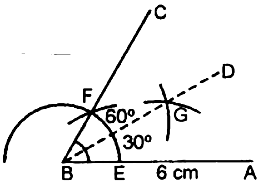
Draw line AB = 6 cm. Construct angle ABC = 60°. Then draw the bisector of angle ABC.
Answer

Steps of Construction:
1. Draw a line segment AB = 6 cm.

2. With the help of compass construct ∠CBA = 60°.
3. Bisect ∠CBA, with the help of a compass, take any radius which meet line AB and BC at point E and F.
4. Now, with the help of compass take radius more
than $\frac{1}{2}$

Need a full question paper?

Generate a complete, print-ready paper with questions like this in minutes — across 16+ boards, with answer keys.
Start Generating Free

Similar questions

Evaluate:
$\frac{1}{3}+\frac{7}{9} \div\left(\frac{7}{10} \times 1 \frac{1}{4}\right)$
Find the L.C.M. of the following group of numbers, using
  1. the prime factor method and
  2. the common division method
18, 24 and 96
Multiply and then evaluate :
$(4x + y)$ and $(x – 2y);$ when $x = 2$ and $y = 1.$
Simplify:
$\left(1 \div 3 \frac{1}{3}\right) \times 3 \frac{1}{3} \text { of } 7 \frac{2}{9}-6$
The following data represents the weekly wages (in ₹) of 15 workers in a factory:
900, 850, 800, 850, 800, 750, 950, 900, 950, 800, 750, 900, 750, 800 and 850.
Prepare a frequency distribution table. Now find,
(i) how many workers are getting less than ₹850 per week?
(ii) how many workers are getting more than ₹800 per week?
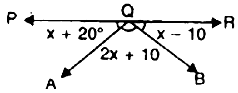
In the given figure, PQR is a straight line. Find x. Then complete the following:
(i) ∠AQB = _______
(ii) ∠BQP = _______
(iii) ∠AQR = _______
In a study of number of accidents per day, the observations for 30 days were obtained as follows:
6356432542
4053615526
2122054616
Construct a suitable frequency distribution table.
Look at the adjoining figure carefully and name :
Image
(i) all pairs of parallel lines;
(ii) all pairs of intersecting lines and their points of intersection;
(iii) all sets of collinear points;
(iv) concurrent lines and their points of concurrence;
(v) one set of three non-collinear points.
A man walks a distance of $5 km$ in 2 hours. Then he goes in a bus to a nearby town, which is $40 km$, in further 2 hours. From there, he goes to his office in an autorickshaw, a distance of $5 km$, in $\frac{1}{2}$ hour. What was his average speed during the whole journey?