Questions

[5 marks sum]

🎯

Test yourself on this topic

20 questions · timed · auto-graded

Question 15 Marks
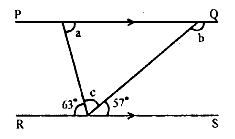
In the following figures, PQ is parallel to RS. Find the angles a, b and c:
Answer
In the given figure,
PQ || RS, ∠BAR = 63°, ∠CAS = 57°
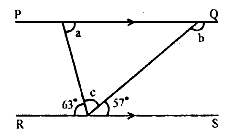
AB is its transversal.
∴ ∠CBA = ∠BAR (Alternate angles)
⇒ a = 63°
∵ PQ || RS and CA is its transversal
∴ ∠QCA + ∠CAS = 180° (Co-interior angles)
⇒ b + 57° = 180°
⇒ b = 180° - 57° = 123°
But ∠CAS + ∠CAB + ∠BAR = 180° (Straight line angles)
∴ 57° + c + 63° = 180°
⇒ c + 120° = 180°
⇒ c = 180° - 120° = 60°
Hence a = 63°, b = 123°, c = 60°
View full question & answer
Question 25 Marks
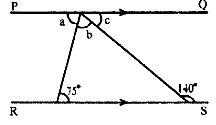
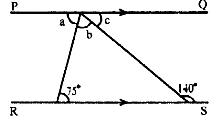
In the following figures, PQ is parallel to RS. Find the angles a, b and c:
Answer
In the given figure,
PQ || RS, ∠B = 75°, ∠ACS = 140°

AB is its transversal
∴ ∠PAB = ∠ABC
⇒ a = 75°
Again PQ || RS and AC is its transversal
∴ ∠QAC + ∠ACS = 180° (Co-interior angles)
⇒ c + 140° = 180°
⇒ c = 180° - 140° = 40°
But a + b + c = 180° (Straight line angles)
∴ 75° + b + 40° = 180°
⇒ b + 115° = 180°
⇒ b = 180° - 115° = 65°
Hence a = 75°, b = 65°, c = 40°
View full question & answer
Question 35 Marks
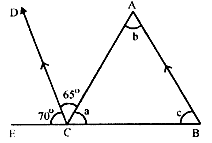
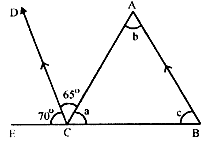
In the following figure, BA is parallel to CD. Find the angles a, b and c:
Answer
In the given figure,
ABC is a triangle and AB || DC and AC is its transversal.

∠BAC = ∠ACD (Alternate angles)
⇒ b = 65°
Again AB || DC and BCE is its transversal
∴ ∠ABC = ∠DCE
⇒ C = 70°
But ∠ACB + ∠ACD + ∠DCE = 180 (Straight line angle)
∴ a + 65° + 70° = 180°
⇒ a + 135° = 180°
⇒ a = 180° - 135° = 45°
Hence a = 45°, b = 65° and c = 70°
View full question & answer
Question 45 Marks
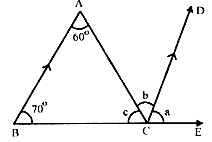
In the following figure, BA is parallel to CD. Find the angles a, b and c:
Answer
In the given figure,
ABC is a triangle and CD || BA, BC is produced to E.

∠A = 60°, ∠B = 70°
∵ AB || DC and BE is its transversal
∴ ∠DCE = ∠ABC (Corresponding angles)
⇒ a = 70°
∴ a = 70°
Similarly, AB || DC and AC is its transversal
∴ ∠ACD = ∠BAC (Alternate angles)
⇒ b = 60°
∴ b = 60°
But a + b + c = 180° (Straight line angle)
⇒ 70° + 60° + c = 180°
⇒ 130° + c = 180°
⇒ c = 180° - 130° = 50°
Hence a = 70°, b = 60° and c = 50°
View full question & answer
Question 55 Marks
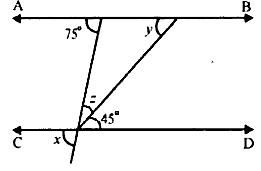
In the following figure, AB is parallel to CD; find the values of angles x, y and z:
Answer
In the given figure,
AB || CD
and MN is its transversal
∴ ∠LMN = ∠NMD  (Alternate angles)
⇒ y = 45°
and AB || CD and LM is its transversal
∴ ∠ALM = ∠CMP  (Corresponding angles)
⇒ 75° = x
∴ x = 75°
and ∠ALM = ∠LMD     (Alternate angles)
⇒ 75° = z + 45°
⇒ z =75° - 45° = 30°
Hence x = 75°, y = 45° and z = 30°
View full question & answer
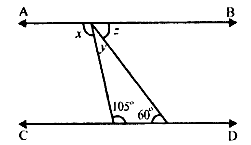
Question 65 Marks
Answer
In the given figure,
AB || CD
and LM is its transversal
∴ ∠ALM = ∠LMN  (Alternate angles)
⇒ ∠x = 105°
∴ x = 105°
Similarly AB || CD and LN is its transversal
∴ ∠BLN = ∠LNM  (Alternate angles)
∴ ∠z = 60°
∴ z = 60°
But x + y + z = 180°  (Straight line angles)
⇒ 105° + y + 60° = 180°
⇒ y + 165° = 180°
⇒ y = 180° - 165° = 15°
Hence x = 105°, y = 15° and z = 60
View full question & answer
Question 75 Marks
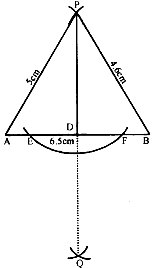
Draw a line segment AB = 6.5 cm. Locate a point P that is 5 cm from A and 4.6 cm from B. Through the point P, draw a perpendicular on to the line segment AB.
View full question & answer
Question 85 Marks
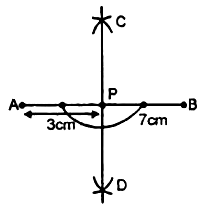
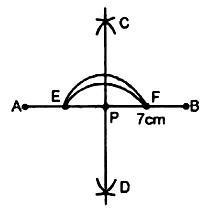
Draw a line segment AB = 7cm. Mark a point Pon AB such that AP=3 cm. Draw perpendicular on to AB at point P.
Answer
1. Draw a line segment AB = 7 cm.


2. Out point from AB – AP =3cm
3. From point P, cut arc on outside of AB, E and F.
4. From point, E & F cut arcs on both sides intersection each other at C & D.
5. Joinpoint P, CD.
6. Which is the required perpendicular.
View full question & answer
Question 95 Marks
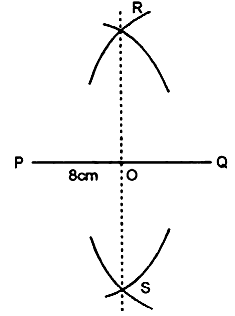
Draw a line segment PQ = 8cm. Construct the perpendicular bisector of the line segment PQ. Let the perpendicular bisector drawn meet PQ at point R. Measure the lengths of PR and QR. Is PR = QR?
Answer
Steps of Construction:
1. With P and Q as centers, draw arcs on both sides of PQ with equal radii. The radius
should be more than half the length of PQ.
2. Let these arcs cut each other at points R and RS
3. Join RS which cuts PQ at D.
Then RS = PQ Also ∠POR = 90°.
Hence, the line segment RS is the perpendicular bisector of PQ as it bisects PQ at P and is also perpendicular to PQ. On measuring the lengths of PR = 4cm, QR = 4 cm Since PR = QR, both are 4cm each∴ PR = QR.
View full question & answer
Question 105 Marks
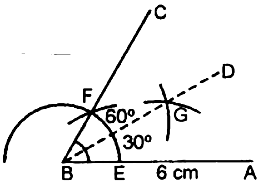
Draw line AB = 6 cm. Construct angle ABC = 60°. Then draw the bisector of angle ABC.
Answer
Steps of Construction:
1. Draw a line segment AB = 6 cm.

2. With the help of compass construct ∠CBA = 60°.
3. Bisect ∠CBA, with the help of a compass, take any radius which meet line AB and BC at point E and F.
4. Now, with the help of compass take radius more
than $\frac{1}{2}$

View full question & answer
Question 115 Marks
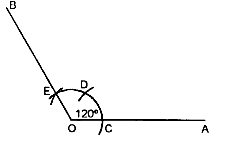
Construct the 120° angle, using ruler and a pair of compass only.
Answer
Steps of construction:
To construct an angle of 120°.
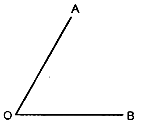
  1. With centre O on the line OA, draw an arc to cut this line at C.
  2. With C as a centre, drawn the same size arc which cuts the first arc at point D.
  3. With D as a centre, draw one more arc of same size which cuts the first arc at E.
  4. Join OE and produce it upto point B. Then, ∠AOB = 120°.
View full question & answer
Question 125 Marks
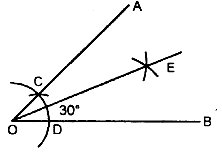
Construct the 30° angle, using ruler and a pair of compass only.
Answer
Steps of construction:
To construct an angle of 30°.
  1. Draw a line OB of any suitable length.
  2. At O, draw an arc of any size to cut OB at D.
  3. With D as a centre, draw the same size arc, to cut the previous arc at C.
  4. Join OC and extend up to a suitable point A. Then, ∠AOB = 60°.
  5. Bisect this angle of get two angles each of 30°. Thus, ∠EOB = 30°.
View full question & answer
Question 135 Marks
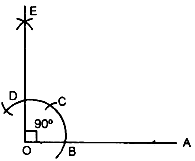
Construct the 90° angle, using ruler and a pair of compass only.
Answer
Steps of Construction:
To construct an angle of 90°.
  1. With O as a center, draw an arc to cut OA at B.
  2. With B as a centre, draw the same size arc to cut the previous arc at C.
  3. Again with C as centre and with the same radius, draw one more arc to cut the first arc at D.
  4. With C and D as centres, draw two arcs of equal radii to cut each other at point E.
  5. Join O and E, Then, ∠AOE = 90°.
View full question & answer
Question 145 Marks
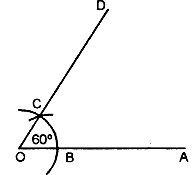
Construct the 60° angle, using ruler and a pair of compass only.
Answer
Steps of Construction:
To construct an angle of 60°.
  1. Draw a line OA of any suitable length.
  2. At o, draw an arc of any size to cut OA at B.
  3. With B as a centre, draw the same size arc, to cut the previous arc at C.
  4. Join OC and extend up to a suitable point D, Then, ∠DOA = 60°.
View full question & answer
Question 155 Marks
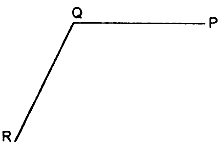
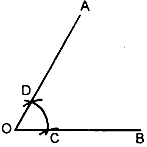
In your note-book copy the following angle using ruler and a pair compass only.
Answer
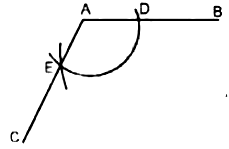
Steps of Construction: 1. At point A draw line AB = QP


2. With Q as centre, draw an arc of any suitable radius, to cut the arms of the angle A + C and D.
3. With A as centre, draw the arc of the same size as drawn for C and D. Let this arc cuts line AB at D.
4. In your compasses, take the distance equal to distance between 7 and
5; and then with D as centre, draw an arc which cuts the earlier arc at E. 5. Join AE and produced upto a suitable point C. ∠BAC, so obtained is the angle equal to the given ∠PQR.
View full question & answer
Question 165 Marks
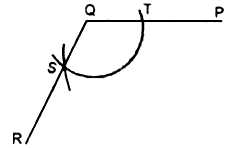
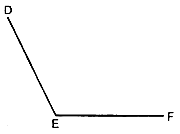
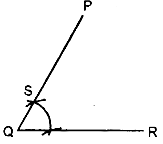
In your note-book copy the following angle using ruler and a pair compass only.
Answer
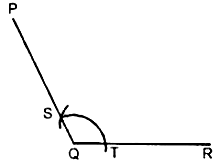
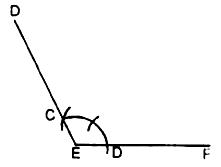
Steps of Construction:
1. A t point E, draw line EF.


2. With E as centre, draw an arc of any suitable radius, to cut the amis of the angle at C and D.
3. With Q as a centre, draw the arc of the same size as drawn for C and D. Let this arc cuts line QR at point T.
4. In your compasses, take the distance equal to the distance between C and D; and then with T as a centre, draw an arc which cuts the earlier arc at S.
5. Join QS and produce up to a suitable point R ∠PQR, so obtained, is the angle equal to the given ∠DEE
View full question & answer
Question 175 Marks
In your note-book copy the following angle using ruler and a pair compass only.
View full question & answer
Question 185 Marks
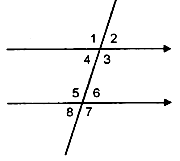
If ∠1 = 120°, find the measures of : ∠2, ∠3, ∠4, ∠5, ∠6, ∠7 and ∠8. Give reasons.
Answer
l || m and p is their transversal and ∠1 = 120°
∠1 + ∠2 = 180°    (Straight line angle)
∴ 120° + ∠2 = 180°
⇒ ∠2 = 180° - 120° = 60°
∴ ∠2 = 60°
But ∠1 = ∠3   (Vertically opposite angles)
∴ ∠3 = ∠1 = 120°
Similarly ∠4 = ∠2   (Vertically opposite angles)
∴ ∠4 = 60°
∠5 = ∠1     (Corresponding angles)
∴ ∠5 = 120°
Similarly ∠6 = ∠2   (Corresponding angles)
∴ ∠6 = 60°
∠7 = ∠5   (Vertically opposite angles)
∴  ∠7 = 120°
and ∠8 = ∠6 (Vertically opposite angles)
∴  ∠8 = 60°
Hence ∠2 = 60°, ∠3 = 120°, ∠4 = 60°,∠5 = 120°, ∠6 = 60°, ∠7 = 120° and ∠8 = 60°.
View full question & answer
Question 195 Marks
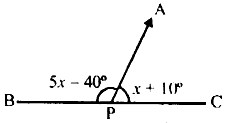
A line segment AP stands at point P of a straight line BC such that ∠APB = 5x – 40° and ∠APC = .x+ 10°; find the value of x and angle APB.
Answer
AP stands on BC at P and
∠APB = 5x – 40°, ∠APC = x + 10°

(i) ∵ APE is a straight line
∠APB + ∠APC = 180°
⇒ 5x – 40° + x + 10° = 180°
⇒ 6x - 30°= 180°
⇒ 6x = 180° + 30° = 210°
$x=\frac{210^{\circ}}{6}=35^{\circ}$
(ii) and ∠APB = 5x – 40° = 5 x 35° – 40°
= 175 ° – 140° = 135°
View full question & answer
Question 205 Marks
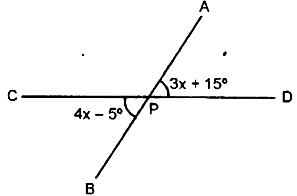
The adjoining figure shows two straight lines AB and CD intersecting at point P. If ∠BPC = 4x – 5° and ∠APD = 3x + 15°; find:

(i) the value of x.
(ii) ∠APD
(iii) ∠BPD
(iv) ∠BPC
Answer
(i) 4x - 5 = 3x + 15 (∵ ∠CPB = ∠APD; opposite angles)
⇒ 4x - 3x = 15 + 5
⇒ x = 20
(ii) ∠APD = 3x + 15
= (3 × 20) + 15
= 60 + 15 = 75°
(iii) ∠BPD = 180 - ∠BPC
= 180 - (4x - 5)
= 180 - 4x + 5
= 185 - (4 × 20)
= 185 - 80 = 105°
(iv) ∠BPC = 4x - 5
= (4 × 20) - 5
= 80 - 5
= 75°
View full question & answer
[5 marks sum] - MATHS STD 6 Questions - Vidyadip