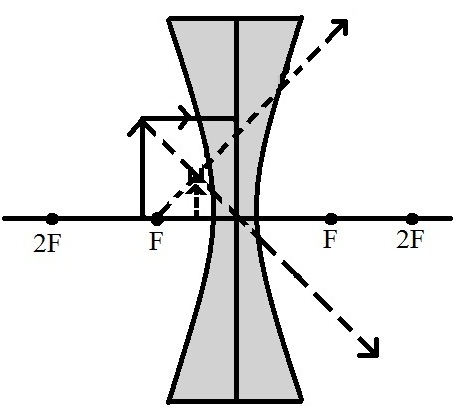
Draw ray diagrams showing the image formation by a concave lens when an object is placed:
At the focus of the lens.
At the focus of the lens.
Download our app for free and get started

Download our appand get started for free
Experience the future of education. Simply download our apps or reach out to us for more information. Let's shape the future of learning together!No signup needed.*
Similar Questions
- 1View SolutionName the lens which always forms a virtual image of an object.
- 2View SolutionYour eye contains a convex lens. Why is it unwise to look at the sun?
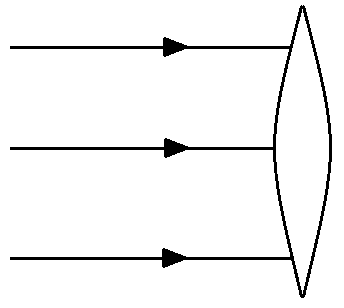
- 3View SolutionWhere must the object be placed for the image formed by a converging lens to be:
- Real, inverted and smaller than the object?
- Real, inverted and same size as the object?
- Real, inverted and larger than the object?
- Virtual, upright and larger than the object?
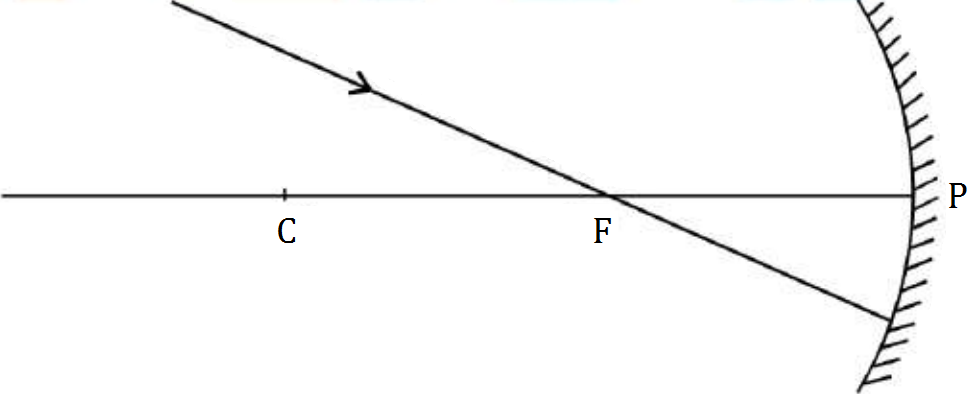
- 4Redraw the following diagram on your answer-sheet and show the path of the reflected ray. Also mark the angle of incidence $(\angle\text{i})$ and the angle of reflection $(\angle\text{r})$ on the diagram.View Solution
- 5View SolutionWhat do you understand by the power of a lens? Name one factor on which the power of a lens depends.
- 6View SolutionWrite down a formula for the magnification produced by a concave mirror.
- In terms of height of object and height of image.
- In terms of object distance and image distance.
- 7View SolutionExplain with the help of a diagram, why the convex lens is also called a converging lens.
- 8Light travels through air at 300 million $ms ^{-1}$. On entering water it slows down to 225 million $ms ^{-1}$. Calculate the refractive index of water.View Solution
- 9View SolutionState any four characteristics of the image of an object formed by a plane mirror.
- 10View SolutionExplain with the help of a diagram, why the concave lens is also called a diverging lens.