Where must the object be placed for the image formed by a converging lens to be:
- Real, inverted and smaller than the object?
- Real, inverted and same size as the object?
- Real, inverted and larger than the object?
- Virtual, upright and larger than the object?
Download our app for free and get started
- Beyond 2F.
- At 2F.
- Between F and 2F.
- Between F and optical centre.

Download our appand get started for free
Experience the future of education. Simply download our apps or reach out to us for more information. Let's shape the future of learning together!No signup needed.*
Similar Questions
- 1View SolutionGive two uses of a convex mirror. Explain why you would choose convex mirror for these uses.
- 2View SolutionIf the magnification of an image formed by a mirror is positive, what does it mean?
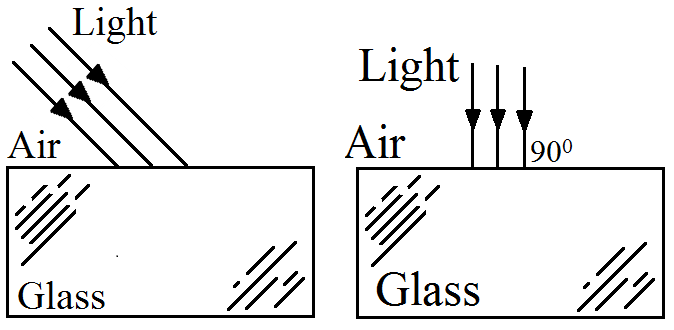
- 3View SolutionDraw and complete the following diagrams to show what happens to the beams of light as they enter the glass block and then leave it:
- 4View SolutionA doctor has prescribed a corrective lens of power, -1.5D. Find the focal length of the lens. Is the prescribed lens diverging or converging?
- 5View SolutionWhat is meant by power of a lens? What does its sign (+ve or -ve) indicate? State its S.I. unit. How is this unit related to focal length of a lens?
- 6View Solution“A concave mirror of focal length ‘f’ can form a magnified erect as well as an inverted image of an object placed in front of it.” Justify this statement stating the position of the object with respect to the mirror in each case for obtaining these images.
- 7View SolutionThree convex lenses are available having focal lengths of 4cm, 40cm and 4m respectively. Which one would you choose as a magnifying glass and why?
- 8View SolutionName the lens which always forms a virtual image of an object.
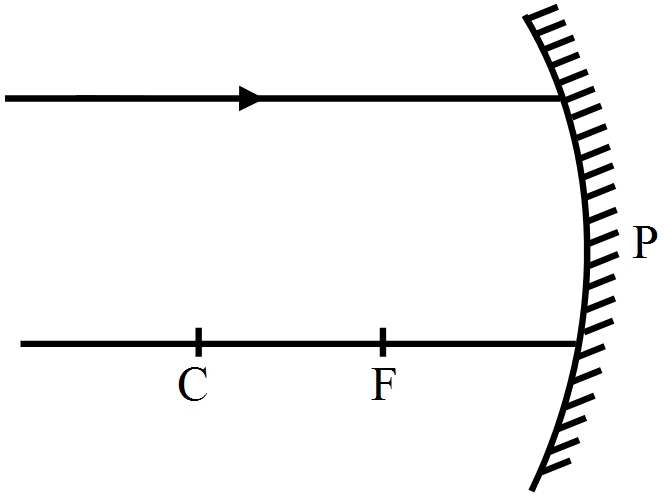
- 9Redraw the following diagram on your answer sheet and show the path of the reflected ray. Also mark the angle of incidence $(\angle\text{i})$ and the angle of reflection $(\angle\text{r})$ on the diagram.View Solution
- 10View SolutionA convex lens of focal length 25cm and a concave lens of focal length 10cm are placed in close focal contact with each other. Calculate the lens power of this combination.