Question
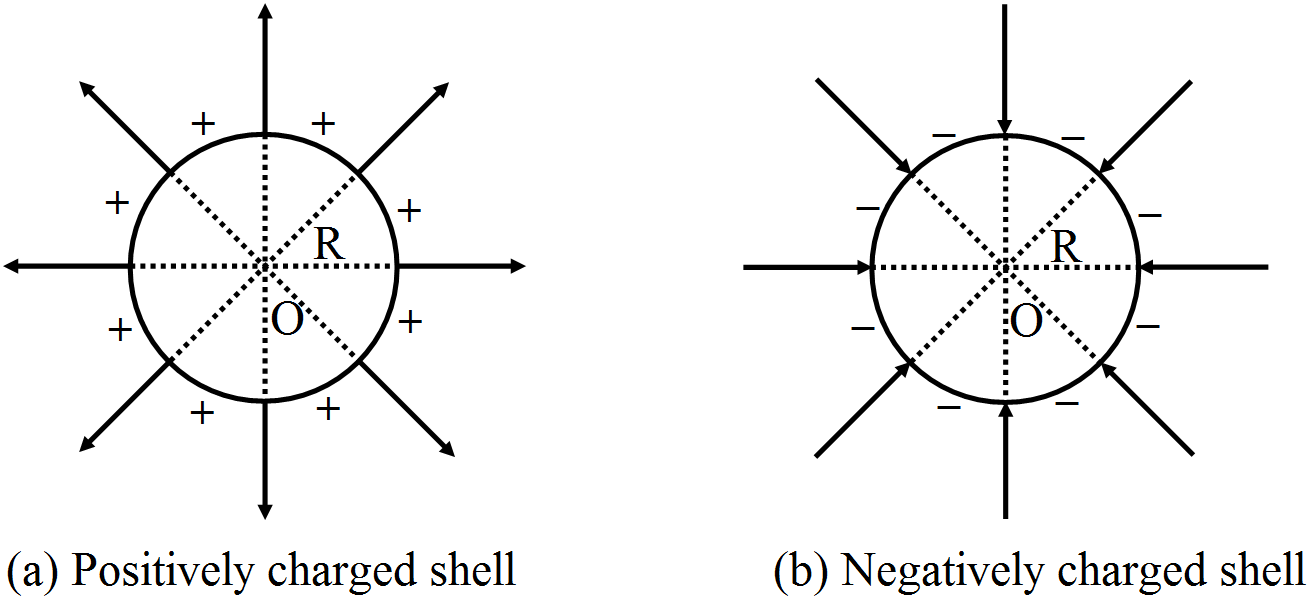
Draw the electric field lines due to a uniformly charged thin spherical shell when charge on the shell is (a) positive and (b) negative.
Answer

The electric field lines are shown in the figure. For a positively charged shell, the field lines are directed in radially outward direction and for negatively charged shell, these are directed in radially inward direction.

Need a full question paper?

Generate a complete, print-ready paper with questions like this in minutes — across 16+ boards, with answer keys.
Start Generating Free

Similar questions

A circular loop of radius 20cm carries a current of 10A. An electron crosses the plane of the loop with a speed of 2.0 × 10⁶m/s. The direction of motion makes an angle of 30° with the axis of the circle and passes through its centre. Find the magnitude of the magnetic force on the electron at the instant it crosses the plane.
Double - convex lenses are to be manufactured from a glass of refractive index 1.55, with both faces of the same radius of curvature. What is the radius of curvature required if the focal length is to be 20cm?
A laser beam has intensity 2.5 × 10¹⁴Wm-2. Find amplitudes of electric and magnetic fields in the beam.
Find the temperature at which the average thermal kinetic energy is equal to the energy needed to take a hydrogen atom from its ground state to n = 3 state. Hydrogen can now emit red light of wavelength 653.1nm. Because of Maxwellian distribution of speeds, a hydrogen sample emits red light at temperatures much lower than that obtained from this problem. Assume that hydrogen molecules dissociate into atoms.
A solid sphere rolling on a rough horizontal surface with a linear speed v collides elastically with a fixed, smooth, vertical wall. Find the speed of the sphere after it has started pure rolling in the backward direction.
Explain with example, whether the neutron-proton ratio in a nucleus increases or decreases due to $\beta-$decay.
A totally reflecting, small plane mirror placed horizontally faces a parallel beam of light, as shown in the figure. The mass of the mirror is 20g. Assume that there is no absorption in the lens and that 30% of the light emitted by the source goes through the lens. Find the power of the source needed to support the weight of the mirror. Take g = 10m/s2.

How many time constants will elapse before the charge on a capacitors falls to 0.1% of its maximum value in a discharging RC circuit?
Suppose the circuit in Exercise 7.18 has a resistance of $15\Omega.$ Obtain the average power transferred to each element of the circuit, and the total power absorbed
The ground state energy of hydrogen atom is – 13.6 eV. If an electron makes a transition from an energy level – 0.85 eV to – 3.4 eV, calculate the wavelength of the spectral line emitted.To which series of hydrogen spectrum does this wave length belong?