Question
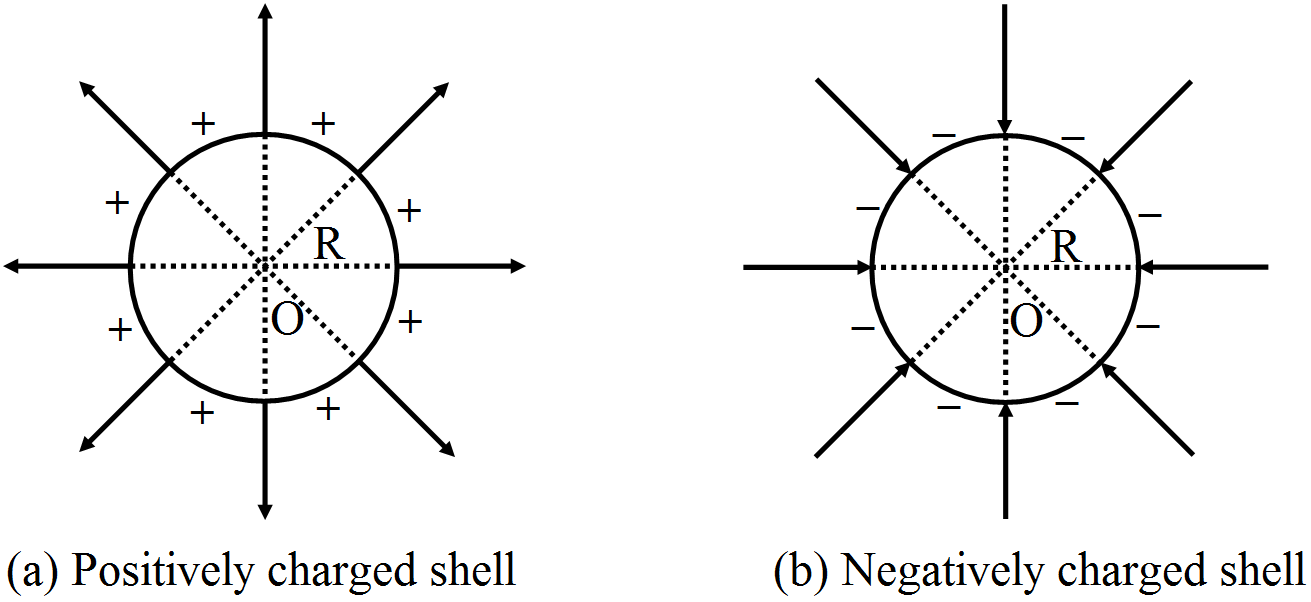
Draw the electric field lines due to a uniformly charged thin spherical shell when charge on the shell is (a) positive and (b) negative.
Answer

The electric field lines are shown in the figure. For a positively charged shell, the field lines are directed in radially outward direction and for negatively charged shell, these are directed in radially inward direction.

Need a full question paper?

Generate a complete, print-ready paper with questions like this in minutes — across 16+ boards, with answer keys.
Start Generating Free

Similar questions

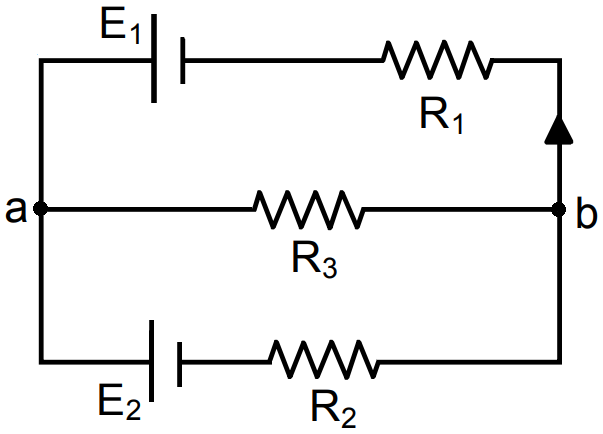
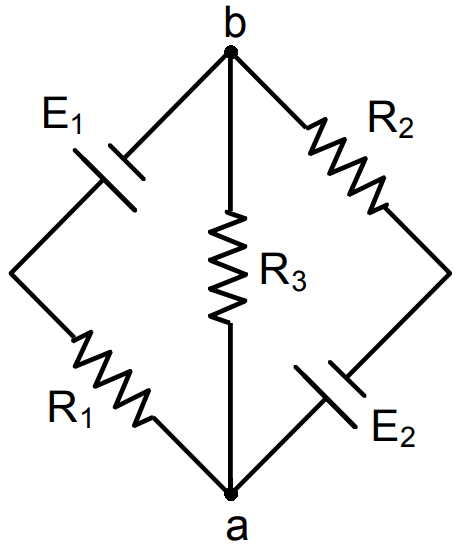
Find the potential difference Va - Vb in the circuits shown in figure.


Carbon (Z = 6) with mass number 11 decays to boron (Z = 5).
  1. Is it a $\beta^+-\text{decay}$ or a $\beta^--\text{decay}?$
  2. The half-life of the decay scheme is 20.3 minutes. How much time will elapse before a mixture of 90% carbon-11 and 10% boron-11 (by the number of atoms) converts itself into a mixture of 10% carbon-11 and 90% boron-11?
  1. State Bohr’s quantization condition for defining stationary orbits. How does de Broglie hypothesis explain the stationary orbits?
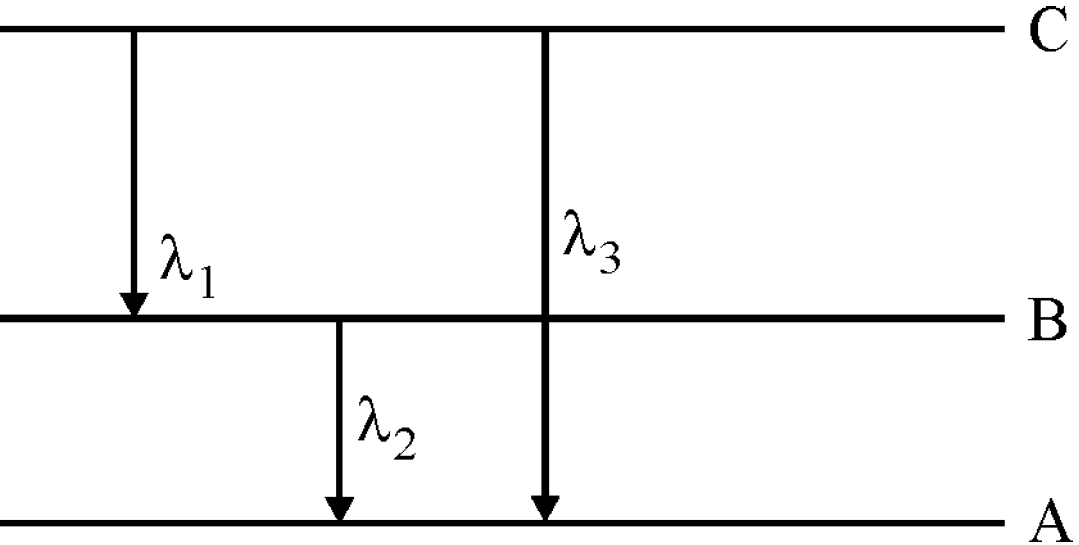
  2. Find the relation between the three wavelengths$\lambda_{1} , \lambda_{2}$ and$\lambda_{3}$ from the energy level diagram shown below.

Suppose the platform with the kid in the previous problem is rotating in anticlockwise direction at an angular speed $\omega.$ The kid starts walking along the rim with a speed v relative to the platform also in the anticlockwise direction. Find the new angular speed of the platform.
Can two particles be in equilibrium under the action of their mutual gravitational force? Can three particles be? Can one of the three particles be?
The specific heat capacities of hydrogen at constant volume and at constant pressure are 2.4cal-g-1 °C−1 and 3.4cal-g-1 °C-1 respectively. The molecular weight of hydrogen is 2g-mol-1 and the gas constant, R = 8.3 × 10⁷ erg°C-1 mol-1. Calculate the value of J.
Find the range of frequency of light that is visible to an average human being $(400\text{nm}<\lambda<700\text{nm}).$
A system has two charges $q_A=2.5$$\times 10^{-7} C$ and $q_B=-2.5 \times 10^{-7} C$ located at points A: $(0$,$0,-15 cm)$and $B :( 0 , 0 ,+15 cm)$, respectively. What are the total charge and electric dipole moment of the system?
Two charged particles, having equal charges of 2.0 × 10-5C each, are brought from infinity to within a separation of 10cm. Find the increase in the electric potential energy during the process.
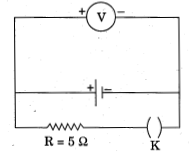
Write any two factors on which internal resistance of a cell depends. The reading on a high resistance voltmeter, when a cell is connected across it, is 2.2 V. When the terminals of the cell are also connected to a resistance of 5 Ω as shown in the circuit, the voltmeter reading drops to 1.8 V. Find the internal resistance of the cell.