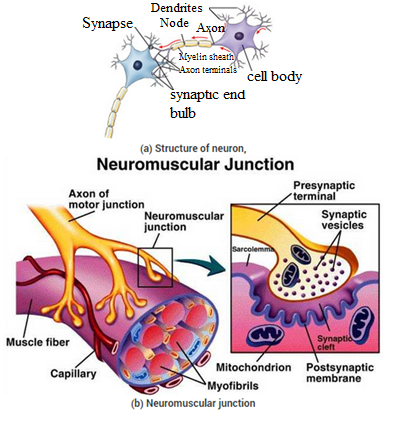
The specialised tips of some nerve cells detect all information from our environment. These receptors are usually located in our sense organs, such as the inner ear, the nose, the tongue, and so on. So gustatory receptors will detect taste while olfactory receptors will detect smell. This information, acquired at the end of the dendritic tip of a nerve cell, sets off a chemical reaction that creates an electrical impulse. This impulse travels from the dendrite to the cell body, and then along the axon to its end. At the end of the axon, the electrical impulse sets off the release of some chemicals. These chemicals cross the gap, or synapse, and start a similar electrical impulse in a dendrite of the next neuron. This is a general scheme of how nervous impulses travel in the body. A similar synapse finally allows delivery of such impulses from neurons to other cells, such as muscles cells or gland. It is thus no surprise that nervous tissue is made up of an organized network of nerve cells or neurons, and is specialised for conducting information via electrical impulses from one part of the body to another.