Question
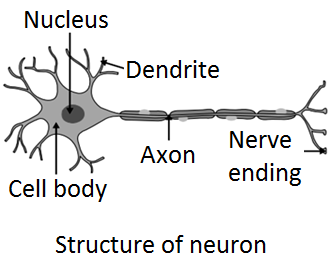
Draw the structure of a neuron and explain its function.

Answer

Neuron is the structural and functional unit of nervous system. It serves to carry nerve impulse from one part of body to other. It has dendrites, cell body and axon. Dendrite receives signals from sensory receptors or other neurons. The long extension of cell body of nerve cell is called as axon that serves to conduct the nerve impulse away from the cell body. Cell body is the metabolic center of neuron.

Need a full question paper?

Generate a complete, print-ready paper with questions like this in minutes — across 16+ boards, with answer keys.
Start Generating Free

Similar questions

You are provided with two containers made up of copper and aluminium. You are also provided with solutions of dilute HCl , dilute $HNO _3, ZnCl _2$ and $H _2 O$. In which of the above containers these solutions can be kept?
In the reaction represented by the following equation:$\text{CuO(s)}\ +\ \text{H}_2(\text{g})\xrightarrow{\ \ \ \ \ \ \ \ \ \ \ \ }\text{Cu(s)}\ +\ \text{H}_2\text{O(1)}$
  1. Name the substance oxidised.
  2. Name the substance reduced.
  3. Name the oxidising agent.
  4. Name the reducing agent
What is ten per cent law? Explain with an example.
What are the various ways in which a chemical equation can be made more informative? Give examples to illustrate your answer.
Define evolution. How does it occur? Describe how fossils provide us evidences in support of evolution.
When a moist slice of bread was kept aside for a few days then some organism grew on it to form a white cottony mass which later turned black. When this slice of bread was observed through a magnifying glass, then fine thread-like projections and thin stems having bulb-like structures at the top were seen.
  1. What is the common name and scientific name of the organism which grew on the moist slice of bread?
  2. How did this organism grow on the moist slice of bread automatically?
  3. What are the fine, thread-like projections on the surface of slice of bread known as?
  4. What name is given to the knob-like structures and what do they contain?
  5. What is the name of this method of reproduction?
  6. Name one unicellular organism which reproduces by this method.
  7. Name tow non-flowering plants which reproduce by this method.
State two uses each of the following compounds:
  1. Sodium hydroxide.
  2. Chlorine.
  3. Hydrogen.
  4. Hydrochloric acid.
What are the functions of an ecosystem?
What is Joule’s heating effect? How can it be demonstrated experimentally? List its four applications in daily life.
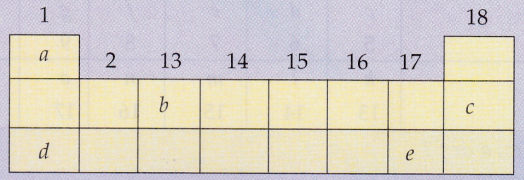
The following diagram shows a part of the periodic table containing first three periods in which five elements have been represented by the letters a, b, c, d and e (which are not their chemical symbols):
  1. Select the letter which represents an alkali metal.
  2. Select the letter which represents a noble gas.
  3. Select the letter which represents a halogen.
  4. What type of bond is formed between a and e?
  5. What type of bond is formed between d and e?