Questions

[5 marks Questions]

🎯

Test yourself on this topic

5 questions · timed · auto-graded

Question 15 Marks
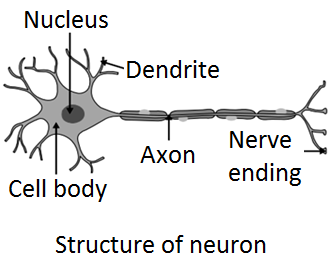
Draw the structure of a neuron and explain its function.
Answer
Neuron is the structural and functional unit of nervous system. It serves to carry nerve impulse from one part of body to other. It has dendrites, cell body and axon. Dendrite receives signals from sensory receptors or other neurons. The long extension of cell body of nerve cell is called as axon that serves to conduct the nerve impulse away from the cell body. Cell body is the metabolic center of neuron.
View full question & answer
Question 25 Marks
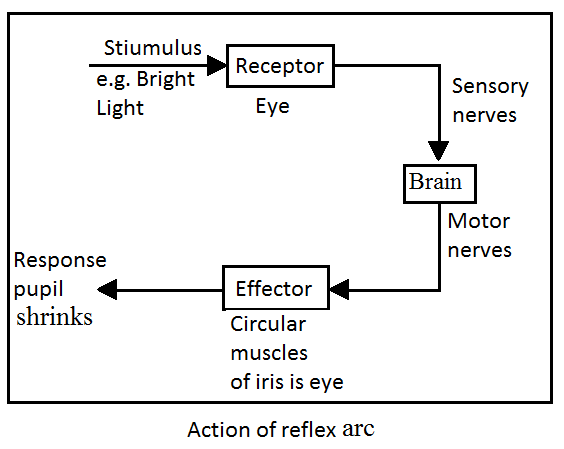
What are reflex actions? Give two examples. Explain a reflex arc.
Answer

Reflex action: A reflex action, is an involuntary and nearly instantaneous movement in response to a stimulus.
For example:
  1. Moving away your hand upon touching a hot object.
  2. Closing your eyes on sudden exposure to bright light.
Reflecx arc: Reflex arc is a simple nervous pathway and consists of receptors, sensory neurons, interneurons, motor neurons and muscles. The sensory neurons transmit the sensory information from sensory receptors to spinal cord or brain. The interneurons integrate the incoming information and signal is relayed to motor neurons. The motor pathway transmits the signal from motor neurons to the effector organs (usually muscles and glands).
View full question & answer
Question 35 Marks
Name various plant hormones. Also, give their physiological effects on plant growth and development.
Answer
Five types- Auxin, gibberelin, cytokinin, ethylene and abscisic acid.
Auxin: Cell enlargement, root formation, apical dominance, inhibition of abscission, fruit growth.
Gibberellin: Growth in stem and leaves, higher fruit yield, overcoming dormancy.
Cytokinin: Essential for cell division, differentiation, prevention of senescence and overcoming apical dominance.
Ethylene: Promotes transverse growth, fruit ripening and overcoming dormancy of some parts.
Abscisic Acid (ABA): Induces dormancy, senescence and abscission, checking excessive activity of growth promoting hormones, closure of stomata under water stress.
View full question & answer
Question 45 Marks
What constitutes the central and peripheral nervous systems? How are the components of central nervous system protected?
Answer
The central nervous system consists of the brain and the spinal cord.
  1. Brain is the main centre of coordination of sensory information in the body. It is located in protective brain box or cranium and is covered by membranous meninges. Cerebrospinal fluid is the clear tissue fluid which makes protective cushion around and within CNS. It is present in central canal of spinal cord and in brain ventricles.
  2. Spinal cord is a long cylindrical structure that begins from the medulla oblongata and extends downwards. It is enclosed in a protective bony cage vertebral column and is also surrounded by meninges.
Peripheral Nervous System (PNS): It lies outside the central nervous system and consists of somatic and autonomic nervous system.

It includes cranial, spinal and visceral nerves.
  1. Cranial nerves: Thses consist of the 12 pairs that emerge from the brain mostly concerned with head, neck and facial region of the body.
  2. Spinal nerves: 31 pairs of spinal nerves arise from the spinal cord and spread throughout the body.
  3. Visceral nerves: These arise from the spinal cord and are connected to the internal organs of the body.
View full question & answer
Question 55 Marks
What are the major parts of the brain? Mention the functions of different parts.
Answer
Major Parts of Brain: Fore-Brain: Olfactory lobes (2), Cerebral hemispheres (2) or cerebrum, Diencephalon. Mid-Brain: Cerebral peduncles, Corpora quadrigemina. Hind Brain: Pons, Cerebellum, Medulla oblongata. Functions:
  1. Olfactory Lobes: Receive sensation of smell from olfactory epithelium and relay the same to temporal lobes of cerebral hemispheres.
  2. Cerebral Hemispheres:
  1. Frontal Lobes: Centres of intelligence, control of movements and facial muscles, speech.
  2. Parietal Lobes: Taste and cutaneous sensations with some components of speech.
  3. Temporal Lobes: Hearing, smell, recall of audiovisual memory, some components of speech.
  4. Occipital Lobes: Sight.
  1. Diencephalon: Hypothalamus part regulates activity of smooth muscles and functions as control centre for hunger, thirst, fatigue, sleep, sweating, temperature and emotions. Pituitary gland and pineal gland are components of diencephalon.
  2. Corpora Quadrigemina: Superior – sight reflexes. Inferior – auditory reflexes.
  3. Cerebellum: Controls posture and equilibrium.
  4. Pons: Part of respiratory centre.
  5. Medulla Oblongata: Centre for reflexes, blood pressure, heart beat, breathing.
View full question & answer
[5 marks Questions] - Science STD 10 Questions - Vidyadip