Question
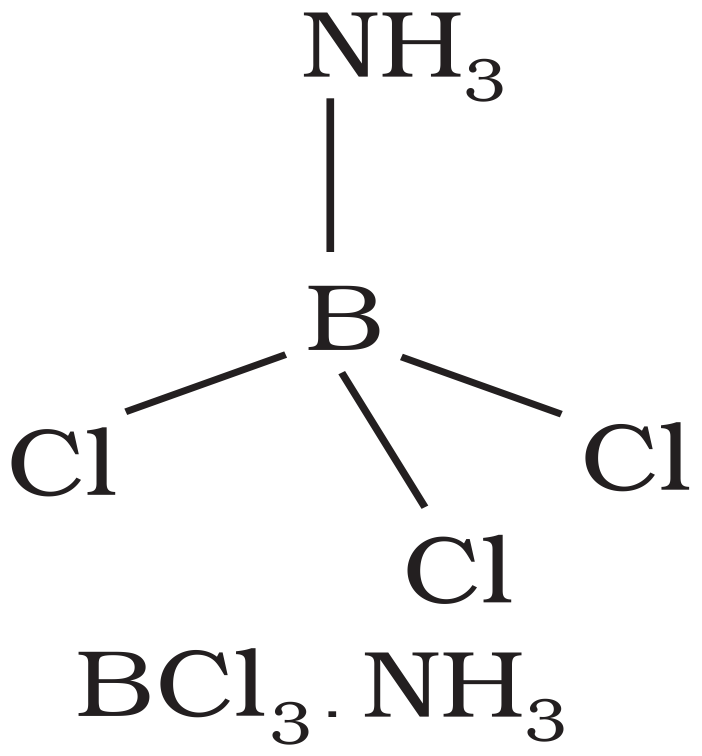
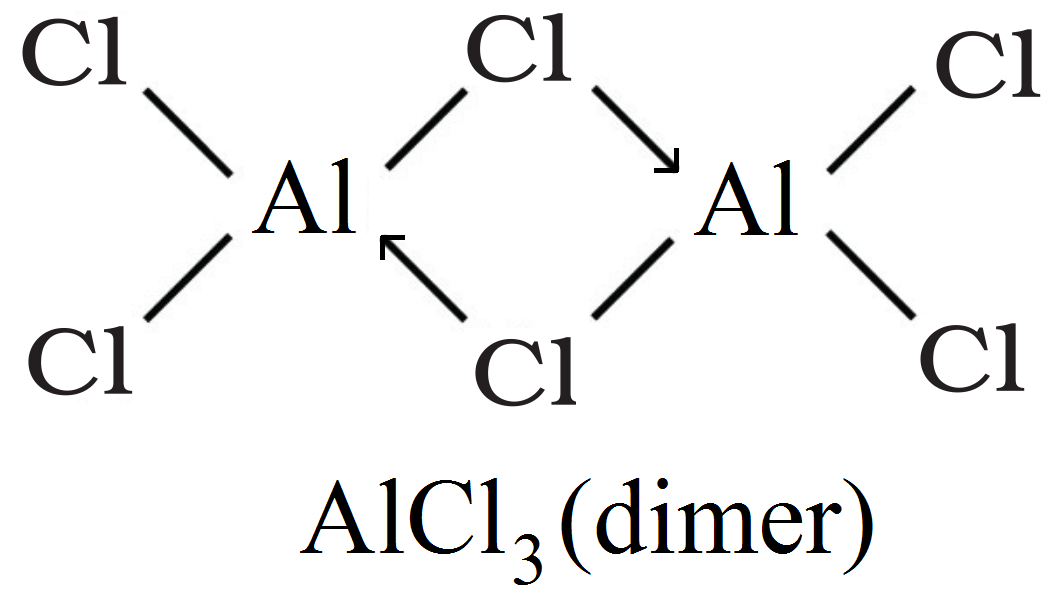
Draw the structures of $\mathrm{BCl}_3$. $\mathrm{NH}_3$ and $\mathrm{AlCl}_3$ (dimer).

Answer

In $\mathrm{BCl}_3$, the central B atom has six electrons in the valence shell. It is, therefore, an electron deficient molecule and needs two more electrons to 'complete its octet. In other words, $\mathrm{BCl}_3$ acts as a Lewis acid. $\mathrm{NH}_3$, on the other hand, has a lone pair of electrons which it can donate easily. Therefore, $\mathrm{NH}_3$ acts as a Lewis base. The Lewis acid $\left(\mathrm{BCl}_3\right)$ and the Lewis base $\left(\mathrm{NH}_3\right)$ combine together to form an adduct as shown below:

In $\mathrm{AlCl}_3$, Al has six electrons in the valence shell. Therefore, it is an electron deficient molecule and needs two more electrons to complete its octet. Chlorine, on the other hand, has three lone pairs of electrons. Therefore, to complete its octet, the central AI atom of one molecule accepts a lone pair of electrons from Clatom of the other molecule forming a dimeric structure as shown below.

Need a full question paper?

Generate a complete, print-ready paper with questions like this in minutes — across 16+ boards, with answer keys.
Start Generating Free

Similar questions

What are the necessary conditions for any system to be aromatic?
The concentration of sulphide ion in $0.1$ M HCl solution saturated with hydrogen sulphide is $1.0 \times 10^{-19} \mathrm{M}$. If $10$ mL of this is added to $5$ mL of $0.04$ M solution of the following: $\mathrm{FeSO}_4, \mathrm{MnCl}_2, \mathrm{ZnCl}_2$ and $\mathrm{CdCl}_2$. in which of these solutions precipitation will take place?
Calculate the volume strength of a $3\%$ solution of $H_2O_2$.
On the basis of molecular orbital theory, prove that O2 molecule has two unpaired electrons, hence it is paramagnetic.
Explain Heisenberg's uncertainty principle and also explain its importance.
  1. A cylinder of gas supplied by a company is assumed to contain 14kg of butane. If a normal family requires 20000kJ of energy per day for cooking, how long will the cylinder last?
  2. If the air supplied to the burner is insufficient, a portion of gas escapes without combustion. Assuming that 25% of the gas is wasted due to this inefficiency, how long will the cylinder last (Heat of combustion of butane $= 2658kJ/ mol.)?$
A sample of $0.50 g$ of an organic compound was treated according to Kjeldahl's method. The ammonia evolved was absorbed in $50 ml$ of $0.5 \mathrm{M} \mathrm{H}_2 \mathrm{SO}_4$. The residual acid required $60 mL$ of $0.5 M$ solution of NaOH for neutralisation. Find the percentage composition of nitrogen in the compound.
Discuss the trend of the following:
The solubility and the nature of oxides, of Group 2 elements.
An organic compound contains 69% carbon and 4.8% hydrogen, the remainder being oxygen. Calculate the masses of carbon dioxide and water produced when 0.20g of this substance is subjected to complete combustion.
Derive the Rydberg formula.