Three resistances of magnitude $2$, $3$ and $5$ $ohm$ are connected in parallel to a battery of $10\, volts$ and of negligible resistance. The potential difference across $3\,\Omega $ resistance will be ............... $volts$
Easy
Download our app for free and get started
(d) Potential difference across all resistors in parallel combination is same.

Download our appand get started for free
Experience the future of education. Simply download our apps or reach out to us for more information. Let's shape the future of learning together!No signup needed.*
Similar Questions
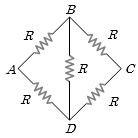
- 1Five equal resistances each of value $R$ are connected in a form shown alongside. The equivalent resistance of the networkView Solution
- 2What is the resistance of a carbon resistance which has bands of colours brown, black and brown .............. $\Omega$View Solution
- 3View SolutionA thick wire is stretched so that its length become two times. Assuming that there is no change in its density, then what is the ratio of change in resistance of wire to the initial resistance of wire
- 4An electric lamp is marked $60\, W$, $ 230\, V$. The cost of $1\, kilowatt$ hour of power is Rs. $1.25$. The cost of using this lamp for $8$ hours is Rs. ................View Solution
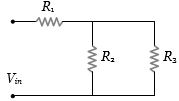
- 5For ensuring dissipation of same energy in all three resistors $({R_1},\,{R_2},\,{R_3})$ connected as shown in figure, their values must be related asView Solution
- 6Two resistors of $6\,\Omega $ and $9\,\Omega $ are connected in series to a $120\, volt$ source. The power consumed by the $6\,\Omega $ resistor is ........... $W$View Solution
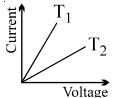
- 7The current in a metallic conductor is plotted against voltage at two different temperatures $T_1$ and $T_2$. Which is correctView Solution
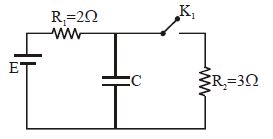
- 8In the circuit shown in the figure $K_1$ is open. The charge on capacitor $C$ in steady state is $q_1$. Now key is closed and at steady state charge on $C$ is $q_2$. The ratio of charges $q_1/q_2$ isView Solution
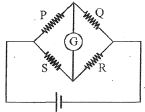
- 9Resistances are arranged in a cyclic order to form a balanced wheatstone bridge as shown in figure. Ratio of power consumed in the branches $P + Q$ and $R + S$ isView Solution
- 10Current density in a cylindrical wire of radius $R$ is given as $J =$ $\left\{ {\begin{array}{*{20}{c}}View Solution
{{J_0}\left( {\frac{x}{R} - 1} \right)\,\,for\,\,0 \leqslant x < \frac{R}{2}} \\
{{J_0}\frac{x}{R}\,\,\,\,for\,\,\,\frac{R}{2} \leqslant x \leqslant R}
\end{array}} \right.$The current flowing in the wire is: